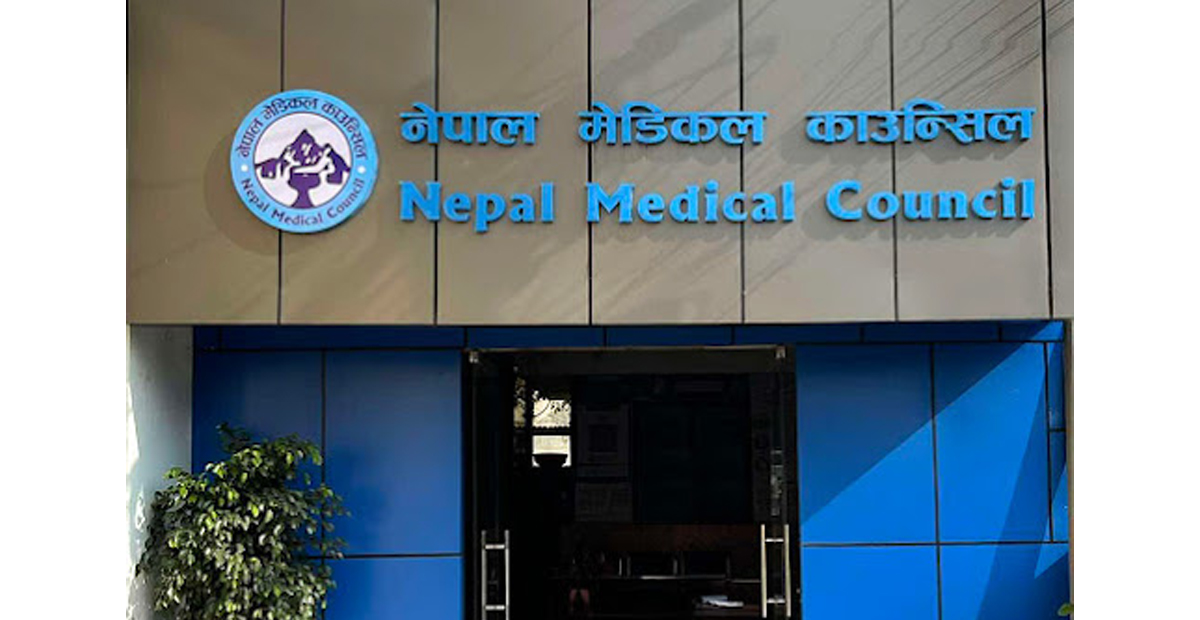
The recent decision of the Nepal Medical Council to remove the names of Nepali-origin doctors from its register after they acquired foreign citizenship raises serious questions of law, fairness and due process.
The Council itself appears to have published two notices: one dated April 24, listing 17 doctors, and another dated May 1, listing 19 doctors. The notices state that the doctors’ names were removed from the registration book after they renounced Nepali citizenship and acquired foreign citizenship. News portals, including Lokantar, later reported further details based on a conversation with Nepal Medical Council Registrar Dr Satish Kumar Deo, including comments about possible registration under a Non-Resident Nepali category.
The issue is not whether the Nepal Medical Council has the authority to regulate the medical profession. It clearly does. The real question is whether the current Nepal Medical Council Act clearly allows permanent medical registration to be canceled solely because a doctor later acquired foreign citizenship. A second question is whether the affected doctors were given notice, reasons, an opportunity to respond, and a clear transition pathway before their names were publicly listed as deregistered.
Council membership and medical registration are different
The Nepal Medical Council Act distinguishes between a “member” of the Council and a “registered medical practitioner.” A member holds a governance role within the Council. A registered medical practitioner is a doctor whose name is entered in the registration book.
This distinction matters. A person may become ineligible to sit as a member of the Council without necessarily losing the right to remain registered as a doctor.
Section 6 of the Act is titled “Disqualification for Membership.” It states that a person is disqualified from being nominated, elected, or continuing as a member of the Council if that person is not a Nepali citizen. On its plain reading, this provision concerns Council membership. It does not appear to say that a doctor who has already obtained permanent registration must be removed from the medical register if he or she later acquires foreign citizenship.
Section 7 also deals with termination of Council membership, not removal from the medical register. If the Council relied on Section 6 to remove doctors from the register, the decision may be legally unsound. A statutory body can only exercise powers clearly given to it by law.
The grounds for removing a doctor from the register are different
Section 17 of the Nepal Medical Council Act separately deals with circumstances in which a doctor’s name may be removed from the registration book. These grounds include conviction for a criminal offense involving moral turpitude, or a finding by the Council that the practitioner has committed professional misconduct. Other provisions also deal with matters such as breach of the professional code of conduct, fraud or mistake in registration, or other recognized regulatory concerns.
These are serious matters relating to integrity, competence, public safety or professional conduct. Foreign citizenship, by itself, does not appear to be clearly listed as an independent ground for removing a permanent registered medical practitioner from the register.
The Rules may require citizenship documents at the time of application, and temporary registration may be linked to Nepali citizenship. However, that is different from saying that an already registered permanent medical practitioner automatically loses registration if citizenship status changes later.
If the Council has relied on another law, directive, regulation, by-law or legal advice, it should identify that source clearly.
NMC published lists, not a legal pathway
It is important to distinguish between two sources of information.
The first source is the NMC itself. It appears to have published two lists of affected doctors. However, the lists provide limited detail. They do not identify the specific legal provision authorizing deregistration of permanent registered doctors solely on foreign citizenship grounds. They also do not set out any appeal, review, hearing, conversion, voluntary declaration, voluntary surrender, or NRN registration pathway.
The second source is the Lokantar report. That report provides additional explanation based on conversation with Registrar Dr Satish Kumar Deo. According to Lokantar, Dr Deo stated that doctors who acquired foreign citizenship could again register as Non-Resident Nepalis or foreign citizens if they wished to practice in Nepal.
That distinction is important. A media report may help the public understand the issue, but it is not a formal regulatory notice. A quote or “bite” to a journalist does not create a legal pathway, impose a legal duty, or provide procedural fairness.
A media comment is not a regulatory process
A voluntary self-declaration process may be reasonable. However, it must be grounded in law and officially published by the NMC. It should refer to the specific provisions of the Nepal Medical Council Act, Rules, by-laws, the Nepal Citizenship Act, or any other applicable law. It should also explain the consequences of declaration or non-declaration.
At present, it is difficult to know whether Dr Deo’s comments represent the NMC’s official legal position, an intended future policy, or an informal explanation to journalists. That uncertainty is unfair to affected doctors.
The fair sequence should be: law first, official notice second, voluntary declaration third, transition or conversion fourth, and deregistration only as a last resort.
It should not be deregistration first, followed later by an uncertain possibility of NRN registration described in a media report.
Deregistration is not a minor administrative act
Deregistration can affect reputation, livelihood, professional identity and international standing. It may be understood by employers, medical institutions and foreign regulators as an adverse regulatory action.
Many foreign medical regulators ask doctors whether they have ever been removed from a medical register, suspended, deregistered, refused registration, or subjected to adverse action by any medical council or licensing authority.
Even if the NMC intended the decision to be administrative rather than disciplinary, the word “deregistration” may be interpreted overseas as a serious regulatory event. It may delay or jeopardize registration renewal, hospital credentialing, specialist recognition, medical indemnity or employment.
This is particularly unfair if there is no allegation of professional misconduct, clinical incompetence, fraud, criminal conviction, moral turpitude, impairment, dishonesty, or patient-safety concern.
Nepal should not alienate its overseas medical diaspora
Many Nepali-origin doctors living overseas maintain professional, educational and emotional links with Nepal. They may contribute through teaching, training, specialist consultation, telemedicine, research, mentoring, medical camps or support for health institutions.
A harsh and unclear regulatory approach may alienate precisely those professionals who could contribute to Nepal’s health system. If the Council wishes to bring such doctors into a proper regulatory framework, a clear NRN registration pathway would be more constructive than immediate deregistration.
A fairer pathway is available
If the current law genuinely prevents non-Nepali citizens from holding permanent medical registration, the Council should identify the exact legal provision and provide affected doctors with procedural fairness.
They should receive written reasons, notice of the proposed action, and an opportunity to respond before any final decision is made. If an NRN registration pathway is intended, it should be formally created, published and implemented.
Even if the Council concludes that some doctors cannot continue to hold registration, they should be given the option to voluntarily resign, surrender, withdraw, or request voluntary removal of their registration. A voluntary administrative surrender is very different from deregistration through adverse regulatory action.
What the Council should now do
The Nepal Medical Council should urgently review the decision and clarify the legal basis relied upon. It should explain whether the decision was based on Section 6 of the Nepal Medical Council Act, the Nepal Citizenship Act, or another legal provision.
If the decision was based on Section 6, the Council should reconsider whether a provision concerning disqualification for Council membership can properly be used to cancel the registration of permanent registered medical practitioners.
If foreign citizenship requires a change in registration category, the NMC should first publish an official notice setting out the legal basis, NRN registration pathway, transfer process, consequences of voluntary declaration, and consequences of non-compliance.
Where doctors have already been deregistered, the Council should consider reinstatement, conversion to an appropriate category, or voluntary administrative surrender rather than adverse deregistration. It should also clarify that any change in registration status was not due to misconduct, incompetence, dishonesty or patient-safety concerns.
In the end
The Nepal Medical Council has an important responsibility to regulate the medical profession and protect the public. But regulatory power must be exercised within the limits of the law.
A provision that disqualifies a person from Council membership should not be extended to cancel medical registration unless the statute clearly permits it. Similarly, an NRN registration pathway should not be left to informal media comments. It should be created, published and implemented through a clear legal process.
A fair and legally sound resolution would strengthen the Council’s credibility. It would show that Nepal’s medical regulator acts not only with authority, but also with legal precision, proportionality and fairness.
(The author is a consultant psychiatrist practicing in Melbourne, Australia. He served as president of the Australasian Nepalese Medical and Dental Association from 2021 to 2023, and as president of the Nepalese Association of Victoria from 2016 to 2018.)