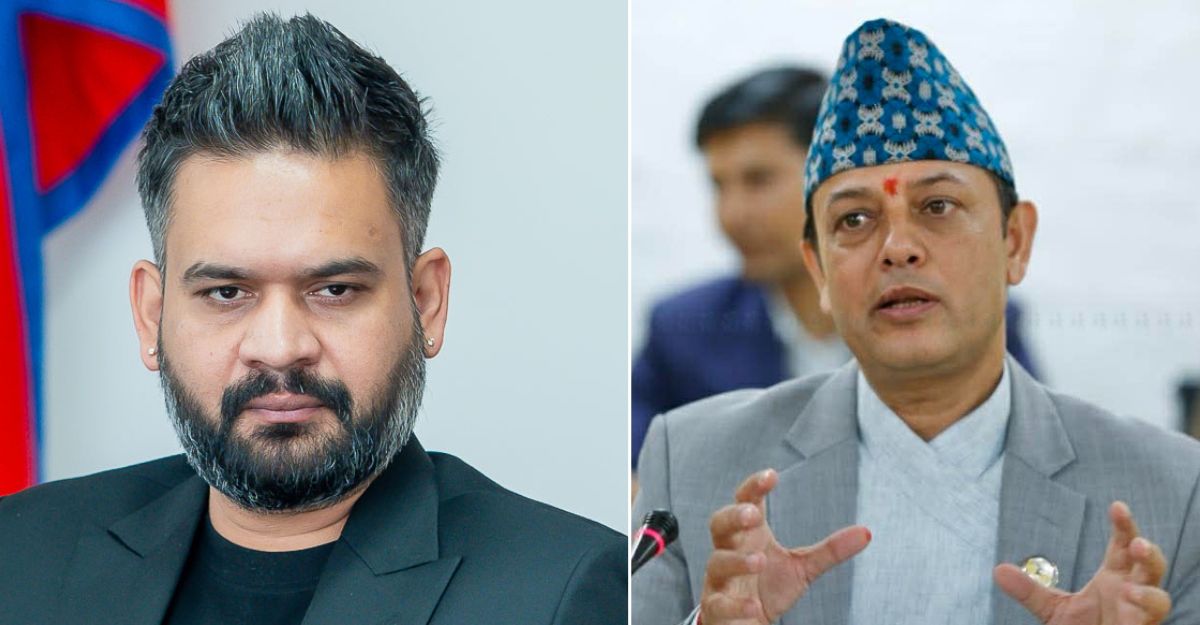
Speaker Dol Prasad Aryal has failed to implement the provision in the House of Representatives Regulations requiring a question-and-answer session with the prime minister.
After opposition lawmakers obstructed Thursday’s parliamentary session demanding enforcement of the rule, Aryal met Prime Minister Balen Shah to discuss the matter. Although the speaker urged the prime minister to attend Parliament for the scheduled Q&A session as mandated by the rules, Shah refused. He declined to allocate time for the Q&A session.
According to the House of Representatives Regulations, the speaker must allocate one hour on one day during the first week of every month for lawmakers to question the prime minister.
Although Parliament has already met for four days during the first week of Jestha, no Q&A session with the prime minister took place. Under the regulations, if the session does not take place during the first week, the speaker must schedule it for another day the following week.
Following that provision, Speaker Aryal visited the Prime Minister’s Office to request Shah’s attendance in Parliament for questioning. However, the prime minister rejected the request despite the binding provision of the regulations.
Shah reportedly told the speaker that he would address Parliament at a time of his own choosing after adequate preparation.
The speaker later briefed the Business Advisory Committee, informing members that the prime minister had refused to provide time for the Q&A session and had instead said he would appear some other time.
After the prime minister’s refusal, opposition parties surrounded the House rostrum in protest. Lawmakers from the CPN-UML, Nepali Communist Party, Shram Sanskriti Party, and Rastriya Prajatantra Party gathered in front of the speaker’s chair and chanted slogans.
Nepali Congress lawmakers also protested from their seats over the prime minister’s refusal to allocate time.
Opposition lawmakers shouted slogans including: “We do not want a prime minister above the Constitution,” “Present the prime minister in Parliament,” “Implement the House of Representatives Regulations,” “Down with dictatorship,” “Make the prime minister accountable,” and “Long live democracy.”
Amid the protests and slogans, Speaker Aryal tabled a proposal to pass the Alternative Development Finance Mobilization Bill. Lawmakers were unable to participate in debate on the bill, and even lawmakers who had registered amendments could not discuss them.
Finance Minister Swarnim Wagle, who was in Parliament to present the proposal for passage of the bill, waited in a room behind the speaker’s chair. He stepped out through the door to present the proposal for discussion and passage. Normally, ministers sit directly in front of the speaker and walk to the rostrum from their designated seats when tabling proposals.
Even lawmakers from the ruling Rastriya Swatantra Party had registered amendments to the bill. RSP lawmakers Lila Adhikari and Ganesh Karki said that they had withdrawn their amendments. However, Finance Minister Wagle said that he had accepted the withdrawn amendments too – an unusual parliamentary practice, as under the House regulations lawmakers are only required to withdraw amendments not accepted by the minister.
As the speaker continued the House meeting amid sloganeering, legislative business proceeded without discussion. Lawmakers lost the opportunity to participate in debate.
Amendment proposer Yuvaraj Dulal was still participating in protests from the well of the House when the speaker called out his name for discussion. However, Dulal requested the speaker to create an environment for speaking in Parliament.
RPP lawmaker Khusbu Oli had also registered her name to participate in discussion. But after being unable to reach the rostrum because of the protests, she urged the speaker to restore order.
Amid continued protests, the Alternative Development Finance Mobilization Bill was passed. Opposition lawmakers protested and shouted slogans in Parliament for nearly an hour.
The House of Representatives also approved two other bills despite the obstruction: the House of Representatives Member Election Bill and the Voter Registration Bill. Lawmakers will now be allowed to register amendments to those bills.
The next meeting of the House of Representatives has been scheduled for May 26.