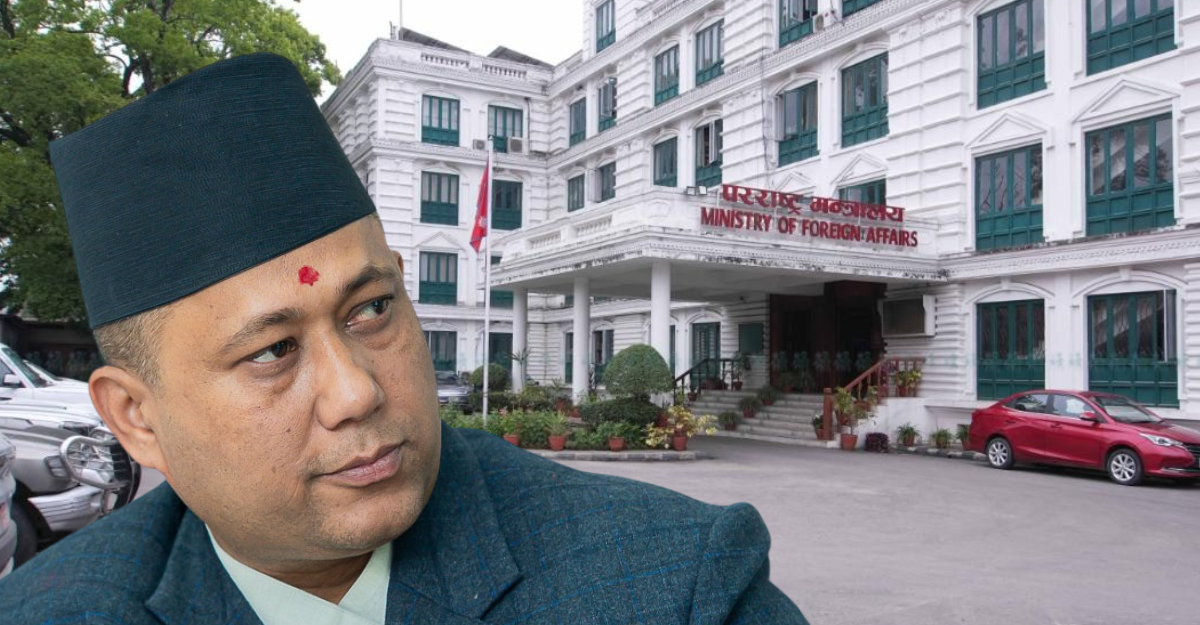
Even as the government swiftly moves forward with the process of appointing public officials, questions are growing over why the appointment process for ambassadors – whose posts remain vacant in nearly a dozen and a half countries – has not yet begun.
After the interim government led by Sushila Karki and the current government headed by Prime Minister Balen Shah recalled ambassadors appointed by the previous government of KP Sharma Oli, ambassadorial posts have remained vacant in diplomatic missions across 17 countries including India and China.
This vacancy has stalled diplomatic initiatives with those countries, and the newly elected prime minister’s traditional visit to India remains uncertain. Questions are therefore being raised about when the ambassadorial appointments will finally take place.
After the formation of the government led by PM Shah, ambassadors to six countries – India, Australia, Sri Lanka, South Korea, Denmark, and South Africa – were recalled.
Prior to that, on October 16, the interim government led by Sushila Karki had recalled 11 ambassadors from China, Germany, Israel, Malaysia, Qatar, Russia, Saudi Arabia, Spain, the United States, the United Kingdom, and Japan.
The 17 countries without an ambassador include Nepal’s northern and southern neighbors, India and China, which require the highest level of diplomatic engagement, as well as major donor countries like the US, Japan, and Australia. The new government of the new party, which secured a near two-thirds majority in the March 5 elections, faces an urgent need to advance diplomatic initiatives with all these nations.
Moreover, since PM Shah is himself a new political figure in Nepal’s power structure, there is widespread curiosity not only about his domestic policies, but also about his foreign policy. Since assuming office, he has not held individual meetings with any country's ambassador, opting only for collective briefings.
This has fueled interest within diplomatic circles regarding how PM Shah and his government view bilateral issues with neighboring countries.
Under such circumstances, delays in appointing ambassadors not only risk cooling bilateral relations but could also impact bilateral aid. The fact that the newly elected prime minister's customary visits to India and China have not yet been initiated is being viewed as a consequence of this diplomatic vacuum.
The countries with vacant ambassador posts also include Malaysia, Qatar, and Saudi Arabia, which are primary foreign employment destinations for Nepalis. A diplomatic vacuum in these countries means the concerns of Nepalis already working or seeking employment in those countries cannot be effectively addressed.
On the other hand, the Ministry of Foreign Affairs has stated that it plans to reform the ambassadorial appointment system practiced in Nepal so far by introducing an open competitive modality. Under this plan, at least 40 percent of ambassadors would be selected through open competition. However, no official notice inviting applications has yet been issued, further fueling doubts about whether the vacant ambassadorial posts will be filled anytime soon.
When asked about these questions surrounding ambassador appointments, Foreign Minister Shishir Khanal said that the government is currently studying the restructuring of Nepali embassies and consulates-general around the world, and that appointments would proceed after its report is received.
Nepal currently appoints ambassadors to 34 countries and consuls-general to 10 countries. Among these, positions are vacant in 17 countries, while the tenures of ambassadors in several other nations – including Brazil, Myanmar, Oman, Austria, Bangladesh, and Egypt – are set to end in a few months. Once their tenures end, this government will need to appoint at least 24 ambassadors all at once.
Questions have long been raised over whether ambassadors and consuls-general are even necessary in all these countries. In the past, too, the Ministry of Finance had suggested reducing their number, noting that maintaining diplomatic missions in unnecessary countries had led to increased expenditure.
“There is a perception that the number of diplomatic missions at present is too high. Because of this, we haven't been able to station adequate staff where they are truly needed,” Foreign Minister Khanal said. “We are conducting a study to reduce the number of embassies and consulates-general in order to restructure staff and reduce expenses.”
The study will recommend which countries require an embassy and which do not. It will also recommend how many staff members are needed in each country, which embassies should be closed, and where those employees should be redeployed.
According to him, diplomatic missions in Middle Eastern countries are severely understaffed. The existing staff's duties are largely limited to distributing passports, preventing them from executing broader diplomatic roles.
Citing Japan as an example, Foreign Minister Khanal added, "There are only four diplomatic staff members in Japan. Those four positions were created when there were only 30,000 Nepalis in Japan, but now the number has reached 300,000. They haven’t been able to focus on diplomatic work.”
Since restructuring embassies and staff is crucial to making Nepal's diplomacy effective in the current situation, the government is prioritizing it, he said.
According to him, once the study committee's recommendations are received, unnecessary diplomatic missions will be closed based on those findings, and the ambassador appointment process will begin.
"The study committee's report will arrive within this week at the latest. After determining where missions are needed and where they are not based on its recommendations, the process to appoint ambassadors to the necessary countries will move forward," Foreign Minister Khanal said.
He further shared that once the report arrives this week, applications will be called to appoint ambassadors through open competition.
"A public notice will be released on social media stating the need for an ambassador to a specific country," he said. "Interested candidates can submit their personal applications, and individuals can also recommend the name of another person they deem qualified."
According to the 2018 procedures related on ambassador appointments, at least 50 percent of ambassadors must be selected from officers within the Ministry of Foreign Affairs. Diplomats coming from within the ministry are known as career diplomats. In the past, the remaining 50 percent were appointed by ruling parties based on political power-sharing and personal proximity.
Khanal plans to revise this ratio by increasing the share of career diplomats from 50 percent to at least 60 percent, though the exact figure has not yet been finalized. The remaining 40 percent would then be selected through open competition rather than direct political appointments.
The government has yet to determine the countries where career diplomats will be appointed and the ones that will have ambassadors selected through open competition.
Under this modality, a public notice would be issued specifying the country for which an ambassador is needed. Applicants would be required to submit their qualifications and give a detailed presentation outlining their plans and proposals for expanding diplomatic and economic relations with that country.
After applications are submitted, a screening process would begin. A panel of experts from the Foreign Ministry would interview applicants and evaluate their proposed plans. Selection would proceed based on presentations, question-and-answer sessions, and the proposed diplomatic strategies.
Khanal said that ordinary citizens would also be able to recommend other individuals for ambassadorial positions.
"If someone believes a particular individual is qualified to serve as an ambassador to a particular country, they can recommend their name. The ministry will directly contact the individual based on such recommendation and take the conversation forward," Khanal explained.
He said that discussions have begun on the new modality to end the previous practice in which ruling parties or coalition partners directly appointed ambassadors based on political affiliation or personal ties, and instead move toward a transparent and competitive system for appointments.
The ruling Rastriya Swatantra Party (RSP) had also committed to merit-based appointments and reducing political interference in its election manifesto.