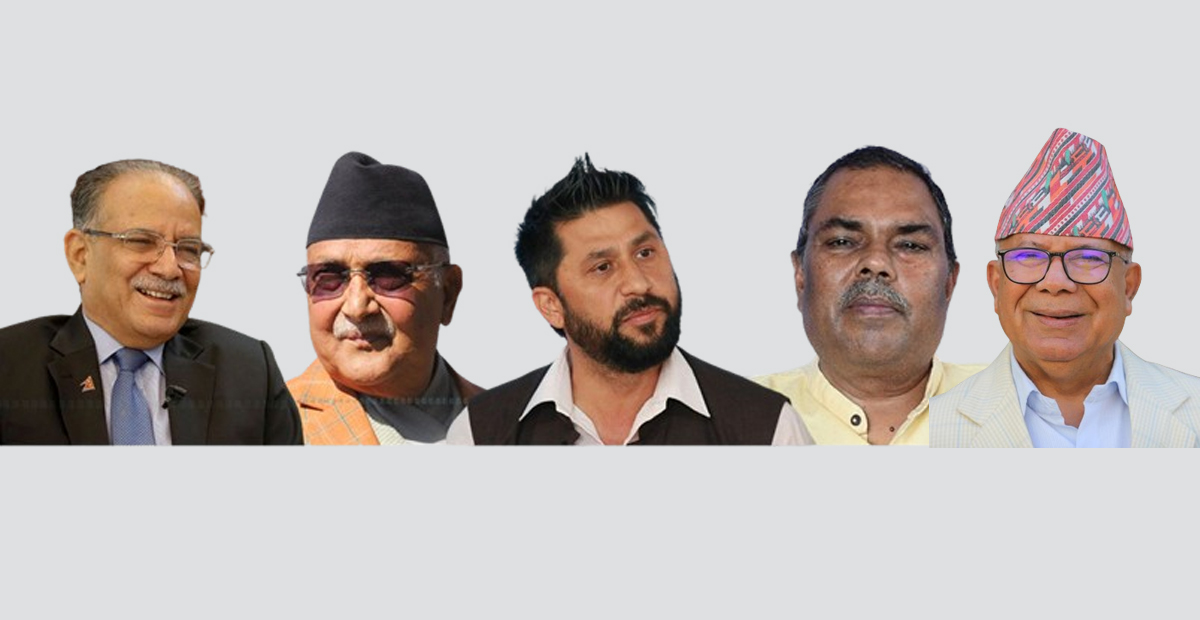
While topis-topis are gathered and hooted up on trucks of social imagination heading into the election timeline, you rarely see a single didi-bahini — let alone anyone from disadvantaged sexual and gender orientations. It’s deeply disturbing. I keep asking myself, “Kahan chhan hamra ketiharu?” — echoing the chorus from a rap by Ujjwala Maharjan.
When Political Socialization of Women in Nepal by Meena V. Malla (2011) reached my desk recently, it felt less like a coincidence and more like a timely nudge. With Nepal’s political arena once again charged with uncertainty — protests, polarization, and power reshuffling — I found myself searching for language to articulate what continues to feel like an old wound: the persistent absence of women’s meaningful participation in shaping our political present and future. Malla’s book arrived just when these frustrations were swelling, offering a historical mirror that demands we confront what has not changed enough.
As Malla cites Norris and Inglehart (2001), “A fundamental problem facing the worldwide process of democratization is the continued lack of gender equality in political leadership. The basic facts are not in dispute” (p. 19). And yet in Nepal, we continue to behave as if these basic facts can be politely ignored — as if women’s absence from political leadership is temporary or circumstantial, not structural.
Nepal’s concern for women’s political socialization and rights, as Malla reminds us, came painfully late: “Only in the 1970s women’s issues got some attention” (p. 23) — almost a century after women were first enfranchised in New Zealand in 1893. Even our policies reflect this slow awakening: Women in Development (WID) only first appeared in the Fifth Development Plan (1975–1980), initially limited to welfare-oriented training and basic education. It wasn’t until the late 1980s and early 1990s that empowerment — equity, representation, decision-making — entered the political vocabulary. Yet vocabulary alone has not shifted the lived reality.
Despite Nepal ratifying CEDAW (Convention on the Elimination of All Forms of Discrimination against Women) without reservation in 1991, Malla notes that “there remains significant gender inequalities in the distribution of opportunities and resources” (p. 38). Women are still framed primarily as mothers, wives, and dependents — “consumers,” not equal citizens. When scrolling repeatedly through comments on Sabina Kafle’s posts — “tapaile dailai sath dinu bhayeko chha, diyi rahanu hola” — or seeing targeted remarks toward Sunita Dangol — “ayo arko, hamro dailai kam garna nadine” — and when Sumana Shrestha and Toshima Karki are accused of being “daiko gun nadekhne birodhiharu” while current Honorable Prime Minister Sushila Karki is placed on a pedestal as the Aama who must clean up the mess made by all the Buwas, one begins to notice a disturbing pattern.
Malla is clear about why women are found in marginal positions, or are consistently referred to with secondary designations, in the political and public spheres: Nepal’s socialization process is designed to reproduce the patriarchy it claims to be dismantling. As she writes, “male centered biased and controlled process of socialization results in the homo-social reproduction of existing discriminatory and exploitative relationships” (p. 40). The home is feminized and undervalued; politics is masculinized and glorified (p. 41). I vividly remember a colleague laughing and mocking the current prime minister’s analogy– running a country is no different from managing a household. History tells us a harsh truth: women’s contributions were permitted only when they aligned with the interests or approval of male authority. Even the most courageous women leaders had to frame their activism in the language of dutiful daughters, wives, and sisters (p. 48) — as if political agency could only be borrowed, never owned.
So what does it mean for Nepal today that women still appear in political photographs only beside the men who “allowed” them to be there? What stops us from rallying behind female leaders en masse? Why isn’t there a massive following for someone like Akriti Ghimire — akritigg — who worked tirelessly with her team to help shape the very agreement now guiding the interim government and Gen-Z representatives? Perhaps one reason is this: Nepali society fears smart women who can show vulnerability publicly — because when a woman owns both intellect and honesty, what is left to criticize? Here, for a woman to be embraced, she must fit the roles of aama, didi, or bhauju to someone’s beloved dai. Anyone outside that familiar hierarchy — too independent, too ambitious, too capable — is quickly branded a “bad girl”, one who might slip out of control and therefore deemed unreliable.
And we women — unlike the large male followings who readily show up on social media and in the streets — often hesitate to agree or disagree openly. We hold back from expressing political opinions. We feel insecure asserting a public presence. In the language of Malla herself, we have been socialized into a parochial political culture, where women are expected to remain passive observers rather than active participants.
The Interim Constitution of Nepal of 2007, Malla reminds us, envisioned a transformative political shift by mandating 33 percent representation of women in all state agencies, compelling political parties to nominate at least 10.5 percent women candidates in direct elections and 22.5 percent under proportional representation for the Constituent Assembly. By the end of that electoral cycle, women barely made up 32.8 percent of the total elected representatives — yet, a historic milestone that proved what is possible when political will is backed by constitutional commitment.
Yet, looking at Nepal’s current political landscape, the contrast is striking. Today, women’s names are conspicuously absent from party ticket lists, leadership races, and prime-time political debates. What was once a constitutional obligation has quietly slipped into political convenience. The question we must now ask is not whether women are capable of leading — history has already answered that — but why political parties, once compelled to open their doors, are now so willing to close them again.
Sometimes, I question myself: should we, as women, be equally proud of who we are and celebrate what we have been doing as political agents on our own accord and capacities, and simply boycott the race of power? Until the dawn of this century, only 6 percent of female representatives were elected in general elections, and none of the existing political parties had women representation in their central working committees exceeding 10 percent. Until 1990, the illiteracy rate among women in the country was 82 percent. And yet — women have always been here, resisting. From the abolition of Sati through women’s organizing in Siraha in 1917 (p. 46), to their role in the Civil Rights movements of the 1940s, and the struggles for democracy in the 1950s, 1990s, and 2000s, to the current Gen-Z movement. In March 1990, girl students rallied against then King Birendra and Queen Aishwarya at Prithvi Narayan Campus as democracy gained momentum. The protesting girls were lathi-charged, assaulted, and molested. Of those killed during the Maoist insurgency, 2,500 were women and girls. Women from oppressed ethnicities actively joined the Maoist war to dismantle the Hindu-Brahmanic favored social structure, with nearly 70 percent of women participants from non-Khas communities (pp. 50–60). During the Gen-Z breakdown, young girl students rallied out on streets, many lost lives, and many still injured. Ashika Tamang became the sole guardian, attending to every need from topi to kattu, from bhat to ghat. My female friends tell me stories of their restlessness — some running into the streets and doing what they could, others staying home with family while still showing solidarity. Hundreds of bahiniharu on Discord silently and patiently observed the loud bhaiharu. Actors like Akriti Ghimire and her team brought solution-oriented content to their audiences, instead of adding fuel to the fire. Our presence as caregivers and mediators, whether silent or vocal, is difficult to measure.
Global data show that at the current pace of change, gender equality in leadership remains agonizingly distant. According to the UN Sustainable Development Goals Report 2025, the so-called “super election year” of 2024 did little for gender parity: as of January 2025, women held just 27.2 percent of national parliamentary seats worldwide, up only 0.3 percentage points from 2024 and 4.9 points since 2015. Moreover, the UN SDG Report 2023 warned that if progress continues at this rate, it will take another 140 years for women to achieve equal representation in positions of power and leadership. This record scares me to my bones, making me ask the same question again: Kahan chhan hamra ketiharu?
Yet, as Ujjwala Maharjan’s rap reminds us, “sangharshama ek dhunga” thapirachan– they are aiding our collective struggle. We must recognize that stunt garerai matrai desh bandaina, additionally women doing stunts might simply be perceived as abhiyantas not netas. National didi and aama might not have the same fan following as national dai either. Both our national and global society need to learn: just because women are not loud does not mean they are absent. Perhaps it is time we start asking— how we recognize women’s way of leading, how we recognize their way of exercising power. Power is not only in noise or visibility; it is in courage, strategy, resilience, negotiations, and the subtle, often unseen ways women influence change. How can we learn to see it, follow it, and let it redefine what leadership truly means?
References:
Malla, M. V. (2011). Political socialization of women in Nepal. Adroit Publishers.
National Statistics Office (NSO), Nepal. (2024). Poverty Status, 2023: Nepal Living Standard Survey IV 2022/23 [Data set]. NSO Open Data Portal. https://data.nsonepal.gov.np/dataset/poverty-status-2023 (Accessed December 2025).
United Nations. (2025). The Sustainable Development Goals Report 2025. United Nations Department of Economic and Social Affairs. Retrieved from https://unstats.un.org/sdgs/report/2025/The-Sustainable-Development-Goals-Report-2025.pdf (Accessed December 2025).
United Nations. (2023). The Sustainable Development Goals Report 2023. United Nations Department of Economic and Social Affairs. Retrieved from https://sdgs.un.org/sites/default/files/2023-07/The-Sustainable-Development-Goals-Report-2023.pdf (Accessed December 2025).
(Palanchoke is a researcher at University of the Arts Helsinki, Finland with interest in gender-inclusive placemaking.)