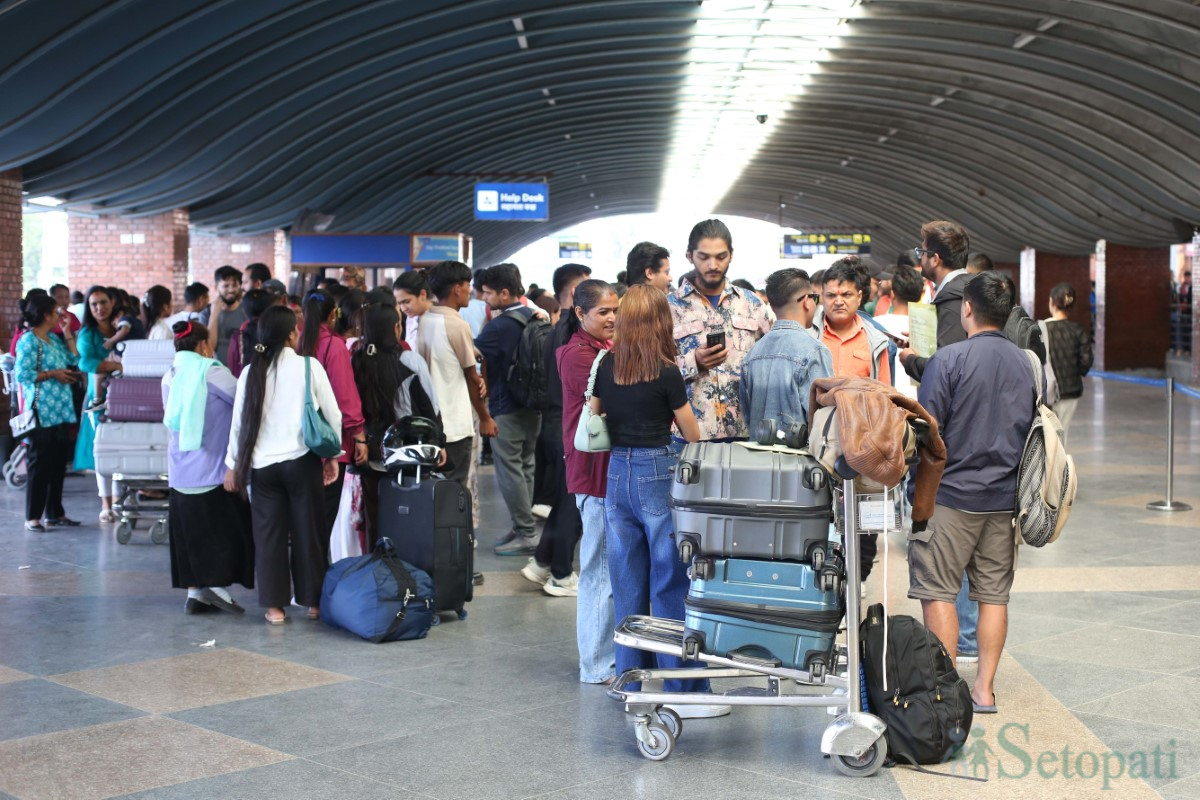
I boarded an Emirates flight in Toronto en route to Kathmandu, expecting an uneventful journey with a six-hour layover in Dubai before transferring to FlyDubai. Instead, the trip became an inadvertent ethnography—a window into the everyday precarities Nepali migrant workers face, long before they even reach home.
This journey coincided with my travel to Kathmandu for a workshop organized by the Canada-based Feminist Migration (FeMig) Project in collaboration with AMKAS Nepal, supported by the German government. The workshop aims to explore what gender-responsive and feminist migration governance should look like, particularly as global discussions intensify ahead of the International Migration Review Forum 2026. My in-flight observations underscored the urgency of grounding these policy debates in the lived realities of migrants—especially women—who navigate deep structural inequalities every day.
Transit as a site of vulnerability
At Dubai International Airport’s Terminal 1, I joined a shuttle to Terminal 2 packed with young Nepali men and women returning after years of labor in the Gulf. Their faces carried the weight of exhausting work, long shifts, and the emotional toll of displacement. They form the backbone of Gulf economies, yet their labor remains undervalued, and their dignity easily compromised—even in spaces as mundane as airport corridors.
On the flight, the subtle but pervasive inequalities embedded in transnational mobility became starkly visible. A young Nepali man stepped out of the lavatory only to be sternly confronted by a flight attendant: “Why didn’t you flush the toilet?” she demanded, twice, in English. Confused, he turned to me for help. When I translated, he insisted he had flushed. His embarrassment—mixed with fear—was unmistakable. After three years in Saudi Arabia, he understood discipline and hard work intimately, yet here he was treated as ignorant and careless. This moment captured what I describe in my research as “entangled precarity”—a layering of vulnerabilities migrants experience across borders, systems, and institutions.
Moments later, a young Nepali woman wandered toward the front of the plane, searching for the lavatory. Unable to locate it, she mistakenly tried opening a couple of cabinet doors. A flight attendant saw her and shouted, “Don’t ever do that again!” The woman froze, visibly panicked. Whether she understood the reprimand mattered less than the fear that seized her body. Even in the air, hierarchies of mobility and the unequal power built into migration governance asserted themselves.
Who gets respect in the sky?
As a Nepali traveler myself, I initially felt the same tone of dismissiveness. Curt instructions, perfunctory glances, and a sense of being “othered” were common. Yet the moment the attendants realized I was coming from Canada—not a Gulf labor camp—their behavior changed. Politeness replaced brusqueness; assistance replaced reprimands.
This shift exposes the invisible hierarchies governing mobility. Passengers are treated differently based not only on nationality, but on perceived class, education, and economic mobility. Migration scholars have long noted this stratification, but witnessing it unfold in real time—between Nepalis, in the sky—was striking.
Many migrant workers board flights directly from rural villages, often with limited English proficiency or familiarity with airplane norms. The absence of Nepali-speaking staff on airlines that routinely carry thousands of our workers each week is not a trivial oversight—it reinforces structural inequalities and extends precarity into the air itself.
Precarity is gendered—and transnational
These encounters reminded me of what my research on Nepali women migrants in the Gulf repeatedly shows: precarity is not confined to workplaces or destinations; it travels with migrants. Women face layered vulnerabilities—from exploitative recruitment practices to restricted freedoms—and these do not disappear when they check in for their flight home. In fact, mobility spaces often accentuate them.
Nepali migrants are routinely assumed to be low-skilled laborers, a stereotype that breeds stigma and invisibility. But there is nothing low-skilled about surviving harsh working conditions, navigating foreign bureaucracies, sending remittances home, and sustaining entire households and national economies. What is troubling is how easily their dignity is undermined through small acts of disrespect—from a reprimand over a lavatory to a dismissive glance.
What airlines must do
Airlines serving migration-heavy routes have a responsibility to provide linguistic and cultural support. This is not just about customer service—it is about dignity and equity. Simple measures like Nepali-speaking cabin crew, culturally informed communication, and respectful engagement can meaningfully reduce the anxieties and vulnerabilities migrants face during transit.
The sky mirrors the ground
Flying home, I realized that the sky is also stratified. It reflects global hierarchies of mobility—who is seen, who is valued, and who remains precarious. The workshop in Kathmandu will confront these realities directly, drawing on ethnographic insights, policy debates, and the lived experiences of migrant workers.
Feminist migration governance demands attention not only to recruitment, labor rights, and reintegration, but to the everyday spaces—airports, airplanes, checkpoints—where migrants’ dignity is tested. Only when policies acknowledge these mundane forms of inequality can they claim legitimacy and justice.
Migration is embodied, relational, and fundamentally unequal. Listening to Nepali migrant workers—especially women—not only enriches our understanding but is a political and moral imperative for shaping fair global migration governance.