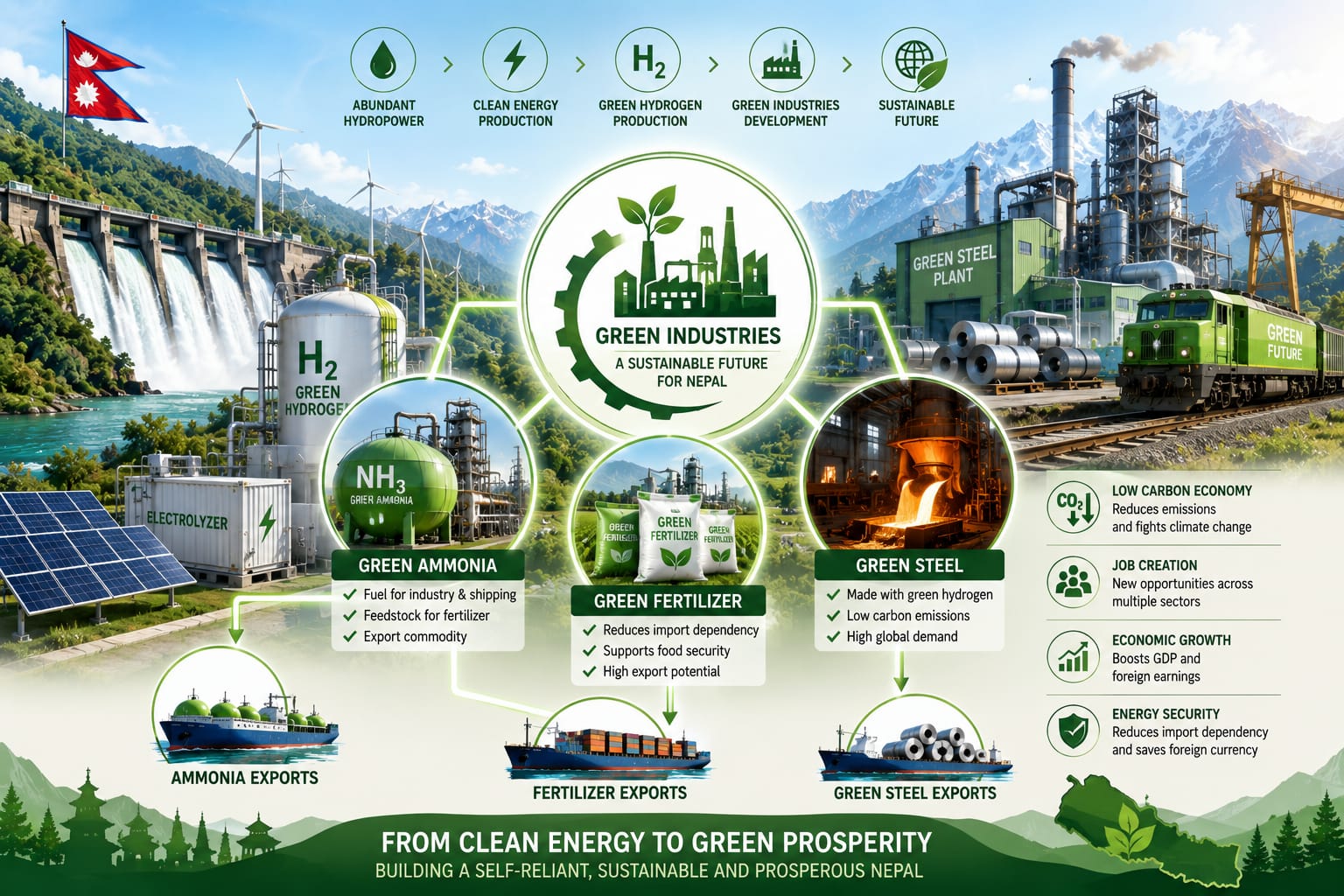
The narrative of Nepal as a water-rich nation is no longer just textbook knowledge; it is rapidly becoming a reality. After enduring 18-hour load-shedding for decades, we have reached a point where surplus electricity is wasted during the monsoon. However, merely increasing electricity generation has not cured our economy's structural illness.
On one hand, our hydropower is going to waste; on the other, we are importing petroleum products worth approximately Rs 300 billion and coal worth Rs100 billion annually. This exposes our policy paradox: we generated electricity, but we failed to link it with domestic industrialization and fuel substitution. Nepal's national agenda can no longer be limited to 'electricity generation and export, we must transform our clean energy into Green Industrialization.
Green Hydrogen: The strategic alternative for fuel substitution
Nearly 90% of Nepal's total energy consumption still comes from non-electric sources. The transport sector relies heavily on petrol and diesel, while industries like cement, brick, tile, and iron are entirely dependent on imported coal and furnace oil.
While electric vehicles (EVs) have made great strides in light transportation, it is technically and economically extremely difficult to directly electrify 'hard-to-abate' sectors, such as freight trucks carrying 25 tons of cargo uphill, or cement and iron industries requiring temperatures of 1400-1600 degrees Celsius. In such scenarios, converting our hydropower into 'Green Hydrogen' is the only viable alternative.
Furthermore, producing green ammonia from this hydrogen will not only halt billions of rupees in annual fertilizer imports but also ensure national food security.
Global market dynamics and Nepal's opportunity
Today, the global market is introducing strict policies to discourage carbon emissions. The European Union is implementing the 'Carbon Border Adjustment Mechanism (CBAM)', which will impose additional taxes on products manufactured with high carbon footprints. Similarly, trillion-dollar funds previously invested in fossil fuels are now shifting towards green energy through 'Green Climate Funds' and 'Sustainable Funds'.
Due to its abundant hydropower potential, strategic geopolitical location (between India and China), and 2045 net-zero target, Nepal can become one of the world's premier destinations for attracting such international green investments. However, this investment will not arrive automatically. The government must rise above traditional administrative sluggishness.
The institutional void: Policies exist, mechanisms do not
There have certainly been some policy initiatives regarding green hydrogen. The government has introduced the 'Green Hydrogen Policy 2080' and announced tax exemptions through the budget. But the implementation side remains extremely weak.
Nepal has institutions like the National Planning Commission, Investment Board Nepal, Ministry of Energy, Ministry of Industry, and the Alternative Energy Promotion Center. They are highly capable within their respective fields. However, Green Industrial Transformation sits exactly at the intersection of energy, industry, climate finance, carbon markets, and infrastructure development. Currently, these ministries and agencies are operating within their own narrow boundaries and limited jurisdictions. The Energy Ministry focuses only on selling electricity, the Industry Ministry envisions only traditional factories, and the Environment Ministry views climate primarily through the lens of conservation rather than economic opportunity.
Because of this, despite having a policy in place, commercialization has stalled due to the lack of working guidelines, safety standards, and inter-ministerial coordination. To bridge this execution gap, a robust institutional mechanism is urgently needed.
The path forward: 'Nepal Green Industrial Authority'
To transform Nepal’s hydropower into green industries, jobs, and climate leadership, the 'Nepal Green Industrial Authority' must be established without delay.
This will not be just another ministry or a body to replace existing institutions. Instead, it will be a mission-oriented, coordinating institution whose primary job will be to attract investment, remove policy bottlenecks, and execute projects. Its core functional areas will include:
Strategic coordination and investment structuring: Eliminating policy contradictions among ministries and designing frameworks like Public-Private Partnerships (PPP) and blended finance.
Project development: Preparing bankable projects for the production of green hydrogen, green ammonia, green fertilizer, and green steel.
Climate and Carbon market integration: Mobilizing funds from entities like the Global Environment Facility (GEF) and the Green Climate Fund (GCF), and developing carbon trading as a national revenue stream.
Establishing the Authority: A fast-track, parallel approach
For the rapid transformation sought by the new government and the country, we do not have the luxury of waiting for years. The traditional process of conducting lengthy studies first and drafting acts later could cause us to miss immediate investment opportunities. Therefore, this must be advanced immediately through a 'Parallel Approach':
Immediate action (Initiation via Formation Order): Set up the mechanism under the Office of the Prime Minister through a Cabinet 'Formation Order' to start work immediately. This will initiate inter-ministerial coordination and begin drafting the frameworks for flagship projects (e.g., a fertilizer plant).
Parallel legal process: From the very day work begins under the Formation Order, submit a draft bill to Parliament to give it a permanent and powerful form. If necessary, strengthen its legal foundation through an 'Ordinance' when Parliament is not in session.
24-month target: Within the next 24 months, this mechanism must be fully established as a powerful Authority, and simultaneously, a few flagship projects based on Foreign Direct Investment (FDI) and domestic capital must have reached the implementation phase.
Its leadership should be at the level of the Prime Minister or Deputy Prime Minister, with direct participation from the Ministries of Finance, Energy, Industry, and Environment, alongside private sector representatives and technical experts.
Conclusion
We have already made massive investments in electricity generation. The next national mission must not merely be to extract clean electricity, but to convert that clean electricity into green fuels, green materials, green jobs, and green economic sovereignty.
Now is not the time to walk at a slow pace or miss opportunities, but to capitalize on historic possibilities. If we act with firm political willpower to immediately establish the powerful 'Nepal Green Industrial Authority' and advance work in a parallel track, the electricity flowing from our rivers will make Nepal not just an energy exporter, but a global model nation of green industrialization and sustainable economic prosperity. This transformation is entirely possible, and its beginning must happen today.
(The author is associate professor at Kathmandu University. He is team leader of Green Hydrogen Lab and program lead of Nepal Hydrogen Initiatives)