In April 2019, while Nepal’s policymakers were still debating the merits of cryptocurrency, Bhutan quietly began mining Bitcoin. The vehicle was elegantly simple: the kingdom’s state-owned sovereign wealth fund, Druk Holding and Investments, repurposed abundant hydropower to run energy-intensive mining operations. By October 2024, Bhutan held approximately 13,000 Bitcoin—a stash that, at peak valuations, was worth well over $1 billion and represented a staggering share of the country’s GDP. A nation with a population smaller than many Nepali districts had looked at a global technological revolution and asked the question Nepal has rarely asked: how do we participate not as consumers, but as producers?
The Bhutan story, it should be noted, has not ended cleanly. By April 2026, Bhutan had sold roughly 70 percent of its Bitcoin holdings, reducing its stash to under 4,000 coins worth approximately $280 million, as declining prices and rising mining difficulty squeezed margins. The IMF’s January 2026 Article IV Consultation flagged crypto-asset volatility as a downside risk to Bhutan’s economy. The lesson, then, is not that Bhutan’s bet was risk-free. It is that Bhutan bet at all. A small Himalayan country identified an asymmetric opportunity, built the institutional capacity to act on it, and moved while others watched.
Nepal, with roughly 83,000 MW of theoretical hydropower capacity and a geography even more generously endowed than Bhutan’s, watched from the sidelines. It is watching again now—this time as the AI revolution reshapes every sector of every economy on earth. The difference is that the AI window will not stay open as long as the crypto window did. And the stakes are incomparably larger.
The world is not waiting
The scale of the AI transformation is difficult to overstate. PwC has projected that AI will contribute up to $15.7 trillion to the global economy by 2030—more than the combined current output of China and India. The United Nations Conference on Trade and Development estimates AI’s market value will reach $4.8 trillion by 2033, roughly the size of Germany’s entire economy. This is the single largest economic shift since industrialization, and the nations building for it are not waiting for consensus.
The UAE appointed the world’s first Minister of State for Artificial Intelligence in October 2017. Omar Al Olama was given ministerial authority, cross-government coordination powers, and a direct mandate from the highest levels of government. The country now has over 1,500 AI companies and is targeting 10,000 within five years. India’s IndiaAI Mission was approved with a budget of approximately $1.25 billion, with a 1,056 percent year-on-year increase in allocation for FY 2025–26 alone, while building over 18,000 GPUs and partnering with Microsoft to train 10 million people by 2030. Singapore committed more than S$1 billion over five years under its National AI Strategy 2.0—funded, accountable, and time-bound.
Until recently, Nepal had none of this. It had no Minister of AI, no billion-dollar mission, no named Chief AI Officer. What it had was a policy document and what the Communications Minister himself described, at its inauguration in November 2025, as an AI Center that “began in a small room.” On April 14, 2026, the picture changed—at least on paper.
A new government raises the stakes
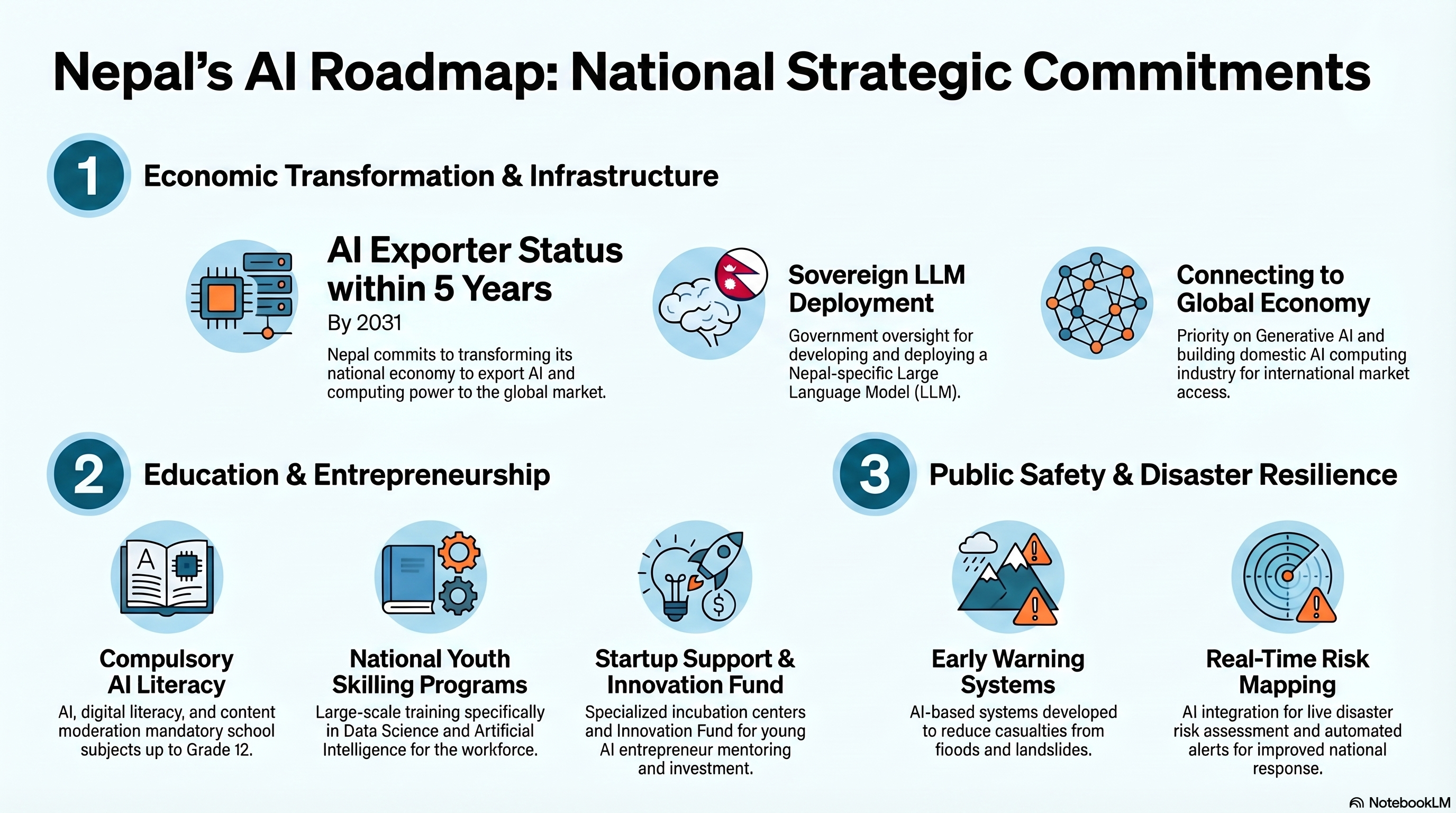
On April 14, 2026, the Shah government released its National Commitment—a consolidated policy platform synthesizing the manifestos of the six parties that won national recognition in the February election. Its technology commitments dwarf anything in the inherited AI policy.
 Infographic created using NotebookLM
Five commitments stand out, none of which has a precedent in Nepal’s technology policy history:
- Nepal will “transform into a country that exports artificial intelligence and computing power within five years” — repositioning Nepal from technology consumer to technology producer.
- Nepal will develop and deploy a Sovereign Large Language Model — making it one of the first developing countries in South Asia to name this as a state goal.
- The IT sector is declared a national strategic industry, with an IT Promotion Board to be formed as a new cross-government coordination body.
- AI and digital literacy will be made compulsory through Grade 12, covering artificial intelligence, data science, and cybersecurity.
- Multinational technology companies will be attracted to establish R&D centers in Nepal, with data server stations named a priority energy-intensive industry—directly linking Nepal’s hydropower endowment to the digital economy agenda for the first time in any government document.
The question—the only question that matters now—is whether the institutional architecture exists to deliver any of it.
What Nepal got right—and where the policy breaks down
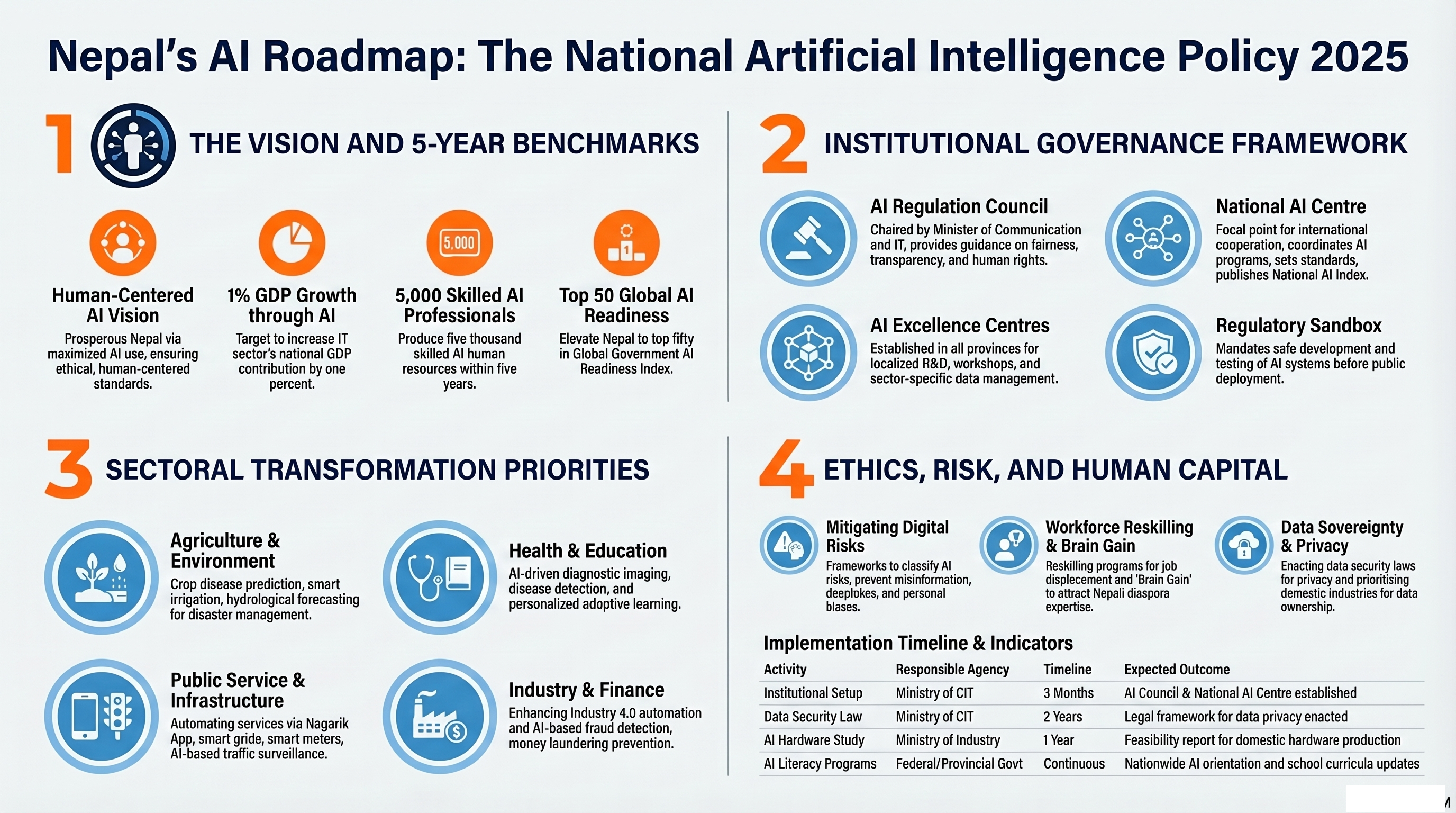
Credit is due. Nepal’s National AI Policy 2025, approved by Cabinet on August 16, 2025, places Nepal among the minority of developing countries that have an AI strategy at all. The policy articulates a vision of “human-centered, ethical, and prosperous” AI development. It identifies real priorities: data governance, AI literacy, sectoral application in agriculture and health, and the creation of regulatory sandboxes for safe experimentation. It recognizes the need for a Brain Gain Program to leverage the Nepali diaspora. These are not trivial achievements in a country where technology policy has historically been an afterthought.
 Infographic created using NotebookLM
But the architecture built on this foundation is too fragile to bear the weight of a national AI transformation. The problems are structural, and they are embedded in the policy’s own text.
Start with governance. Section 10.1 establishes an AI Regulation Council chaired by the Minister of Communication and Information Technology—a political appointee whose tenure depends on coalition arithmetic, not technical competence. The Council meets only twice a year. For a regulatory body overseeing a technology domain where the global landscape shifts monthly, biannual meetings are not governance. They are ceremony. The Council includes three subject-matter experts from the private sector and universities, but nine of its twelve members are government officials. The body designed to regulate Nepal’s AI future is structurally dominated by the bureaucracy it is supposed to reform.
Then consider the National AI Center itself. Section 10.2 places the Center under the Ministry of Communication and Information Technology. This means the Center operates not as an autonomous executive body but as a departmental unit—subject to standard civil service hiring procedures, ministerial budget cycles, and bureaucratic chain-of-command constraints. The policy provides no mechanism for the Center to recruit AI specialists outside government pay scales, no guarantee of technical independence, and no operational autonomy. A center that cannot hire an AI engineer at market rates cannot credibly set standards for AI systems. It certainly cannot develop a Sovereign Large Language Model.
The financial provisions are equally hollow. Section 12 states that “necessary plans, programs, budgets, and human resources shall be ensured through the relevant ministries and agencies.” This is not a funding mechanism. It is a sentence. There is no dedicated AI allocation, no multi-year funding commitment, and no ring-fenced budget. Every rupee the National AI Center spends must be negotiated through MoCIT’s general envelope—competing with telecommunications regulation, postal services, and IT infrastructure for a ministry that is not among the government’s top-tier budget priorities.
Perhaps most tellingly, the vagueness about deliverables runs through the policy’s own implementation plan and its headline targets alike. Schedule 1 assigns nearly every action item a timeline of “Continuous,” with monitoring indicators reduced to “Number of programs” or “Number of standards.” The same problem surfaces in Section 5.3, which commits to producing “at least five thousand skilled human resources in the field of AI within five years”—without ever defining what that means. AI researchers capable of publishing in peer-reviewed journals? Data scientists who can build and deploy production models? Software engineers with applied machine learning competency? Or government employees who have completed a two-week literacy workshop? The distinction matters enormously in cost, curriculum design, and institutional requirements. Sections 9.21 through 9.24 list academic programs, certification programs, reskilling, and upskilling as parallel tracks with no indication of how many graduates each should produce or against what labor market benchmark. An implementation plan without deadlines is a catalog of intentions. A target without a definition is a slogan. The Balen government now faces a direct choice: revise Section 5.3 with a stratified, measurable target—specifying how many researchers, how many engineers, how many literate civil servants, and by when—or acknowledge the number is unworkable and replace it with something the country can actually be held to.
No one is in charge
Here is the most immediate problem: Nepal’s National AI Center has no dedicated, full-time leader whose sole mandate is to drive the country’s AI agenda. The Center was inaugurated in a ceremony on November 10, 2025. The AI Council has been formed. But as of April 2026, there is no appointed Chief AI Officer or equivalent—no single empowered individual who wakes up every morning with one job: to build Nepal’s AI capacity, coordinate across ministries, engage with international counterparts, and be held accountable for results. The Center’s establishment was overseen by a senior civil servant managing AI as one of several portfolios—not the same as a dedicated technical leader with ring-fenced authority. The Center needs someone whose entire professional identity and institutional power are staked on making Nepal’s AI strategy work.
The National Commitment’s announcement of an IT Promotion Board does not fill this gap—and not merely because a board lacks an individual accountable for delivery. The deeper problem is structural. An IT Promotion Board operates under a general mandate: telecommunications infrastructure, software exports, digital services, broadband connectivity. These are legitimate national priorities. They are not AI. Placing Nepal’s AI agenda beneath an IT promotion umbrella means AI will compete for attention, budget, and political bandwidth against a far broader and more entrenched set of interests—and given the institutional weight of traditional IT concerns, it will lose. AI governance requires a distinct skillset, a different regulatory logic, and a speed of decision-making that general IT policy structures were not built to provide. Grouping them together does not serve either.
What Nepal needs is an independent AI body: a dedicated institution, separate from MoCIT and operating outside the IT Promotion Board’s remit, led by a single empowered individual whose entire mandate is Nepal’s AI agenda, and staffed by full-time domain experts—AI researchers, data scientists, ethicists, and legal specialists in technology governance. This is not a secretariat that services a ministerial council. It is an executive body with the authority to set standards, evaluate AI systems, coordinate across ministries, attract diaspora talent, and drive delivery against the commitments the National Commitment has now placed on record. Without it, the Sovereign LLM remains a press release, the AI export ambition remains a slogan, and the 2025 Policy remains what it currently is: a document without an owner.
The evidence from comparable countries points in the same direction. When the UAE appointed the world’s first Minister of State for Artificial Intelligence, that minister was given a dedicated office, a cross-government coordination mandate, and direct backing from the country’s highest leadership—entirely separate from its broader technology portfolio. The result: within years, the country moved from vision to execution. Singapore’s National AI Strategy 2.0 is coordinated through a dedicated group with technical leadership and a clear reporting line, distinct from routine digital government functions. India’s IndiaAI Mission operates with its own governance structure, ring-fenced from the Ministry of Electronics and Information Technology’s day-to-day concerns. In each case, the architecture was the same: AI governed as a sovereign priority, not as a sub-item on a broader technology agenda.
Nepal’s Center, by contrast, is a secretariat without a secretary. A policy without a person. And now—with a Sovereign LLM on the national agenda—an institution without the staff to build one.
Ambition without architecture: the pattern Nepal must break
The National Commitment, released on April 14, 2026, is the most ambitious technology policy statement any Nepali government has made. That deserves acknowledgment. A government committing to AI exports, a Sovereign LLM, and Grade 12 AI literacy is not thinking small. The question is whether this ambition will be institutionalized or whether it will follow the established Nepali pattern: bold platform language, weak follow-through, and a document that becomes the reference point for the next generation’s critique.
Consider what delivering on the National Commitment’s AI promises actually requires. A Sovereign Large Language Model demands GPU infrastructure, large-scale curated datasets, a team of machine learning engineers and linguists, compute budgets, and ongoing maintenance—none of which Nepal currently has at scale. Exporting AI and computing power within five years requires data center investment, reliable power supply contracts, simplified foreign investment procedures, and a workforce pipeline that does not yet exist. Attracting multinational R&D centers requires tax incentives, land tenure clarity, and regulatory predictability that the current environment does not offer.
None of this is impossible. But none of it happens without institutional architecture—a funded body with the authority, the talent, and the time horizon to execute. The National Commitment has raised the target. The 2025 AI Policy has not been revised to match it. The National AI Center has not been restructured to pursue it. The budget has not been ring-fenced to fund it. The gap between stated ambition and operational capacity is not a detail. It is the whole problem.
Three things the government must do before the budget
Prime Minister Balendra Shah took office on March 27, 2026, on the strength of a generational mandate. The Gen Z uprising that toppled the previous government was, at its core, a demand for competent institutions and accountable governance. At 35, Shah is a structural engineer by training—someone who understands that the integrity of a structure depends on its foundations, not its façade. The National Commitment has given Nepal a façade of remarkable ambition. The foundations remain unbuilt. Three things must happen before the upcoming budget for fiscal year 2083/84, expected in late May.
First, appoint a dedicated, full-time AI leader. The IT Promotion Board announced in the National Commitment is welcome. It is not sufficient. Nepal needs a Chief AI Officer—or equivalent title—with genuine executive authority, cross-ministry coordination powers, and a ring-fenced mandate. This person must have the authority to hire technical specialists at competitive salaries, engage with international counterparts, and be personally accountable for measurable outcomes. The UAE understood in 2017 that AI governance requires a named human being responsible for results. Nepal must understand this in 2026. A board without an executive is a meeting, not a strategy.
Second, ring-fence a dedicated AI allocation in the FY 2083/84 budget. AI funding cannot remain buried in MoCIT’s general envelope. It must be a standalone, multi-year commitment visible in the budget documents—signaling to foreign investors, to the Nepali diaspora, and to Nepal’s own young people that this government understands the stakes. The current budget allocated NPR 730 million in subsidized loans for startups and NPR 740 million for digital infrastructure. A government that has committed to a Sovereign LLM and AI exports needs a budget that reflects those ambitions, not one that predates them. The budget is not just a financial document. It is a statement of national intent.
Third, declare the government’s position on the National AI Policy 2025. This is the most foundational of the three asks, and the one most likely to be deferred on the grounds that it is procedural. It is not. The 2025 Policy was drafted under a different government, with different political priorities and a narrower vision of what Nepal could achieve in AI. The National Commitment has now set targets that the 2025 Policy was never designed to deliver—a Sovereign LLM, AI exports within five years, Grade 12 AI literacy at national scale. These ambitions require a governing framework that matches them. That means the Balen government must answer three questions before the budget, in public, in writing: first, will it adopt the 2025 Policy as the operative framework for AI development? Second, if not, will it revise the policy—updating its governance structures, funding mechanisms, and workforce targets to match the National Commitment’s ambitions? Third, if revision is insufficient, what would an overhaul look like—what new institutional arrangements, new budget architecture, and new accountability mechanisms would a fit-for-purpose AI policy for this government actually contain? Silence on these questions is not neutrality. It is a choice to proceed without a plan.
The promise is there. Now comes the hard part.
Nepal’s AI community, its young professionals, and its diaspora scattered across the technology centers of the world are watching this moment with cautious hope. They have seen bold declarations before. What they are looking for now is different: a government that treats AI not as a talking point for press conferences but as a national project demanding sustained attention, real money, and accountable leadership. The National Commitment has signaled that this government understands the stakes. That signal matters. Signals, however, are not systems.
The AI revolution is not waiting for Nepal to get comfortable with the idea. Countries are moving from policy to product, from ambition to infrastructure, from vision documents to deployed systems. Every month that Nepal’s National AI Center operates without a leader, without a specialist team, and without a ring-fenced budget is a month the gap widens. This is not a revolution Nepal can observe and join later at a discount. The window is open. It will not stay that way.
The hope is real. The commitment is on paper. What the nation is waiting for—what the diaspora is watching for, what Nepal’s next generation of engineers and researchers deserves—is the execution.
Chandan Goopta leads Marketing Technology and Nepal Operations at Rain Local, and is co-founder of the National AI Olympiad. He is a researcher in AI policy, governance, and ethics.