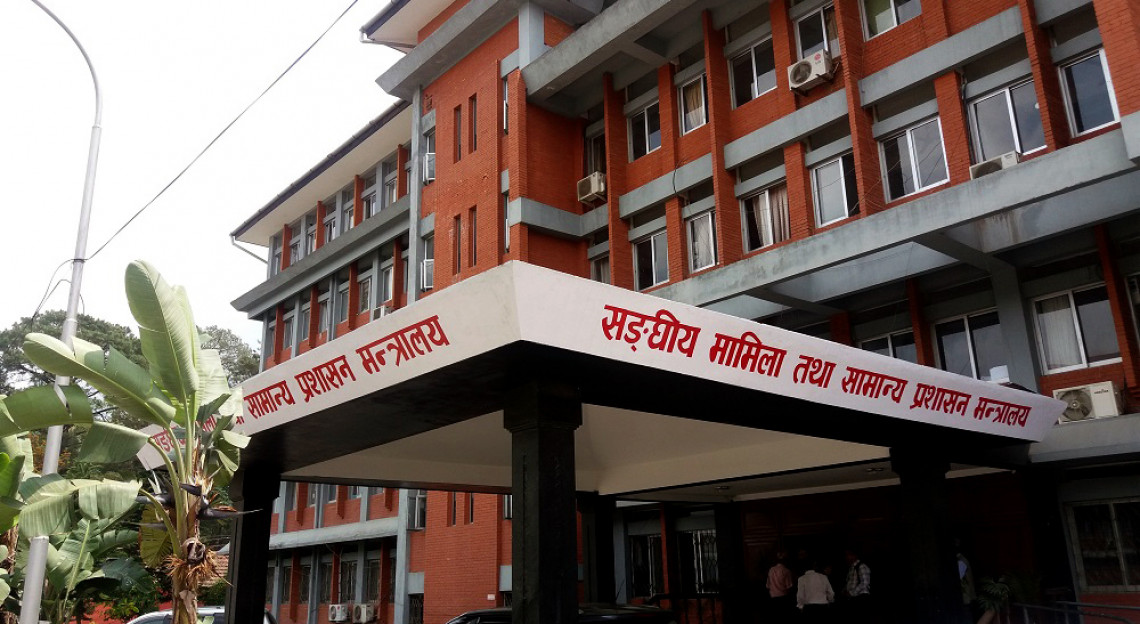
The government is preparing to retire civil servants who have completed 30 years of service or crossed the age of 55.
A bill prepared by the Ministry of Land Management, Cooperatives, Federal Affairs, and General Administration has proposed such a provision as a one-time measure.
The bill, which proposes retirement for employees who have completed 30 years of service and those who have crossed the age of 55, has been sent to the Public Service Commission for its opinion.
The Ministry of Law and Ministry of Finance, among others, have already provided their comments on the draft. After receiving the Public Service Commission’s opinion, the ministry plans to submit the bill to the Cabinet.
Under the existing Civil Service Act, civil servants are required to retire at the age of 58.
“We have prepared a bill to retire, as a one-time measure, employees who have completed 30 years of service or crossed the age of 55,” General Administration Minister Pratibha Rawal told Setopati. “The bill is still under discussion, and we have sent it to the Public Service Commission seeking its opinion.”
If the government retires employees who have completed 30 years of service or are over 55, an estimated 10,000 civil servants could leave the civil service. The government is also preparing to provide a financial package to the employees being retired, although the details of the package have not yet been finalized.
The government led by Balen Shah has already said that the Federal Civil Service Bill is among its priorities. The government had also pledged in its 100-day commitment paper to finalize the bill soon, but the legislation has yet to gain momentum.
It is still uncertain whether the draft currently under discussion at the ministry level will be approved by the Cabinet. If approved, the bill will be sent to Parliament. It will acquire legal status only after being passed by both the House of Representatives and the National Assembly and authenticated by the president.
Debate over retirement age
The retirement age in Nepal’s federal civil service has been debated for years.
As the average life expectancy of Nepalis has increased, the previous Federal Civil Service Bill submitted to Parliament had proposed raising the retirement age from 58 to 60.
Raising the retirement age was expected to generate significant financial savings for the government by delaying pension payments and shortening the period during which retirees would receive pensions.
At the time, lawmakers debated the possibility that introducing a retirement age of 60 all at once could prevent new recruits from entering the civil service through the Public Service Commission for up to two years.
The House of Representatives’ State Affairs and Good Governance Committee therefore proposed a phased approach: retirement at 58 in the first year the law took effect, 59 in the second year, and 60 in the third year.
Two contrasting views emerged during parliamentary discussions on the retirement age.
Some lawmakers expressed concern that retiring a large number of employees at once would remove experienced civil servants from the government. They feared this could leave Nepal without sufficient experienced officials to participate in negotiations through bilateral mechanisms, including with India. They also warned that institutional experience in handling various situations could be lost and that effective knowledge transfer could be disrupted.
On the other hand, lawmakers argued that raising the retirement age at once could restrict opportunities for qualified young people to enter the civil service. Some prospective applicants could also cross the maximum recruitment age while waiting for vacancies, potentially causing significant mental stress.
Parliament therefore concluded that any change in the retirement age should be implemented gradually and in a planned manner.