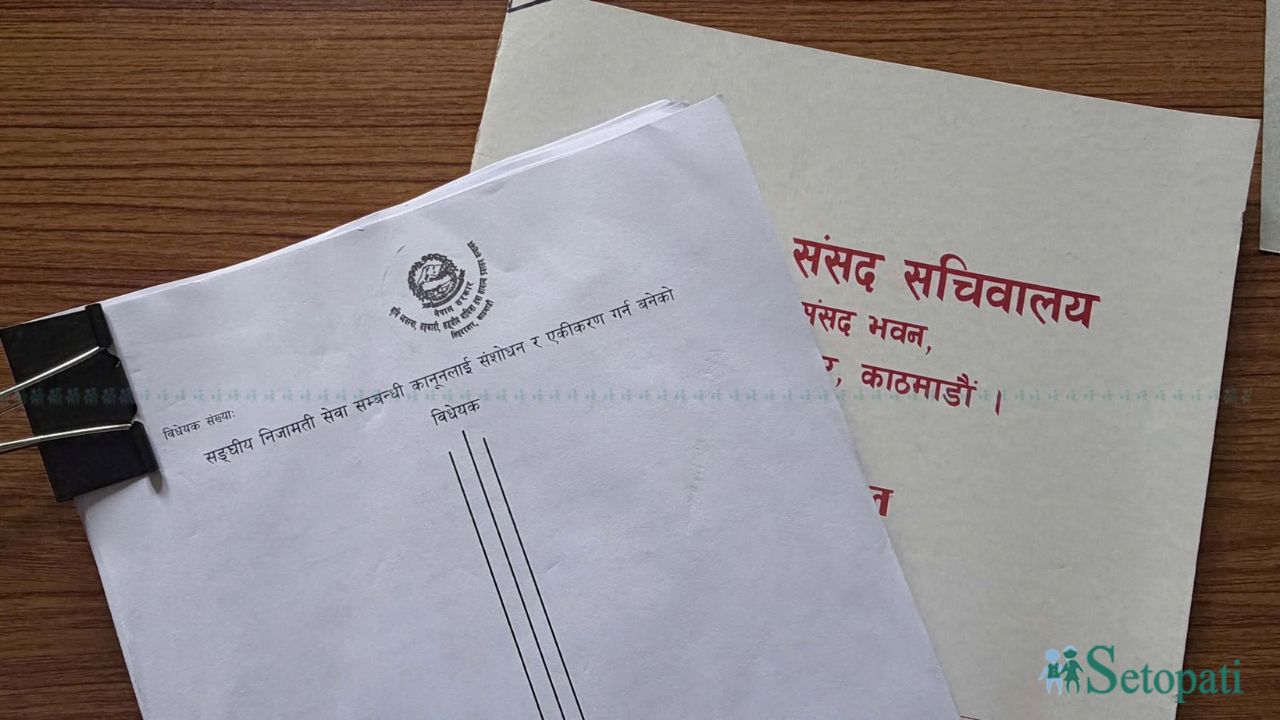
The long-debated Federal Civil Service Bill has been registered in Parliament.
In the bill, the government has proposed that civil servants who have completed 30 years of service or reached the age of 55 be subject to mandatory retirement. This provision would apply to employees who are serving at the time the law come into force. After that, the normal mandatory retirement age for civil servants would be 60 years.
The bill proposes that employees who retire because they have completed 30 years of service or reached the age of 55 would not face any reduction in their pension benefits. In the case of employees retiring at 55, up to three additional years of service would be counted for pension purposes.
The Cabinet, at its meeting on Tuesday, decided to present the bill concerning the formation, operation, and terms of service of the federal civil service in Parliament. The bill was advanced after incorporating suggestions received from the Public Service Commission.
The bill also sets terms of office for the chief secretary and secretaries. Officials at the 14th level, including the chief secretary and chief registrar, would have a two-year term. Officials at the 13th level, including secretaries and equivalent positions, would have a three-year term.
Retirement at 30 years of service or age 55
One of the bill’s key provisions concerns mandatory retirement for employees who are in service when the act comes into effect.
Such employees would be compulsorily retired if they have either reached the age of 55 or completed 30 years of service. This would represent a major one-time change from the current retirement age of 58.
For employees appointed after the law comes into force, or those who remain in service thereafter, the normal retirement age would be 60.
The new provision would also require employees who have completed 30 years of service but are younger than 55 to retire. The government has proposed the measure with the stated aim of managing long-serving employees while creating opportunities for new personnel. However, Parliament is expected to debate its impact on employees’ length of service, pension liabilities, and administrative experience.
Proposed pension provisions
The bill provides that civil servants who have completed 20 or more years of service would receive a monthly pension for life.
For pension calculations, a maximum of 30 years of service would be counted. The monthly pension would be determined by multiplying the total years of service by the employee’s final salary and dividing the result by 50.
The minimum pension would not be less than 50 percent of the starting salary of a serving employee in the equivalent position. The maximum pension would not exceed the starting salary scale.
If the starting salary scale of serving employees is increased, retired employees in the equivalent position would also receive an increase in their pension equivalent to two-thirds of that increase, according to the bill.
Restrictions on contract and daily-wage hiring
The bill tightens restrictions on hiring employees on a daily-wage or contractual basis for work that is supposed to be performed by civil servants.
Except in specific circumstances provided by law, individuals cannot be hired on a daily-wage or contractual basis to perform duties assigned to civil servants.
Appointments made in violation of the act would automatically become void. The bill also proposes that salaries, allowances, and other benefits provided to a person appointed unlawfully be recovered from the official who made the appointment.
Two-year term for chief secretary, three years for secretaries
The bill sets terms of office for officials holding senior positions in the gazetted special class.
The term of office for 14th-level officials, including the chief secretary and chief registrar, would be two years. Similarly, 13th-level officials, including secretaries and equivalent officials, would serve for three years.
For gazetted special-class officials, the bill proposes retirement when either their term expires or they reach the age of 60, whichever comes first.
The bill also contains provisions concerning civil servants’ service conditions, appointments, transfers, promotions, retirement, and other aspects of public administration. Following its registration in Parliament, lawmakers can hold clause-by-clause discussions and propose amendments. The proposed provisions will become law only after the bill is passed by Parliament and authenticated by the president.
Two-year cooling-off period
The bill proposes a two-year cooling-off period for senior civil servants after they leave government service.
“A civil servant who resigns from or retires from a gazetted special or first-class position in the Federal Civil Service or another government service shall not be appointed to any constitutional, diplomatic, or other government position until two years have elapsed from the date the resignation was accepted or the date of retirement from service,” the bill states.
This means that retired officials would also be barred for two years from working as employees or consultants on projects operated by entities other than intergovernmental organizations or international development partners.
Similarly, they would not be allowed to work as employees or consultants for an organization related to the area of responsibility of the agency where they served during the final year before retirement, or for an organization regulated by that agency.
However, the bill states that if the government requires their expertise for civil service reforms, there would be no obstacles to using the experience and expertise of former civil servants.
The provision had also been the subject of extensive discussion and debate in the previous Parliament.
At the time, lawmakers held lengthy discussions in the State Affairs and Good Governance Committee over the cooling-off provision. A mistake made by the House of Representatives eventually led then committee chair Ramhari Khatiwada to resign.
The National Assembly subsequently corrected the error made by the House of Representatives.
The committee had reached an agreement on a two-year cooling-off period and sent its report to the House of Representatives.
However, because the earlier provision was also retained in the bill, the two-year cooling-off period became ineffective.
The House of Representatives passed the committee's report and sent it to the National Assembly.
The National Assembly's Legislation Management Committee amended the provision to ensure that the two-year cooling-off period would remain effective.
The bill was then returned to the House of Representatives for passage.
Although the bill was expected to be passed in a single sitting, it became inactive after Parliament was dissolved following the Gen Z-led protests on September 8 last year.
Six months after the formation of the new government, the Federal Civil Service Bill has been registered again in Parliament with the same two-year cooling-off provision.