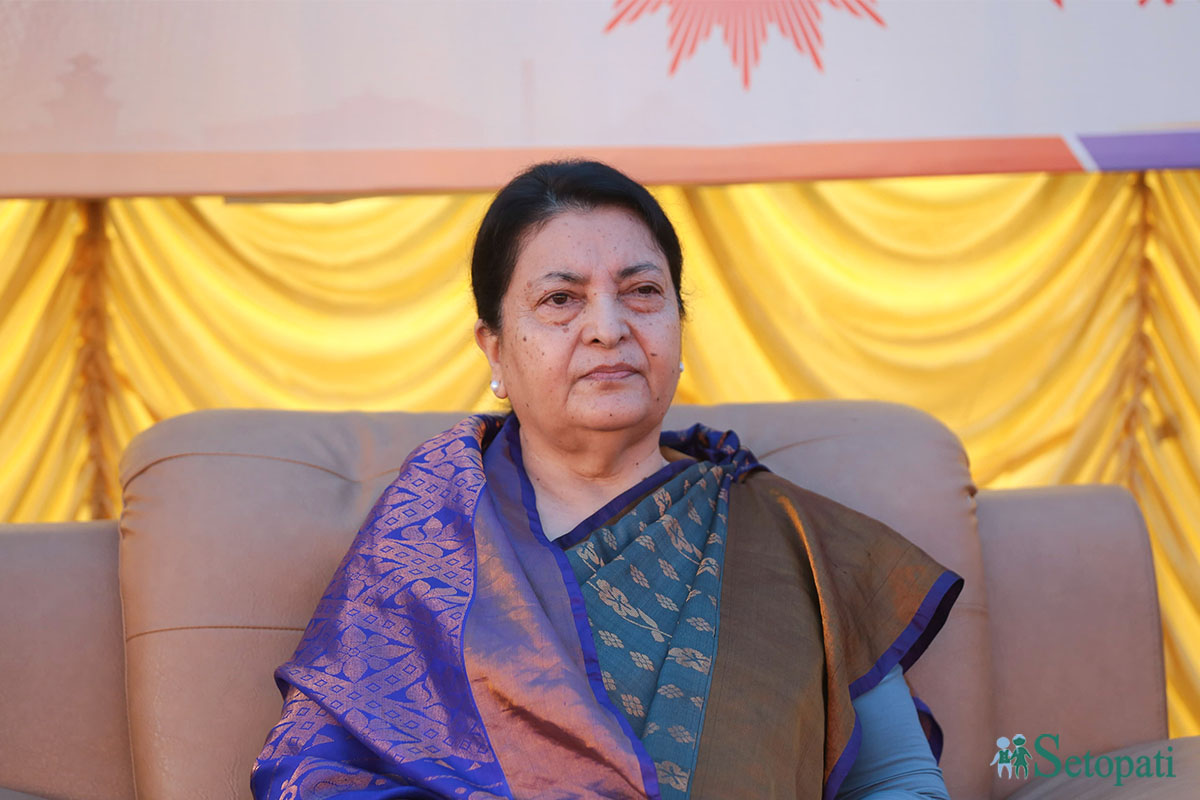
After the CPN-UML made former president Bidya Bhandari a “senior leader” ranked second only to Chairman KP Sharma Oli, the main question that has arisen within the party is: What powers does this position give her?
The question has arisen also because Bhandari, who is not even a central committee member, has been given the position of “senior leader,” which is not provided for in the party’s statute.
Leaders have expressed curiosity about her legal standing in the party, saying that Oli gave Bhandari the post only for the sake of power balance in order to sideline issues such as leadership transition.
After becoming “senior leader,” can she participate in the party’s regular meetings or not? What will be her role in party bodies, from the secretariat to the central committee? Can she assume any responsibilities in the chairman’s absence? What weight will her vote carry in the party’s decision-making process?
Leaders Setopati spoke to say that the UML has so far not publicly clarified the division of responsibilities to answer these questions.
The decision to make Bhandari a senior leader was made by the central committee meeting held from September 21 to 24 in Bhainimandal, Lalitpur. The party’s formal decision mentions that she has been given “second rank.”
Bhandari was previously a vice-chairperson of the UML. After becoming president, she left active party responsibilities. Having completed two terms as president, she has now returned to active party politics.
The proposal to make her senior leader was presented to the central committee meeting by Chairman Oli. The meeting approved the proposal.
Deputy General Secretary Yogesh Bhattarai wrote a note of dissent on the decision.
Position created, but where are the powers?
Following the decision to make Bhandari senior leader, much interest and curiosity has been expressed within the party about her future role.
According to the leaders Setopati spoke to, the most interesting aspect of this decision is that the post was created, but the functions and powers of this post are not clear in the statute itself.
According to one UML leader, the central committee can create such a post if it deems it necessary. When proposing to make Bhandari senior leader, Oli had based it on the provision in Article 105 of the statute regarding the removal of obstacles.
Leaders say that the article provides that if any obstacle arises in the implementation of the statute, the central committee can remove it and that it must later be ratified by a statute convention or national convention.
Therefore, Bhandari’s position currently appears politically clear but institutionally unclear.
Politically she is ranked second after Oli. But it is not yet clear how much power this ranking gives her.
One UML leader believes its real meaning will gradually become clearer based on how Bhandari presents herself in the party’s meetings and decision-making process.
“The statute can be interpreted in any way. That is what the chairman has also done this time. He can give a post to whoever he thinks is appropriate at any time,” the leader said. “It is too early to say how long their cooperation will last. But for now both needed each other. Both fulfilled their respective needs.”
Asked how Bhandari will now move forward in the party, the leader said, “It depends on how she puts forward her views in party meetings. Her ambitions will also gradually become clearer.”
How powerful will Bhandari’s seat be in party meetings?
With the decision of the UML central committee meeting to make Bhandari senior leader, she has been brought into the party’s formal decision-making process.
According to UML publicity department chief Niraj Acharya, as the leader ranked second after the chairman, Bhandari will now be active in party meetings and events.
“She has been nominated as the leader after the chairman. She will now be active in that role,” he told Setopati. “She will participate in party meetings and other events as the second-ranked leader .”
UML Secretary Sherdhan Rai’s interpretation is similar.
According to him, since Bhandari is a former president and has already been party vice-chairperson twice, she had to be given a role commensurate with that status, which is why she was made senior leader.
“Once you are a party member you have to be on some committee. After the decision to renew her party membership, she had to be on some committee. A person who has been head of state and vice-chairperson twice had to be given a role accordingly,” he said. “There is no question of the second-ranked leader having no role in the party. Her presence will be there from the party secretariat to all committee meetings. She will work on that basis.”
Rai said that as the second-ranked leader, Bhandari will contribute to the policies and work taken up by the party. He said that the forthcoming statute convention or general convention of the party would ratify the decision to make Bhandari senior leader through the statute.
This means that in the interpretation of the UML leadership, Bhandari has not returned to the party merely as a respected figure. She has returned as a leader who will participate in the party’s regular meetings and activities.
But future meetings will reveal how influential she will be in decision-making.
Bhandari second, Thapa third
With Bhandari being given second rank, the previous party ranking has also changed.
Vice-chairman Ram Bahadur Thapa, who was previously ranked second after Chairman Oli, has now moved to third rank.
Previously, when Oli was absent, Thapa used to take on the responsibility of acting chairman.
The question has also arisen as to who will take on that responsibility now.
According to a leader close to Oli, when the need arises Bhandari will be able to take on such responsibility.
If that happens, the post of senior leader will not remain limited merely to ceremonial ranking. It will also give Bhandari direct political authority linked to the operation of the party in the chairman’s absence.
However, the UML has not formally announced such a division of responsibilities yet.
The changed power equation after Bhandari’s return
The meaning of the decision to make Bhandari senior leader cannot be viewed separately from the power dynamics within the party.
Before the central committee meeting Vice-chairman Bishnu Paudel and General Secretary Shankar Pokharel were expected to would put forward differing views on the party’s future direction.
But after Chairman Oli did not take the report of the Election Review and Party Reorganization Task Force to the central committee meeting, they were unable to put forward different views as expected.
After that, debate has begun within the UML about the political meaning of Oli bringing Bhandari back into the party with a formal role.
According to some leaders, Bhandari’s arrival could force even the group close to Pokharel to seek a new political equation.
But leaders close to Pokharel view it differently.
One such leader said that it was not practical to immediately register a dissenting view because the group did not have enough numbers in the central committee to get its agenda approved.
“There were not enough numbers in the central committee to proceed according to the general secretary’s position. Under those circumstances, we had no alternative but to accept the central committee’s decision. That does not mean we have abandoned our agenda,” a leader close to Pokharel said. “Now that Bidya Bhandari has returned, things could become easier because the agenda she has raised and the one we have raised are the same. Now the voice in favor of reorganization will gradually become stronger.”
What is Bhandari herself doing?
After becoming senior leader, Bhandari has already started her public political activities.
Participating in an event organized in Butwal, Rupandehi on September 29, she put forward the view that the party leadership should conduct a self-assessment of its work.
Butwal is also a place connected with her political journey. It was at the eighth general convention held here in 2008 that she was elected party vice-chairperson for the first time.
Recalling that episode, she expressed the view that the party should move forward by correcting the leadership’s mistakes and weaknesses.
This has indicated that Bhandari will not remain limited to the role of merely attending party meetings as senior leader.
But what her political priorities are and where she will position herself in the power equation within the party remain to be seen.
A 'card' or a new power center?
There are two interpretations within the UML regarding Bhandari’s arrival.
One group of leaders understands it as an attempt to balance power within the party and to unite the organization for the forthcoming election.
Another group of leaders argues that Oli brought Bhandari into the party to strengthen his own position in the internal power balance.
According to one central member, Oli used the “Bidya Bhandari card” after sensing that his grip on the party was weakening.
According to the leader, even if Oli’s leadership continues until the forthcoming local-level elections, the debate on party reorganization will resurface after that.
“Elections are approaching. So we should not get caught up in party disputes. The call for reorganization will be raised again in the central committee meeting to be held after the local-level elections,” the central member said. “We had said that we should reorganize the party now and go into the elections. That was not possible through the central committee. Now this voice will rise after the elections as well and we believe Bidya Bhandari will also support it.”
Leader Krishna Gopal Shrestha, who is close to Bhandari, links her return to party reform.
“Her return as senior leader is a positive aspect. It has further energized the party,” he said. “Now she will participate in party events nationwide. She will have a role in strengthening the party organization.”
The real test ahead
The UML has given Bhandari respect, second rank, and a political space to participate in party meetings.
But ranking and power are not the same thing.
Currently, the party has placed her in the second rank after the chairman. Party leaders have said that she will participate in meetings from the secretariat to various committees and be active in party work.
But the post of senior leader does not have a clear constitutional or statutory jurisdiction.
Therefore, Bhandari’s real political status will be determined not by the ranking assigned on paper, but by how much influence she exerts on party decisions, how decisive her views are in meetings, and the direction in which her political relationship with Chairman Oli moves ahead.