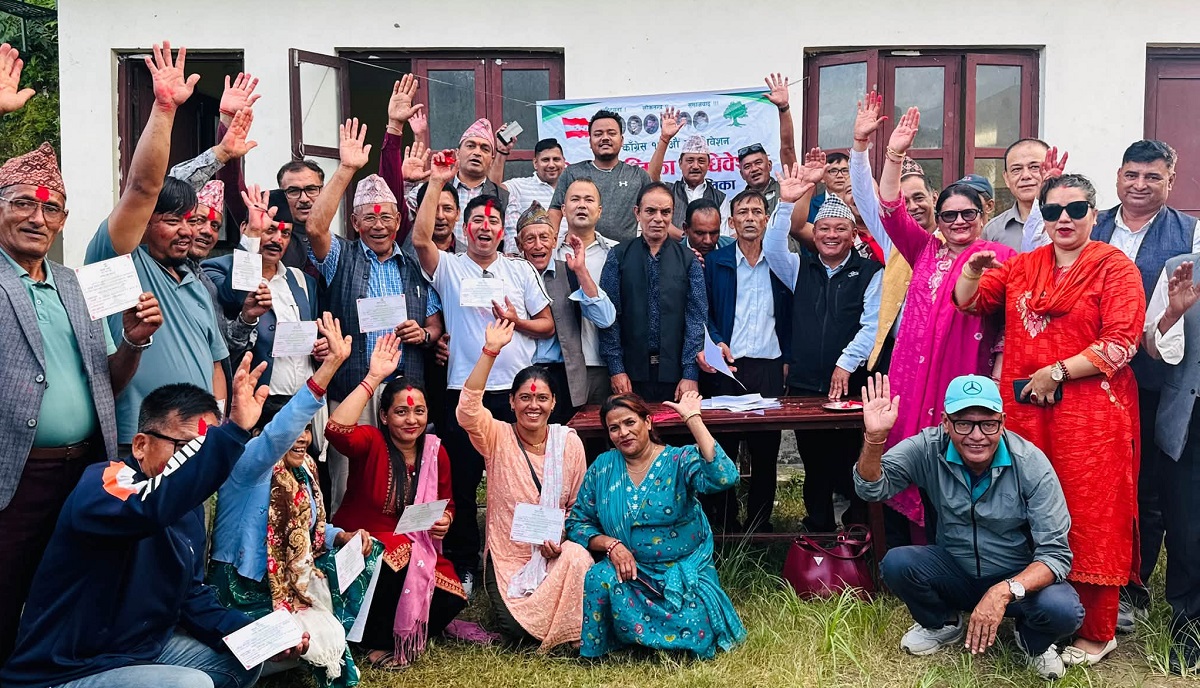
Most leadership positions at the ward level have been selected unanimously under the Nepali Congress’s 15th general convention. However, competition for leadership has begun to intensify as the convention process moves to higher levels.
Under the Nepali Congress’s ward structure, each ward has one president, two vice-presidents including one woman, one secretary, and one joint secretary. The treasurer is appointed by the president from among the ward committee members.
The ward committee also consists of 12 members: two women, three open-category members, one Dalit member, one youth member, and five nominated members.
Party leaders say competition at the ward level has been relatively low because the party’s amended statute, adopted through the special general convention held in January, provides for mandatory representation from different clusters.
In previous general conventions too, ward-level leadership was generally elected unanimously. A similar pattern has emerged in most wards this time. However, elections were held to select ward presidents in some places.
An election was held for ward president in Waling Municipality-13, Syangja. Ishwari Gaire was elected ward president, defeating Raj Kumar Gaire. Elections were also held in some other wards.
According to Prem Khadka, coordinator of the party’s central election committee, conventions have been completed in almost all wards. New working committees have been elected, along with constituency representatives.
“Leadership was selected unanimously in most wards. This is not something that has happened only now; it was the same in the past. Elections were held only in wards where consensus could not be reached,” Khadka told Setopati. “In some wards, elections were held only for office-bearers while members were selected unanimously. Rather than whether there was an election or consensus, what matters is how actively the active members participated. We found their participation encouraging.”
Khadka said that conventions have been completed and leadership selected in around 600 of the country’s 753 local levels, while conventions remain to be held in 153 local levels.
According to him, ward conventions have been completed in most districts in the Tarai, while municipal-level conventions are still pending. “The remaining ward and municipal conventions should be completed within a day or two,” he said.
In some districts, including Gorkha, provincial assembly constituency conventions have already moved forward and leadership has been selected.
Preparations are also underway to hold House of Representatives constituency conventions. Conventions have been affected in Kathmandu and some other districts because of continuous rainfall and Indra Jatra.
Notices have been issued postponing constituency conventions for a few days in districts including Dang, Syangja, Kaski, Tanahun, Kavre, Ramechhap, and Okhaldhunga.
According to the election committee, House of Representatives constituency conventions must be completed by September 27, with working committees and general convention representatives selected by then. The central election committee has already issued a circular to polling officers regarding the process.
The Nepali Congress’s 15th general convention will be held at Khula Manch in Kathmandu from October 2 to 5.
Competition appears to be increasing as the convention process moves to higher levels.
While leadership at the ward level has largely been selected through consensus, elections have begun at the municipal level. Competition is also expected in provincial assembly constituency conventions, House of Representatives constituency conventions, and the selection of general convention representatives and Mahasamiti members.
In the convention held in Bharatpur Metropolitan City last Wednesday, Buddhikanta Neupane was elected president. Of the 1,335 eligible voters, 1,232 cast their ballots. Neupane received 660 votes, while his closest rival, Jyoti Prasad Kandel, received 413.
An election was also held in Pokhara Metropolitan City, where Surendra Man Bijukchhe was elected president with 667 votes. Presidential candidates Santosh Paudel and Ganesh Thapa received 317 and 315 votes, respectively.
There were no elections in Kathmandu and Lalitpur metropolitan cities, where leadership was selected unanimously. Sushan Vaidya became president of the Kathmandu Metropolitan City committee, while Raju Maharjan became president of the Lalitpur Metropolitan City committee. Conventions in Birgunj and Biratnagar metropolitan cities are yet to be held.
Elections were also held in some sub-metropolitan cities.
Ram Krishna Koirala was elected president at the Hetauda Sub-metropolitan City convention. He defeated Kabin Sangami by nine votes. Of the 581 votes cast, Koirala received 284 and Sangami received 275.
Leadership was also selected through an election in Butwal Sub-metropolitan City. Jyoti Bhandari was elected president, defeating Jit Bahadur Malla. Of the 669 eligible voters in Butwal, 648 cast their ballots.
There are differences within the Nepali Congress between the leadership that emerged from the special general convention and the faction led by former party president Sher Bahadur Deuba. The Deuba faction is holding ward conventions on October 1 and proceeding with conventions at various levels before holding a parallel central general convention from December 7 to 9.
Against this backdrop, the Nepali Congress under the leadership of Gagan Thapa is reportedly making efforts to select leadership unanimously from the ward level to the center wherever possible.
"If we go for consensus, people will say leadership was handpicked by leaders from their pockets, and there will still be dissatisfaction. If we hold elections, there will be an opportunity for people to allege they lost because of the leaders at the top, and it may become easier for members to switch to the other faction," said an office-bearer. "Even so, efforts are being made to achieve consensus."
According to the office-bearer, competition is expected for central committee membership as well as the eight joint general secretary positions, two general secretary positions, and two vice-president positions. Under the amended statute, the Nepali Congress central working committee will have 231 members.
The competition is expected to intensify because members of the working committee formed after the special general convention in January are likely to seek reelection in the 15th general convention and some leaders who did not participate in the special general convention have now been nominated as central members and may seek office-bearer positions.
For the presidency, however, no one appears to have emerged so far to challenge Gagan Thapa.
The office-bearer also claimed that there would be no groups or sub-groups, no panels formed in the names of leaders, and no distribution of candidate lists during the convention.
Central election committee coordinator Khadka also said that elections would be held if consensus cannot be reached.
“It was almost unanimous at the ward level, but if there is no competition as we move higher up, then it would not really be a Congress party convention. In a democratic party, elections and competition are a good thing,” he said.
Central member Arjun Narsingh KC stressed that, given that 100 percent agreement and unity among general convention participants is unlikely, the party should readily embrace healthy, fair, and faction-free democratic competition.
“The true beauty of democracy lies in the free exercise of thought and judgment. Therefore, my humble but firm request is that this competition be kept completely free from any kind of undesirable interference, pressure, or tendency to impose thoughts,” he said.
He said that the convention should be made dignified, well-organized, and fully successful by rising above personal limitations, biases, and differences for the broader interests of the party, a balance between generations, and the strengthening of the organization.
The Nepali Congress is set to bring at least 21 young people into the central committee from among its general convention representatives aged 35 or below. The party also has provisions for central members representing various professional sectors, public liaison committees, and other groups.