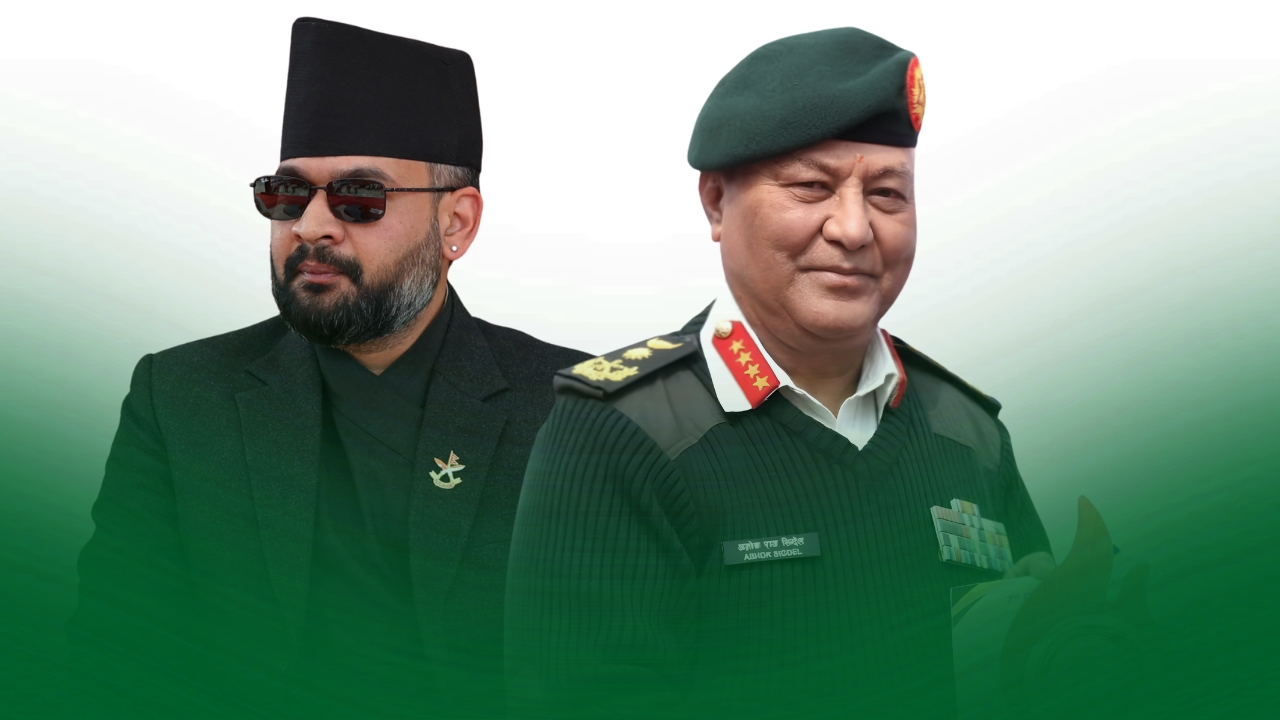
The government is set to establish a National Defense University for study and research on national security, defense, international relations, and strategic affairs.
A bill registered in the House of Representatives by Prime Minister and Defense Minister Balendra Shah gives the Nepal Army a primary leadership and decisive role in the university’s organizational structure, academic leadership, and management.
The university will be located at Perunge Danda in Banepa Municipality, Kavrepalanchowk. In 2019, the government led by then-prime minister KP Sharma Oli had formed an Infrastructure Development Committee to prepare for the establishment of the university. In line with that initiative, most of the physical infrastructure required for the university has now been completed.
The bill assigns the Nepal Army a role at several key levels of the university.
The chief of the army staff (CoAS) will be an ex-officio member of the “Senate,” which will serve as the university’s supreme body. The prime minister will serve as chancellor, while the defense minister will serve as pro-chancellor (co-chair). The Senate will approve the university’s policies, regulations, budget, and annual programs.
Similarly, the university’s Academic Council will include the director general of military training of the Nepal Army as an ex-officio member. The council will be responsible for matters such as determining curricula and setting admission criteria.
The Nepal Army will also have a role in selecting the university’s executive leadership.
A committee headed by the CoAS will recommend appointments to key positions such as vice-chancellor and registrar. The director general of military training of the Nepal Army will serve as member-secretary of the appointment recommendation committee. This gives the army a decisive say in the selection of the university’s leadership.
The bill also provides that a serving major general of the Nepal Army will be assigned as the commandant of the National Defense College, which will operate under the university. The Cabinet will assign the officer on the recommendation of the CoAS. The commandant will oversee the college’s day-to-day administration as well as its academic and teaching activities.
The bill allows personnel from the Nepal Army to be deputed to the university as part of the workforce required for its operation.
The university will also be able to directly grant affiliation to educational institutions associated with security agencies, including the Nepali Army Command and Staff College, Nepali Army War College, and Nepali Military Academy.
The bill says a specialized academic center is necessary to address geopolitical sensitivities and evolving security challenges, and to provide higher education and training to both military and civilian officials.
Nepal has been sending senior security officials and civil servants abroad every year for courses related to national security, defense, strategic studies, and war-college programs. The university aims to attract military and civilian security officials from other countries for higher education and training as well.
According to the bill, a Center for Strategic Studies and Research will operate under the university as a think tank. The bill claims that the institution will help reduce Nepal’s dependence on foreign consultants and foreign universities for defense and strategic matters.
It further argues that the university will develop defense knowledge based on Nepal’s geopolitical circumstances, domestic security challenges, and its own national context, thereby producing responsible human resources capable of protecting, strengthening, and promoting the national interest.
The university’s Senate will include senior government officials such as the chief secretary and the secretaries of finance, law, home affairs, foreign affairs, defense, and education. In addition, three members—including one woman—will be nominated from among experts in national security, defense, strategic studies, or diplomacy.
The university will also be able to grant affiliation, subject to meeting the required standards, to educational institutions associated with the Nepal Police Staff College, Armed Police Force Nepal Command and Staff College, and the National Investigation Department.