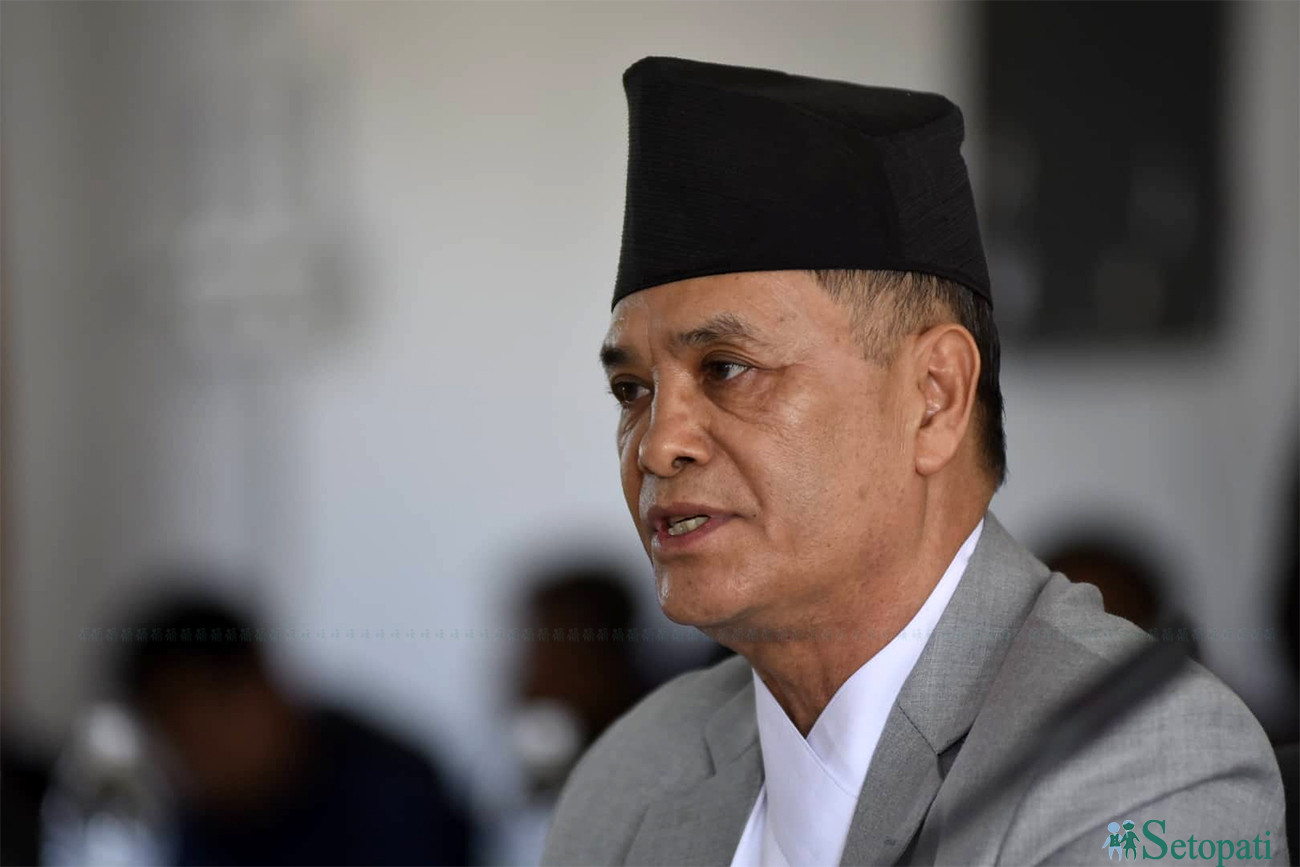
The arrest of former chief justice Cholendra Shumsher Rana by Nepal Police at around 3 a.m. on Sunday, and his continued detention under police control, has raised a number of questions.
Police are currently holding him at the Kathmandu Valley Crime Investigation Office in Teku. Nepal Police has so far made no official institutional statement about Rana’s arrest.
When journalists inquired, Senior Superintendent of Police SP Santosh Khadka, chief of the office, gave reasons for bringing Rana to the police office that have raised even more questions and suspicions.
Here are five important questions surrounding Rana’s arrest.
1. What kind of threat was serious enough that police could not provide security at his home and instead had to bring him to the Crime Investigation Office?
Police have said that Rana was taken into custody for security reasons, but they have not disclosed who posed the threat or what kind of threat he faced. Speaking to Setopati, SSP Khadka said that he could not discuss the security threat against Rana.
Informally, senior police officials have said that some Gen Z youths had posted threats against Rana on Facebook and that he faced a security threat.
The idea that a former chief justice would be taken from his home at 3 a.m. simply because someone claiming to be a Gen Z supporter issued threats on Facebook does not appear convincing.
Therefore, Nepal Police needs to officially and institutionally inform the public: Who posed what kind of threat to Rana that led to his arrest? Or, on what charge was he arrested?
If Nepal Police is unable to provide security to a former chief justice at his home as soon as he faces a threat, and instead has to take him to the Crime Investigation Office in the middle of the night, how can ordinary citizens trust that the police will or can protect them?
2. Was Rana informed about the security threat against him? Was he taken to the police office with his consent, or against his will?
When did Nepal Police learn that Rana was facing a security threat and needed protection? Surely, it did not learn about it in the middle of the night while everyone was asleep. It must have known about the threat by the previous day or by Saturday evening.
Did police inform him about the threat? Was he aware of it when police arrived at his home at night?
Did police take Rana to the Crime Investigation Office with his consent? How long is the threat expected to remain, and when will he be allowed to return home? What does Rana himself say about the arrest? Will he be allowed to make his position public? Are his rights to speak and express himself being protected?
3. What action did police take against those who allegedly posed a security threat to Rana?
Who are the people police say posed a threat to Rana? Have potential attackers been identified? Are they being searched for, monitored, or investigated? Apart from bringing the person who allegedly needed protection to the police office, what steps were taken to prevent the threat? Have those individuals been arrested?
Can police make information about those individuals public in the future? If they cannot, what will that mean for the credibility of the police?
4. Was the decision to arrest Rana made by the police or by the political leadership?
Was this an immediate decision by the police deployed at the scene, an order from senior police leadership, or a directive from political leadership? Where is the written record of the decision to arrest or provide security to him? Did police provide Rana with a written notice stating that he was being arrested or taken into protective custody?
Some police officials have indicated that Rana was taken into custody not on the basis of a police decision but on the instructions of senior political leaders.
If that is the case, the issue is even more serious. What wrongdoing did he commit? Who investigated him and established that wrongdoing? Which officer or institution conducted the investigation? Who instructed police to arrest him? Was it the home minister or the prime minister?
When issuing such instructions, did they provide police with evidence? And did police determine that the evidence was sufficient to arrest Rana, or did they unlawfully arrest him simply because an order came from above?
5. Did Rana’s controversial past and his current activities play a role in his arrest?
Rana is arguably the most controversial chief justice in Nepal’s judicial history.
As chief justice, he faced allegations not only of institutionalizing corruption and “judicial deviation” within the courts, but also of crossing the boundaries between the executive and the judiciary.
Rana became chief justice in January 2019. Three years later, he allegedly pressured then-prime minister Sher Bahadur Deuba to appoint “his person” to the Cabinet.
At the time, Deuba appointed Rana’s brother-in-law as a minister.
Following the incident, Supreme Court justices demanded Rana’s resignation, arguing that his alleged authoritarian conduct had crossed the limit and damaged the reputation of the judiciary. They decided to boycott his benches and refuse to hear cases assigned by him.
The justices’ protest ended after a lottery system was introduced for assigning cases, removing the chief justice’s authority to allocate cases. Rana stopped hearing cases after the lottery system was implemented.
As chief justice, he was also accused of facilitating “bench shopping” by colluding with litigants and assigning cases to benches involving judges they preferred, thereby institutionalizing judicial deviation.
In February 2022, an impeachment motion was registered against him in Parliament. Following the registration of the motion, he was suspended.
The current Chief Justice of the Supreme Court, Manoj Sharma, is not merely someone who was close to Rana. Rana played a major role in bringing Sharma to the Supreme Court. Comments continue to be made about the ongoing close relationship between Rana and Sharma.
Some have accused Rana of influencing certain recent court verdicts from outside the judiciary. Some have also remarked that Rana has revived from outside the court the “judicial deviation” that he had allegedly institutionalized while serving in the Supreme Court.
They believe that based on these reasons and information, Rana may have been arrested by the police in the middle of the night on political instructions.
The reason for Rana’s arrest may become clear in due course. For now, however, the central issue is whether he was arrested in accordance with law and due process, or whether, as police have claimed, he was taken into custody for his own protection.