Nearly five months have passed since the government evicted landless and squatter families living along Kathmandu’s riverbanks, but there is still no decision on when and where they will be provided permanent housing.
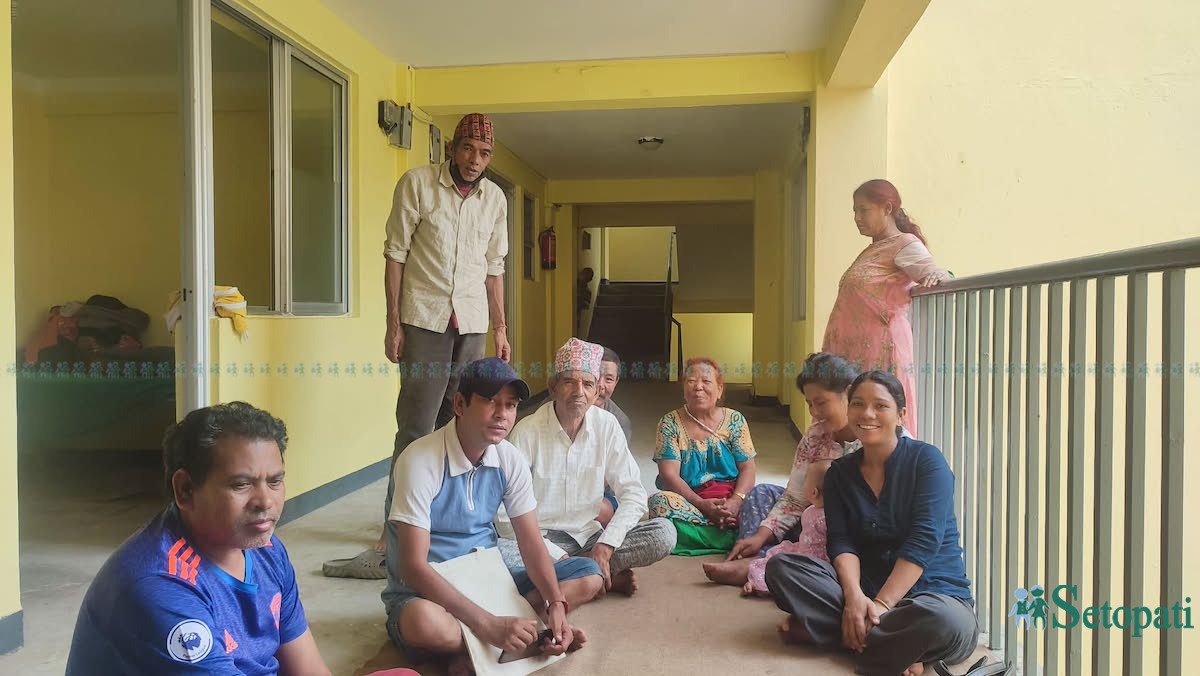
After the squatter settlements were cleared, 388 families were taken to five holding centers in different parts of Kathmandu.
Two of those holding centers have since been closed, while the remaining three currently shelter 108 families.
Meanwhile, the distribution of the self-management allowance announced by the government and the process of resolving the land problems of landless and squatter families have been delayed.
According to Top Bahadur Baniya, information officer at the High Powered Committee for Integrated Development of Bagmati Civilization (HPCIDBC), 102 people from 45 families are staying at the Ichangu Apartments in Nagarjun, 105 people from 42 families are at the Nepal Electricity Authority Training Center in Kharipati, and 65 people from 21 families are at the Bode holding center.
“Those staying at the holding centers currently have no complaints. Work is being carried out as needed,” Baniya said. “The problems of those remaining will also be resolved soon.”
The government had decided to provide Rs 25,000 as a self-management allowance to help the squatters staying at the holding centers arrange accommodation on their own, along with a monthly allowance of Rs 15,000 for some months.
Affected families, however, say the distribution of the money and the process of arranging permanent housing have not progressed as expected.
According to committee data, 2,608 people had registered for the self-management allowance. By August 16, 1,863 of them had received Rs 25,000 each. The budget set aside for those who had not come forward to collect the money by then was returned.
Baniya said that more than 150 people subsequently applied for the self-management allowance.
“Repeated notices were issued asking people to collect the self-management allowance,” Baniya said. “Some collected the money on time and left the holding centers. Some people came to submit applications only later.”
According to him, preparations are underway to provide the allowance to those who submitted new applications once the budget becomes available.
Many families who received the self-management allowance have already left the holding centers. Those still staying there include a large number of people who have been unable to find rooms, as well as sick and physically disabled individuals.
Although they have received the self-management allowance, none of the families has yet received the monthly Rs 15,000 that the government had also announced.
It is still unclear when the monthly assistance will begin and what procedure will be used to distribute it.
Question of permanent housing
Along with arrangements for temporary accommodation, the question of permanent housing for the displaced families also remains unresolved.
The HPCIDBC conducted a preliminary investigation into whether the displaced people owned houses or land along the riverbanks and forwarded their details to the Land Issue Resolving Committee.
According to the HPCIDBC, details of 2,082 people, including digital records of 1,694 individuals, have been forwarded to the committee.
“Some of them were found to have land, while the status of others is still being determined. That will become clear there,” Baniya said. “We believe the committee is carrying out its work.”
The collection and verification of details of the affected families are underway through the Land Issue Resolving Committee with the objective of providing land for permanent settlement. District-level committees are coordinating with the local governments concerned to move the process forward.
However, the HPCIDBC says the identification and management of genuine landless and squatter families have been delayed due to duplicate entries, incomplete documents, and other issues.
The permanent resettlement process will move forward only after the documents are verified by local governments and the records are finalized.
“Once the documents are verified and finalized by the local governments, the holding centers will be completely vacated and the way will be cleared for the permanent settlement of the displaced families,” Baniya said.
Children’s education at holding centers
The education of children from families staying at the holding centers has not been interrupted.
For children staying at the Ichangu Apartments in Nagarjun-1, arrangements have been made for them to attend a nearby early childhood development center for the time being. Manavsewa Ashram is managing food and snacks for them.
The Ichangu facility houses single women, single men, families with young children, and people with physical disabilities.
The families staying at Kharipati and Bode were initially housed at the Kirtipur holding center. They were moved to the two locations after the Kirtipur holding center was inundated.
Although the families were relocated to different holding centers, the children have not been transferred to new schools. Transportation has been arranged to take them to and from their previous schools.
There are more than 40 students at Bode and Kharipati combined. One school bus has been arranged for each location.
The HPCIDBC said that the buses were arranged to prevent potential psychological problems that children might face if forced to change schools repeatedly.
Although temporary accommodation has been arranged at the holding centers, the final destination of the displaced families remains uncertain.
They will be able to leave the holding centers permanently only after all three processes – self-management allowance, monthly assistance, and land management – are completed.