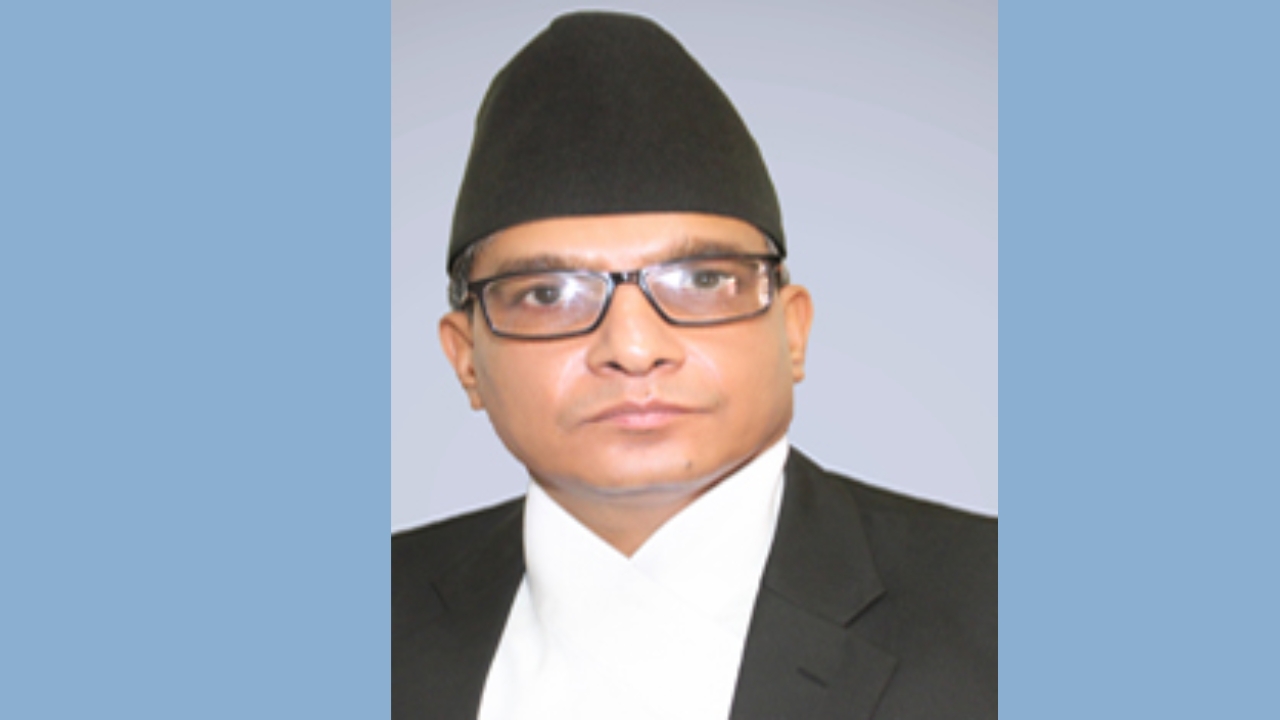
The Constitutional Council has decided to recommend Manoj Kumar Sharma for appointment as the chief justice of the Supreme Court.
National Assembly Chairman Narayan Dahal said that the decision was taken during a meeting held at the Office of the Prime Minister and Council of Ministers in Singha Durbar on Thursday afternoon.
He noted that except for himself and Bhishma Raj Aangdembe, parliamentary party leader of the main opposition Nepali Congress, all other members voted in favor of Sharma.
The Constitutional Council consists of the prime minister, speaker of the House of Representatives, chairperson of the National Assembly, deputy speaker, leader of the opposition, and the law minister.
Having been active as an advocate for a long period, Sharma reached the Supreme Court after progressing through various levels of legal practice, research, and judicial responsibilities.
The Constitutional Council decided to recommend Sharma, who is fourth in the seniority ranking, bypassing Acting Chief Justice Sapana Pradhan Malla, Kumar Regmi, and Hari Prasad Phuyal.
Born in Birgunj in 1970, Sharma completed his initial legal education (BL) at Nepal Law Campus, and later obtained an LLM degree from Pune University in India. He holds a PhD in labor law from Tribhuvan University. His specialized interest and research in labor law have established him as a legal expert with a profound understanding of the field.
Registered as an advocate in 1995, Sharma practiced in various legal sectors for over two decades. He also played an active role in commercial law practice, providing legal consultancy to private sector companies and organizations.
His formal entry into the judiciary began at the appellate court, where he served as an additional judge from June 10, 2013, to December 12, 2015. During that period, he gained significant judicial experience presiding over various types of cases.
Sharma is a regular participant in national and international legal conferences and discussions, keeping him connected with contemporary legal debates and international practices.
He was appointed as a justice of the Supreme Court on April 19, 2019. Since then, he has been performing judicial duties at the apex court.
His combined experience in legal practice, teaching, and judicial service has established him as a seasoned and prominent figure within Nepal’s judicial sector.
Sharma to serve full six-year term
The recommendation will now undergo a hearing by the Parliamentary Hearing Committee. If Sharma’s name is endorsed, he will serve a complete six-year tenure.
Article 129 (4) of the Constitution stipulates that the term of office for the chief justice shall be six years. An age-limit of 65 years has also been set for the chief justice.
Born on June 18, 1970, Sharma is well within the age limit. He is expected to retire after completing his full six-year term before reaching the age limit.
The previous chief justice, Prakash Man Singh Raut, retired after reaching the age of 65.
Two members register note of dissent
Two members of the Constitutional Council submitted a note of dissent against the decision to recommend Sharma as chief justice.
National Assembly Chairman Dahal and NC parliamentary party leader Angdembe registered their dissent, arguing that Sharma was selected by bypassing seniority.
Dahal said that they opposed the decision because it broke with the long-standing tradition and procedure of recommending the senior-most justice of the Supreme Court for the position of chief justice.
“There had been an established practice of recommending the senior-most justice for chief justice. We submitted our written dissent, stating that we could not agree with this sudden breach of tradition and procedure to recommend the fourth-ranked justice for chief justice," Dahal said.