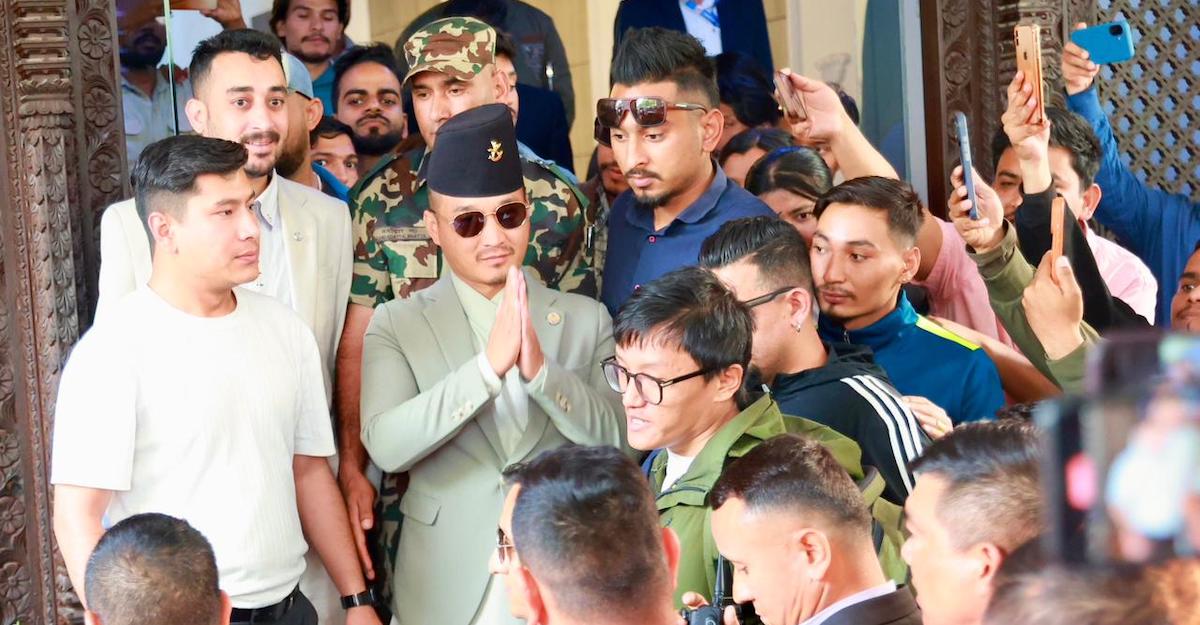
Sudan Gurung resigned from the post of home minister on Wednesday after landing in controversy over the source of his share investments exceeding 40 million rupees and his alleged business partnership with Deepak Bhatta, who is in custody for money laundering investigation.
After his resignation, there has been growing interest in how the investigation against him will proceed.
Writing on Facebook on Wednesday, Gurung stated that he would cooperate with the investigation on him. "To ensure an impartial investigation into the matters related to me, and to prevent any conflict of interest or perceived influence while holding office, I have resigned from the post of home minister effective today," he wrote.
Since his resignation, the government has not appointed a successor. Prime Minister Balendra Shah is currently handling the Home Ministry portfolio himself. Some have interpreted this as a sign that Gurung could return to office if no wrongdoing is found against him.
Amid all this, questions remain about how the probe into Gurung’s share investment sources and other financial transactions will move forward.
So far, no formal complaint has been publicly filed against him, leaving the exact nature of the investigation unclear.
In this context, we have examined four possible ways in which an investigation against Gurung could proceed.
The source of Gurung’s assets came under scrutiny after the Office of the Prime Minister and Council of Ministers released the asset details of Cabinet members on April 12. In his disclosure, Gurung reported shares worth Rs 27,456,200 in publicly traded companies but did not specify the companies.
It later emerged that Gurung held shares in two micro-insurance companies involving investments from businessman Deepak Bhatta, who is currently in the custody of the Department of Money Laundering Investigation (DMLI), and the Shanker Group. Reports revealed that Gurung held shares worth Rs 2.5 million each in Star Micro Insurance and Liberty Micro Insurance, both linked to Bhatta and the Shanker Group.
Additionally, he disclosed 30,000 shares worth Rs 3 million in Hope Holdings Pvt Ltd, 57,000 shares worth Rs 5.7 million in Lagom Premium Apartments, and 70,000 shares worth Rs 7 million in Adventure Villa Pvt Ltd. The source of investments in these unlisted companies also remains unclear.
As the controversy grew, Gurung issued a clarification on Monday, claiming he had "purchased the shares by taking loans." To support his claim, he mentioned the same two companies that had already been reported in the media.
Since he appears to have a partnership with Bhatta – who is already under a money laundering probe – the DMLI could investigate Gurung.
Moreover, it was previously revealed that Bhatta (chairman of Infinity Holdings), Sulav Agrawal (vice-chairman of Shanker Group), Sahil Agrawal (managing director of Shanker Group), and others had supported Hami Nepal, an organization founded by Gurung.
Based on this, the DMLI could investigate the financial transactions of both Hami Nepal and Gurung as part of its ongoing probe against Bhatta.
Gurung himself has acknowledged that Bhatta donated to Hami Nepal. If it is established during the investigation that Bhatta donated money earned through criminal activities to launder illicit funds, the Hami Nepal organization would also come under investigation, implicating Gurung.
According to the definition of money laundering, funds earned through criminal activities are considered “black money.” A criminal groups may invest such money in various ways to legitimize it. If it is proven that Bhatta transferred such funds through various banking channels or companies to Hami Nepal to launder money, Gurung could come under investigation.
Second, another investigation into Gurung could be conducted through a parliamentary probe committee.
A parliamentary probe committee has the authority to investigate the assets of a controversial minister. There are precedents where ministers have resigned to cooperate with such investigations.
In 2022, when Sher Bahadur Deuba was prime minister, Janardan Sharma was the finance minister. Sharma was accused of involving unauthorized individuals in the budget-making process. Amid the controversy and pressure, he resigned on July 6 that year.
A parliamentary probe committee later submitted its report, stating that no evidence was found of such involvement.
After receiving a clean chit from the committee, Sharma was reappointed as finance minister.
Based on this precedent, Parliament could also form a committee to investigate Gurung’s assets. However, since the ruling Rastriya Swatantra Party (RSP) holds a majority in Parliament, it depends on whether it wants such a committee and whether opposition parties will raise the issue strongly.
If such a committee is formed, it will decide whether further investigation is necessary, and the process will move forward accordingly.
The RSP’s disciplinary commission could also investigate him, though such an investigation is not legally binding.
Earlier, the party’s disciplinary commission recommended the dismissal of then labor minister Deepak Kumar Sah. He was accused of misusing his position by continuing his wife as a member of the Health Insurance Board.
The party’s disciplinary commission initiated an investigation soon after questions were raised about Sah. Based on its recommendation, Prime Minister Balen Shah dismissed Sah.
Based on that precedent, the RSP’s disciplinary commission could investigate Gurung as well. However, unlike in Sah’s case, the commission has not yet started such a process against Gurung, nor has the party provided any official information regarding this.
The government has formed an asset investigation commission headed by former Supreme Court justice Rajendra Kumar Bhandari to investigate the assets of high-ranking officials since 2006. The commission received its mandate on Wednesday and has already begun its work.
Experts say this commission, which has been given one year to complete its investigation, could also investigate Gurung’s assets.
The commission has said that it will investigate the assets of officials who have held high state positions between 2006 and 2026 in the first phase. However, it is not clear whether the current Cabinet falls within its jurisdiction.