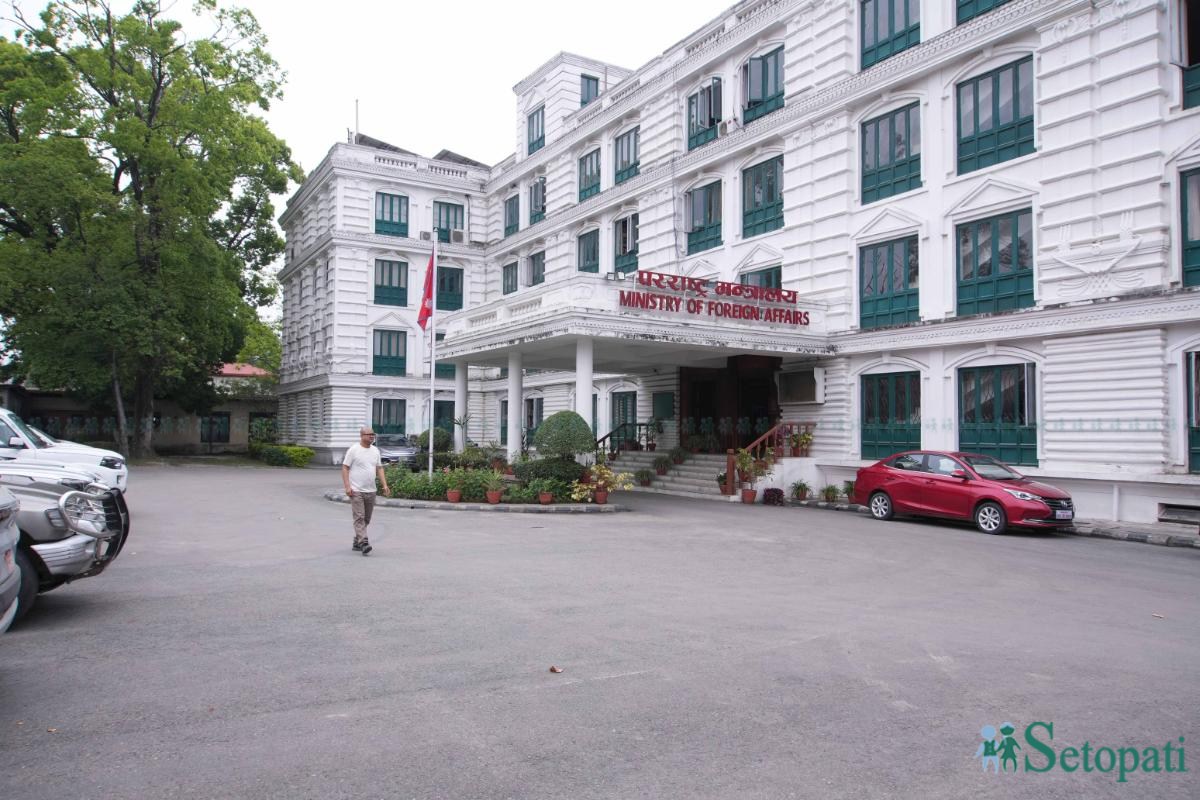
The Ministry of Foreign Affairs (MoFA) has issued a clarification regarding Prime Minister Balendra Shah's statement in the House of Representatives on Sunday that "Nepal has also encroached upon India’s land."
Responding to questions raised by lawmakers regarding border disputes with India, PM Shah had said: "I learned after becoming prime minister that it is not just India that has encroached on Nepal's land, Nepal has also encroached on India’s land in many places."
The Foreign Ministry stated that the issue mentioned by the prime minister in Parliament primarily relates to no-man’s-land encroachment and cross-border occupation, meaning the usage of land across the border.
"Due to the adoption of the Fixed Boundary Principle in riverine border areas during the demarcation of the Nepal-India border, a situation of cross-border occupation exists, where citizens of one country cultivate and reside on land that falls within the territory of the other country," the ministry said in a press release.
MoFA further said that bilateral border mechanisms and technical teams from both countries are actively working to map the long Nepal-India border systematically and scientifically, constructing and repairing border pillars, and collecting data on encroachments in no-man’s-land areas and instances of cross-border occupation.
The ministry said that the work of the technical committee, which had been stalled for a long time, is currently active, and the process of joint data collection is underway.
According to MoFA, studies by the technical committee have shown that in some places, land currently being used and occupied by Nepal may fall within India, and conversely, land currently being used and occupied by India may fall within Nepal.
"The statement made by the honorable prime minister in Parliament that 'in some places, Indian land may be on the Nepali side' is connected to this technical reality and cross-border occupation," the release clarified.
The government also reiterated its commitment to resolving border-related issues through diplomatic dialogue on the basis of historical treaties, agreements, and maps, in line with the spirit of the close relationship between Nepal and India.
The government had sent diplomatic notes to both India and China regarding the issue of India operating a Manasarovar pilgrimage route through the Nepali territory of Lipulekh. A response was received from the Indian government through a diplomatic note, and both countries have expressed their commitment to resolving border disputes through diplomatic channels and mutual discussion, the press release said.
"It is well known that Nepal and India share a centuries-old, long, and open border. Nepal’s current international border is established and guided by the 1816 Sugauli Treaty. Nepal-India borders are yet to be mapped in Susta, Limpiyadhura, Lipulekh, and Kalapani areas. Besides these places, issues of cross-border occupation and no-man’s-land encroachment exist in some other locations," the statement said.