Questions have been raised after Secretary Krishna Hari Pushkar of the Vice President’s Office was taken in by the Kathmandu Valley Crime Investigation Office on Thursday afternoon and released at around 10 p.m. the same night.
Sources claim that Pushkar had sent a message to Prime Minister Balen Shah on his personal mobile number, stating that he sought necessary guidance as he wished to apply for an ambassadorial position.
This has sparked debate over whether a serving secretary can be detained and questioned by police merely for sending such a message to the prime minister.
Is sending a text message to the prime minister’s personal phone number an offense serious enough to warrant police questioning? Under whose instruction and on what basis was Secretary Pushkar brought in?
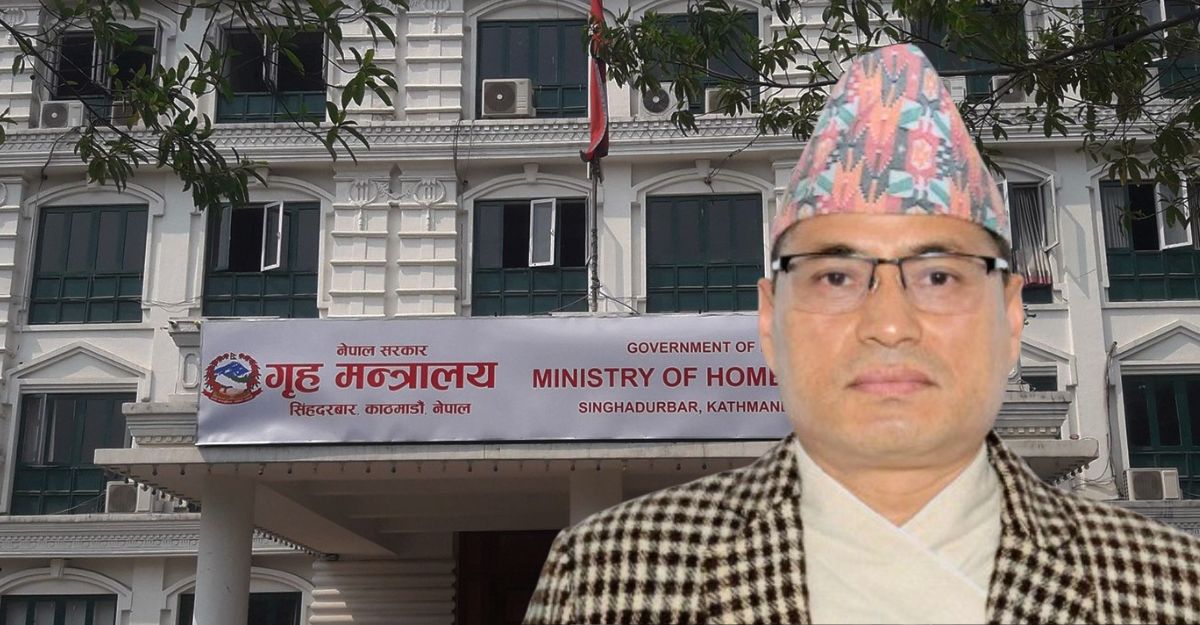
In an interview, Home Secretary Ram Kumar Shrestha responded to these questions.
Secretary Krishna Hari Pushkar of the Vice President’s Office was apparently taken in by police yesterday and later released. Why?
This matter is not exactly as it has been portrayed publicly. He was neither arrested, nor detained. He had apparently sent a message to the prime minister on his mobile number. He was only called in to inquire about it.
What message did he send to the prime minister?
I have not seen it myself. I have only heard about it. It was a personal matter.
Should a secretary be detained by police as soon as they send a message to the prime minister?
Police did not take detain him. It was only an inquiry to gather information. Questioning is a normal procedure.
He is a sitting secretary. If it was a personal message, couldn't the prime minister have called him to ask why he sent it?
When a message is received, one either inquires about it themselves or asks someone else to look into what it is about. That is all.
If the police go to his home, bring him to the police office, and hold him for hours for questioning, doesn't that constitute police custody? It is being said that he was released after questioning because police found no grounds for further action.
That depends on how one chooses to present the situation and the terminology used. As I understand it, the intention was only to understand why the secretary had sent the message and what it was about. It was not viewed as a punitive action. It would be clearer if you asked Pushkar sir himself.
Did you order the police deployment on the prime minister’s instruction after he received the message?
That is not the case.
Then did the directive not come through the official chain of command from the Prime Minister’s Office? How did the police suddenly arrive at Krishna Hari Pushkar's home?
A high-ranking police officer surely did not go to deliver the notice asking him to appear.
For summoning a serving secretary for questioning by police, isn't there supposed to be a chain of command for passing instructions down to the lower agencies through home secretary and the police chief? Or did the prime minister call a lower-level police officer directly and order them to bring the secretary in?
I have nothing to say about that. All I will say is that it is not as it has been reported in the news – that the secretary was detained or arrested. It was a routine inquiry. If the police notify anyone to come in for an inquiry, they must go; I would have to go myself.
If it was a simple message from the secretary, shouldn't the prime minister have asked him directly, or warned him if he was dissatisfied?
Look, if someone sends me a message, there are two ways to inquire about it. I can either ask them myself, or I can ask someone else to find out what it is about.
Is asking someone else to inquire the same as deploying the police?
Let’s leave it at that. Whatever else is said, this is how it is.