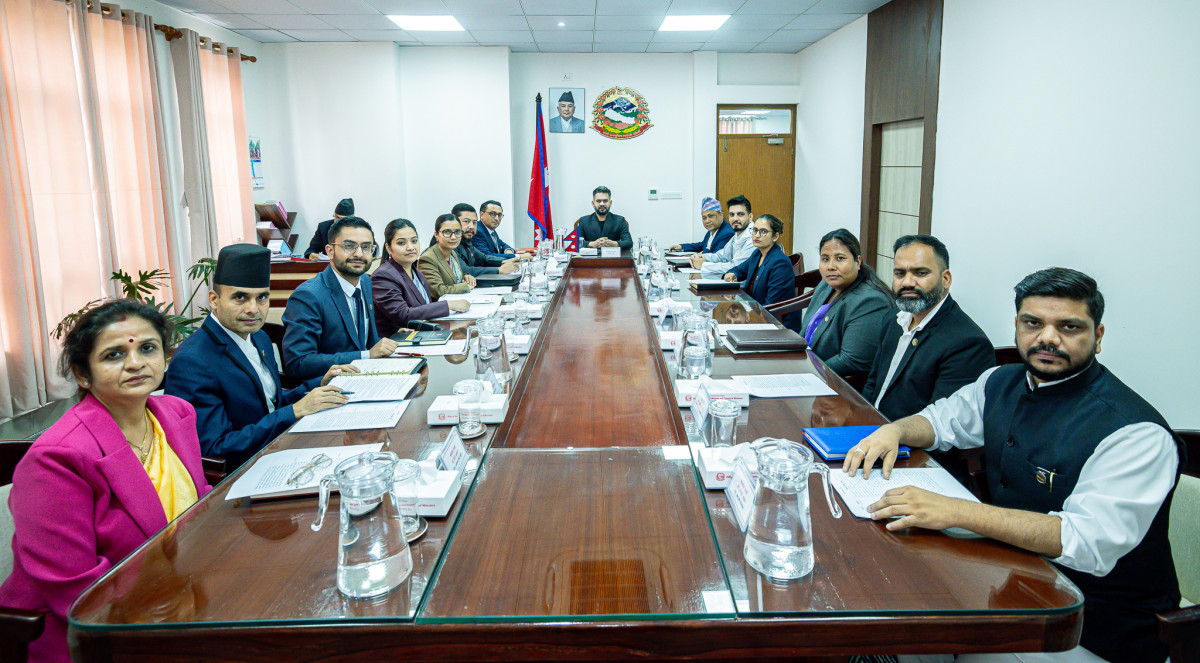
The government led by Prime Minister Balen Shah has come under scrutiny for granting a mandate to the High-level Asset Investigation Commission that excludes current ministers and lawmakers elected to Parliament for the first time from asset investigations.
When the government announced the formation of this commission, and even when it made the decision and issued a formal notice, it had stated that the first phase of investigations would cover individuals who had held high-ranking state positions between 2006 and April 13, 2026.
However, contrary to those announcements, the mandate given to the commission on April 15 specifically exempts members of the current Cabinet and individuals serving in Parliament for the first time from asset investigations.
This provision effectively shields Prime Minister Balen Shah, several Cabinet members, and many lawmakers in the current Parliament from scrutiny regarding their assets.
One of the leaders of the Gen Z movement, advocate Monisha Chaudhary, says the government's decision is not logical from any perspective.
According to her, one of the key demands of the Gen Z movement was to investigate the assets of people who had attained high public office. That demand did not distinguish between new and old political leaders.
"While drafting the agreement between the Gen Z group and the government, we had said that because corruption is a structural issue, the assets of everyone connected to this structure must be investigated," she said. "We had not said that newly elected or newly appointed officials should be exempt from scrutiny."
She said that after the property details of the new ministers were made public, it is clear how important it is to investigate their assets.
"Looking at the asset details disclosed by the new ministers, it has become even more important to investigate them," she said. "At a time when questions are already being raised about whether the current ministers had acquired those assets legally, it is not good to exclude them from asset investigation."
She continued: "They have not clearly explained how much of their wealth comes from legitimate income and how much is inherited property. Such a broad benefit of the doubt is not allowed in politics anywhere. Therefore, we cannot simply assume that all new leaders are honest. State funds are a sensitive matter. Since they are generated from taxpayers' money, it is essential to examine whether anyone has misused them."
Chaudhary believes such investigations are crucial for establishing a long-term foundation for good governance.
Senior Advocate Raju Chapagain also views this behavior as a "tendency to seek immunity for oneself while demanding accountability from others." He argues that such a mandate weakens the commission’s legitimacy.
"It cannot be argued that new parliamentarians or ministers have not misused state power in the past or will not do so in the future," he said. "Even someone who holds office for a single day can misuse power. Therefore, they too should be brought within the scope of investigation."
Chapagain said that the government should still amend the mandate to ensure that all members of the current Cabinet and Parliament are held to the same standard of accountability and brought under the scope of asset investigation. "It would be even better if nothing is found during the investigation," he added. "The main issue is good governance. Whatever promotes good governance should be done. If the commission proceeds according to the current mandate, it will not be good governance-friendly."
Setopati attempted to ask government spokesperson Sasmit Pokharel why the mandate excludes current ministers and first-time lawmakers, he could not be reached, as his phone was switched off.
When asked about it, Prime Minister Shah's press advisor Deepa Dahal said that she did not have official information regarding the matter.
Attempts were also made to contact Hemraj Sharma, spokesperson for the Prime Minister's Office, but he did not answer calls.
Earlier, commission member Ganesh KC told Setopati on Tuesday that the commission's mandate does not include investigating the assets of first-time members of the current Parliament or Cabinet.
"The commission will not investigate individuals serving for the first time in the current Parliament or Council of Ministers. However, lawmakers who have been elected to Parliament for a second term will be investigated," he said. "The assets of Cabinet members have already been made public. But we have not even asked for asset details from the new lawmakers. That is not in our mandate."
When asked why sitting ministers and lawmakers elected on March 5 would be excluded despite the government's public notice stating that all individuals who had held high office until April 13, 2026, would be investigated, KC replied:
"The mandate given to us by the government does not include investigating their assets. However, if a complaint is filed against any of them, we will investigate."
In the first phase, the commission will investigate the assets of individuals who have held high public offices since 2006.
These individuals include prime ministers, ministers, Constituent Assembly members, members of Parliament, province chiefs, chief ministers, provincial ministers, mayors/chairs and deputy mayors/vice-chairs of local governments, former judges, former high-ranking officials of the Nepal Army, former and serving secretaries, former and serving joint secretaries, attorneys general, chief attorneys, provincial lawmakers, former and serving ambassadors.
The commission will also examine whether they have held assets in the names of family members or relatives.
In addition, it has been granted the authority to examine the financial status of relatives of these high-ranking officials who reside abroad.