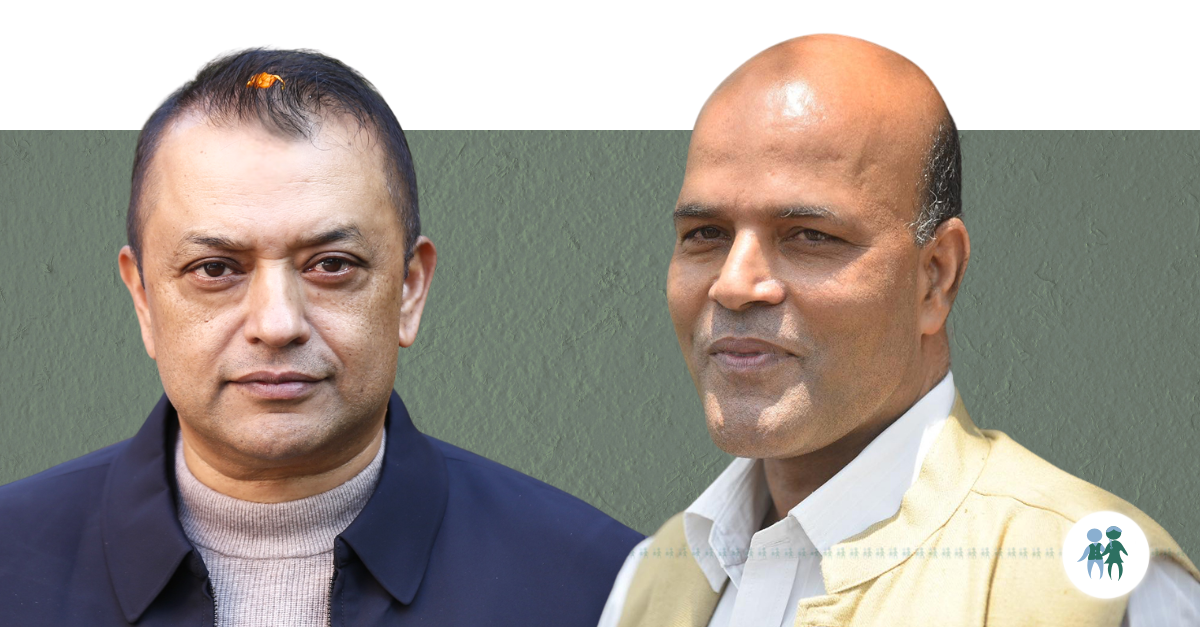
The Setopati team, which has been on a continuous election reporting journey for three weeks, has now arrived at the 11th constituency. In the meantime, traveling through various constituencies including those in Kathmandu, Bhaktapur, Chitwan, Dang, Rupandehi, Dhanusha, and Saptari, we have already written an electoral analysis of Jhapa-5, where the attention of voters across the country was focused during this election. In this final stage of our reporting journey, we have arrived at another constituency where the attention of voters nationwide is also concentrated. This is because Nepali Congress (NC) President Gagan Thapa is contesting from here this time. Amresh Kumar Singh, who has already won elections from this constituency three times, is competing this time representing Rastriya Swatantra Party (RSP).
We reached every ward of every local body within Sarlahi-4 and spoke with approximately one thousand voters. Based on our analysis of conversations with voters, there is a tough competition here between Thapa and Singh. The Setopati team has visited many constituencies during this election to talk to the people and understand their inclinations, providing detailed analyses for 11 constituencies. Among all these constituencies, Sarlahi-4 was the one where we faced the most difficulty in conducting conversations and electoral analysis.
Let’s first discuss why we encountered so many difficulties and challenges here, as it also explains what our readers should expect regarding the election results.
We primarily faced three challenges. First, the language problem. To write a series of electoral analyses, we talk to as many voters as possible individually about the competing parties, their candidates, and their opinions so they can speak openly, express their views without hesitation, and say who they intend to vote for. We went to speak with local voters in every ward of every municipality within Sarlahi-4. However, we faced a significant language problem in many wards here. Many voters hesitated to speak alone, and in some places, if we tried to talk to one person, other people would immediately gather.
When entering the villages and rural areas of Balara Municipality, Gaudaita Municipality, Ramnagar Rural Municipality, and Dhankaul Rural Municipality—located nearly 50 kilometers south of the Mahendra Highway near the Indian border—clear communication was not possible with most voters due to language barriers. Except for the youth and children, most older male and female voters were not comfortable speaking in Nepali language. Among them, it was particularly difficult to make the women understand our questions. Some spoke Maithili, while others spoke Bhojpuri. In such cases, we used the village youth and children who understood Nepali as interpreters.
When the youth and children explained the sense of our questions in the local language, they would often urge, "Say bell, say bell." Some would say "Yes, yes," while others seemed confused. As we continued talking, some changed their statements. We found a trend here where if you start talking to a voter on the road or on a porch, another person or neighbor immediately arrives. This might be part of the culture rather than an attempt to influence anyone, but we felt many times that the voter we were talking to became uncomfortable expressing their true thoughts.
Second, compared to other constituencies, we found many voters in Sarlahi-4 who made collective decisions rather than individual ones. We found that the "control" of villagers or village headmen (ward chairs) over votes is significant. When we asked "Who will you vote for?" many voters gave the name of their headman and said, "Ask that person." Some even said, "Go to that house, we will vote wherever he tells us to."
We also went and spoke with the individuals or houses indicated by those voters. Some headmen said "tree," while others said "bell." That was not just their personal vote, it was a signal of where the vote of the entire village or neighborhood would go. Our dilemma was whether to accept that as how many people were voting for whom and how to adjust that in our election analysis.
While roaming the villages and neighborhoods of this constituency, we once even witnessed a discussion between a headman who won from one party and a cadre from another party. When we reached a house, an elderly man was discussing something with a woman there. We did not understand the conversation happening in the local language. Later, we walked out with the woman and asked who she wanted to vote for. In response, she said, "I am a Maoist. My vote goes to star (NCP). But the headman is trying to pull me and my friends to his side. He has been trying for a few days. We were discussing that when you came inside the house."
"And what was the conclusion?"
"I don't know what other friends will do, but I will vote for star," she said with a laugh. "In fact, I told the headman to bring his people and vote for star instead."
Some locals also told us that the decisions made by headmen and village elites at the last moment determine where a good number of votes will go. Some said many things would be decided on Tuesday, "the day of Holi."
This does not mean that voters here do not make decisions with their own conscience individually. Most of the around thousand voters we spoke with told us who they would vote for and why. However, we also found that a significant number of voters decide collectively. Some people told us that in many other constituencies of Madhesh, voters decide collectively and at the last moment. In Rajbiraj, which falls under Saptari-2, an elderly told us, "Here, voters only decide two days before. You came a bit early to talk about the election."
However, in the Madhesh constituencies where we wrote election analyses—whether it be Dhanusha-3, Saptari-2, or Saptari-3—the margin between the first and second candidates in our analysis is so wide that voters making last-minute collective or individual decisions do not seem to make much difference in the election results. But in places with tough competition, decisions made by voters at the last moment or the influence of village headmen and elites can make a difference.
There is a third reason why it was difficult to assess who would lead the final competition in Sarlahi-4. We found that many voters here intended to cast their direct and proportional votes differently. Many told us this. They said village headmen told them to cast one vote for tree (NC) and another for bell (RSP). However, we found they were confused about which vote to cast for tree and which for bell.
For example, when asking a female voter in Godaita Municipality who she would vote for, she initially said bell. When asked who was standing from bell, she said, "Balen Shah is the candidate, isn't he?" When we told her that Amresh Singh was contesting with the bell symbol here, she said, "No, no, I'm not voting for Amresh." Then she said, "I will give one vote to Gagan Thapa and the other to Balen Shah." She mentioned she didn't know which vote was for Gagan and which was for Balen.
Like her, some voters here said they would give one vote to bell and the other to tree. Due to the language barrier, we did not have the opportunity or ease to speak repeatedly with all voters in this manner. We feel that the votes voters here want to cast for the direct and proportional representation (PR) categories might get mixed up. Despite these challenges in clearly analyzing voter trends, after reaching every ward of every local level in Sarlahi-4 and talking to about a thousand voters, we found a tough competition specifically between NC’s Thapa and RSP’s Singh.
Sarlahi-4 constituency includes wards 1 to 4 and 13 to 15 of Barahathawa Municipality and wards 1 to 12 of Godaita Municipality. Similarly, it includes wards 1 to 7 of Dhankaul Rural Municipality, wards 1 to 11 of Balara Municipality, wards 1 to 7 of Basbariya Rural Municipality, and wards 1 to 4 of Bishnu Rural Municipality. Candidates including Thapa, Singh, Amanish Kumar Yadav of CPN-UML, Rajnish Raya Yadav of Nepali Communist Party (NCP), Rameshwor Raya Yadav of Janata Samajwadi Party (JSP), and Rakesh Kumar Mishra of Janamat Party are competing in the constituency.
We found that no candidates other than Thapa and Singh are even in competition. Compared to these two, Amanish of UML is far behind, and other candidates are even further behind him. Regional parties doing politics centered on Madhesh—the Upendra Yadav-led JSP and the CK Raut-led Janamat—also do not seem to have any influence here this time. The reason for this is that, like in other constituencies of Madhesh, voters here have chosen Balen Shah as their leader instead of other Madheshi leaders and parties.
In this constituency with 121,000 voters, about 10 percent of those we spoke with have not yet decided who they will vote for. In our analysis, since there is a narrow competition between Thapa and Singh, the decision of undecided voters could make a difference in the election result. Since there is only a small margin between the two, our analysis suggests that if voters who previously voted for Singh or NC open up to one side by the election day, that too could shift the outcome.
We have seen that Thapa will likely retain many voters who voted for NC last time in this constituency. This is his strongest point. Besides that, he has also pulled a large portion of traditional NC voters who voted for Singh last time. Singh will also pull some voters who voted for NC previously. However, when analyzing the voters he pulls from NC versus those going from his side to NC, he will be at a loss. Because Singh's popularity has decreased, his votes are also leaking. Voters are angry with him, saying he won three times from this constituency but could not do much. We found more voters criticizing his habits than praising them.
When we spoke to voters in every ward of every local body in Sarlahi-4, most did not say very good things about Singh. Some voters in Balara Municipality, where his home is, mentioned that roads were built in the village and a technical school was opened. However, many criticized him, saying that despite winning repeatedly, Singh did not do much for development. They also mentioned that the state of infrastructure like education and health in the village is very weak. Not only this, many commented that Singh, who does not hesitate to "bow at the feet" of voters during election time, "does not even pick up the phone" of locals after the election.
"Not even five percent of the people here want to vote for Amresh. But the coincidence this time is that he is the RSP candidate. He represents Balen Shah," said 66-year-old Bachcha Jha of Godaita Municipality 7. "The people of Sarlahi-4 are not voting for Amresh this time, they are voting for Balen Shah."
He added, "We would have voted for whoever stood with the bell election symbol."
Currently, there is such a huge "craze" for Shah in Madhesh that voters here do not care about the party called RSP, nor its President Rabi Lamichhane, nor any of its candidates. They only recognize Balen Shah and his election symbol, bell. Most Madheshi youth voting for the first time are attracted to Shah.
In this way, the "Balen factor" has compensated for Singh's weaknesses and made him a strong competitor this time. Because of Shah, many voters who previously voted for the Maoists, UML, Janamat Party, and JSP are attracted toward RSP. This is a "plus point" for Singh. We found that some votes from the Maoist party will also go to NC. UML voters, especially the old ones, are mostly firm with their own party. To understand the politics of this constituency, one must also look at the status of the parties in the previous election.
Sarlahi-4 is considered a traditional NC stronghold. Since Mahantha Thakur, who won three elections between 1991 and 1999, left NC, Singh had been contesting from this constituency. He won the 2013 and 2017 elections from NC. In the First Constituent Assembly election held in 2008, however, Shivpujan Raya of the then Madheshi Janaadhikar Forum was victorious. In the 2022 election, Nagendra Kumar became the NC candidate through the ruling alliance including the then CPN (Maoist Center). While Nagendra got 18,253 votes, Singh, who contested as an independent candidate, won with 20,017 votes.
Congress was first in the PR category. While Congress secured 16,029 votes, Janamat Party received 12,595 votes. The Maoists, at the third place, secured 9,790 PR votes. NC won the most wards in this constituency in the last local election as well.
While NC won 19 wards, Maoist Center (now NCP) won 12. Similarly, UML won 10, Loktantrik Samajwadi Party (LSP) eight, and JSP two. NC also has the most votes among the votes received by these ward chairs. The votes received by NC ward chairs are 23,143, while Maoist ward chairs are second with 18,524 votes. RSP, meanwhile, was not even in the competition here in the last general election. At that time, RSP candidate Dhiraj Thakur got only 306 votes. The PR votes received by RSP were only 1,199.
In any constituency of Madhesh, who or which party traditionally had influence has not meant much in this election. The "Balen factor" has overturned the traditional political balance of power in Madhesh. Since NC President Thapa himself is the candidate in Sarlahi-4, it appears he will "hold" most of the NC voters. This is the main reason he remains in strong competition in this election. Besides that, some youth voting for the first time in this constituency are also attracted to Thapa. In other constituencies of Madhesh, almost all youth voting for the first time have moved toward the RSP because of Balen Shah.
Some voters who voted for the Maoist party last time here also said they would vote for NC. Therefore, it is difficult to say who will win in the final results. Among the 11 constituencies we analyzed, we saw such a narrow competition only in Kathmandu-3 and Sarlahi-4. In all other nine constituencies, RSP candidates have a clear lead. In the closely contested two constituencies, the margin between the two main candidates is similar, and in our analysis, Singh is ahead by a slim margin in Sarlahi.
However, the final result could go in anyone's favor. There are additional challenges to analyzing who will be ahead in the final race in Sarlahi-4, which we have discussed extensively above.
In such a narrow competition, individual voters or collective voters deciding at the last moment make a big difference in the election result. We have also seen that it will be important what other candidates in this constituency who are certain that they are losing the election decide at the last moment. If candidates from other parties who have significant influence but are sure to lose support either Thapa or Singh internally or openly at the end, it will bring a big difference to the final result.
If all "factors" go in favor of just one of the two main candidates in the competition by the election day, then that person will win by a good margin again. We will wait for the result of this constituency with more interest than others because we faced many challenges in analyzing this region, and the final result will teach us many things for the election analyses we conduct in the future.