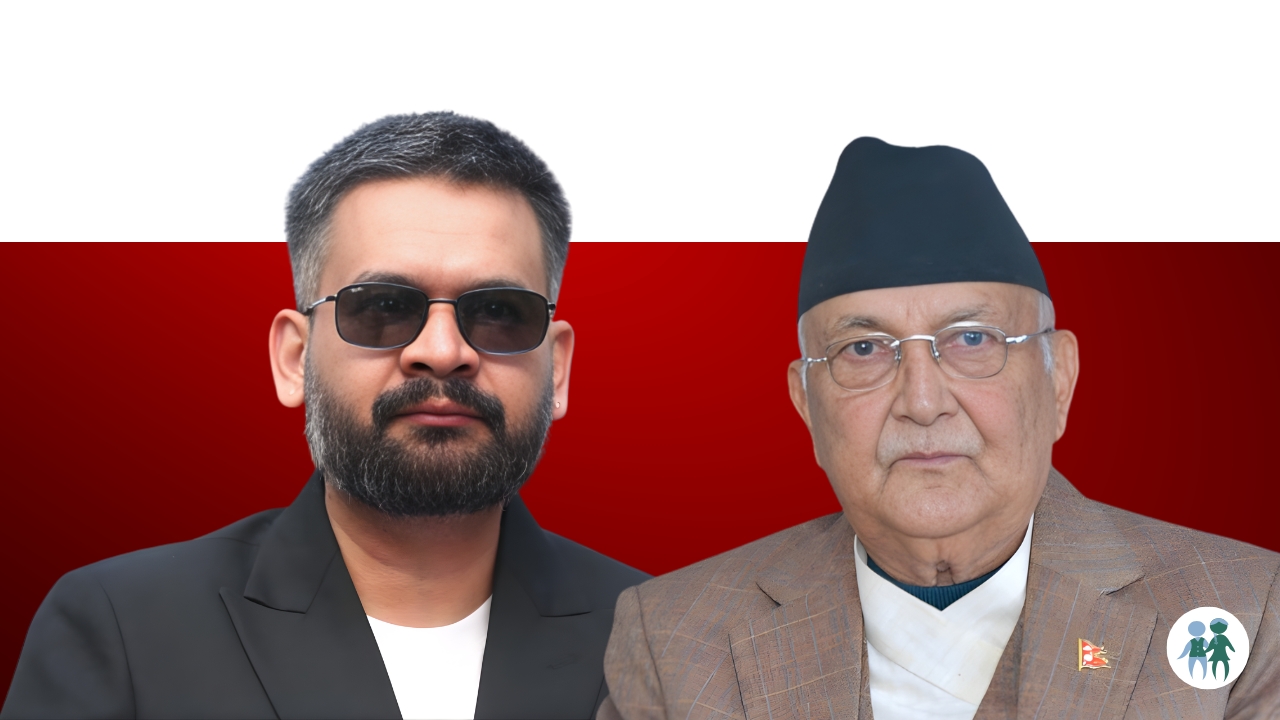
KP Sharma Oli's sense of humor is marvelous. There is perhaps no other leader with his ability to be quick-witted, humorous, and to present every topic in a juicy and funny manner decorated with proverbs and idioms! It turns out this characteristic isn't just Oli’s personal trait. The very climate of Jhapa is like this!
While talking to voters in Oli's constituency, Jhapa-5, we felt that most people here speak in a witty and cheerful way. They don't become solemn even when asked serious questions; instead, they are experts at weaving references from their daily lives into those questions to trigger laughter. They take even difficult situations lightly and burst into laughter while joking about them.
A 65-year-old voter from Damak Municipality was just as witty. Starting a conversation with him about the election, as soon as we asked, "Who do you want to vote for?" he smiled sweetly, stood up abruptly from his chair, and came close to us. Pressing his mouth right against our ear, he said in a low voice, "The vote is for 'Ba' (Father) indeed." He paused for a moment after saying this. Then he added, "...but the 'Ba' with 'Len' attached behind it!" Then he himself burst out laughing. We couldn't hold back our laughter either.
76-year-old Til Bahadur Dahal of Gauradaha Municipality 8 was one step ahead. When we asked the retired Indian Army soldier the same question, he shot back a counter-question: "If I were to stand for election myself today, would anyone vote for me?" We didn't understand his counter-question. Seeing us looking bewildered, he said, "If I go to stand for election at this old age, is there any benefit to this country by voting for someone like me? You tell me!"
We said nothing. He added, "The ones who should win are healthy, young men like you. Now look, Oli and I are roughly the same age. If I have reached a stage where I cannot work, his condition must surely be the same. Yesterday, I handled all the household chores, educated my children, and raised them. Today, I sit and rest; my son and daughter-in-law handle the house. The country is just like my home. Old people like me, who have reached an age where they cannot work, should not occupy the space of healthy youth! One should step aside gracefully on their own and say, 'Come, take over the country!'"
The intention of Dahal, who said he had been voting for Oli in all elections so far, was clear—he is changing his vote this time, choosing Balen Shah, who is the age of his son or grandson, over Oli, who is his own age.
Hari Mishra of Damak Municipality 6, 68, also opened his heart in the same way. We found him watering the garden in front of his house. After we introduced ourselves and requested a conversation, he asked for a moment. He watered the vegetables growing in the garden, turned off the tap, and prepared to start the conversation while wiping his hands with a handkerchief. He is a long-time voter of KP Oli. In his life, he has never voted for anyone other than the 'Sun' symbol of CPN-UML. This time, however, he is changing his vote. He has made up his mind to vote for Shah, not Oli, in the first-past-the-post (FPTP) system.
After talking about the FPTP vote, we brought up the topic of the proportional representation (PR) vote. We asked who his PR vote would go to. In response, pointing toward the garden he had just watered, he said, "If you want to water a field, you have to direct the water entirely to one side, son! You shouldn't put a little bit in one field and a little bit in another. That way, the water won't be enough for any field!"
"When I used to vote for the Sun, I gave both to the Sun. This time I am voting for bell, and I will give both to the bell," he said.
A woman and her Gen Z daughter we met in Damak Municipality-7 were equally cheerful. The woman, who described herself as 'Ex-Gen Z,' did not disclose her name. She said, "Am I running for election that I should write down my name? Everyone here calls me Kanchhi Aunty, just write that."
During her conversation with us, she said, "None of us are saying anything bad about Babai (Oli). He is very good. He did as much as could be done for Damak. But we are done with Babai now! How long will he keep doing it himself? New youths have come and said they will do it. Let's give them a chance and see! If they don't do it, Babai is our own, we'll go back to him tomorrow!"
"Today all the Gen Z are saying Balen, Balen," Kanchhi Aunty said laughing, "I happen to be an Ex-Gen Z, so I have to say the same!" After the conversation, we asked if we could take a photo of the Ex-Gen Z. "Let's not take a photo, hey," she said, "I come out too beautiful in your camera!"
These are just a few examples. In Jhapa-5, which is the political base of former prime minister and UML Chairman KP Sharma Oli and where he has repeatedly won elections in the past, we found such witty and cheerful voters at every step.
For a few days, we reached every ward of every local body within Jhapa-5 and spoke with voters. While talking to them, we saw that the voters here do not have any particularly large grievances against Oli. Some voters did vent anger, mentioning orders to fire shots during the Gen Z Movement and the lack of leadership transfer in the party, but at the same time, they praised the contributions he made for Jhapa and the country as a whole in the past.
While touring this constituency, we rarely found voters who insulted Oli. Except for some voters in the same age group, we also found few who called him by his name alone. Many showed respect by adding 'Ba' or 'Babai' after his name. Voters expressed satisfaction, particularly with his role in blacktopping the roads of Damak Municipality.
However, as far as the question of voting in the election is concerned, we found that the voters of Jhapa-5 are leaning toward Balen Shah, the senior leader of Rastriya Swatantra Party (RSP) and the party’s prime ministerial candidate. Due to the competition between Oli and Shah, Jhapa-5, which has become the 'epicenter' of the upcoming election, is being watched with interest both nationally and internationally.
During our stay in Jhapa, we also met many media persons from the international media. In the same hotel where we stayed, there were journalists from various international media outlets. They all had the same interest—can 35-year-old Shah, who moved into national politics after being elected mayor of Kathmandu from being a rapper, challenge 74-year-old Oli, a top leader and veteran player of politics who played an active role in the country's democratic movement?
To find the answer to this very question, the Setopati team spent the last two days visiting all wards of this constituency and speaking with about a thousand voters. We tried to understand the voters' opinions about the parties and candidates running in the election. We asked what their main concerns are and whom they want to vote for and why. Jhapa-5 includes wards 1 to 10 of Damak Municipality, wards 1 to 8 of Gauradaha Municipality, wards 3 to 6 of Gauriganj Municipality, and wards 1 to 7 of Kamal Rural Municipality.
UML’s Oli, Shah of RSP, Mandhara Chimariya of Nepali Congress (NC), Ranjit Tamang of Nepali Communist Party (NCP), Laxmi Prasad Sangroula of RPP, Dhiren Subba of Janata Samajwadi Party (JSP), Amrit Lal Mahato of Janamat Party, Sameer Tamang of Shram Sanskriti Party, among others, are competing here. Based on the analysis of conversations with voters, Shah is far ahead of Oli in this constituency. The wide lead that he has over Oli today will not be easy for 'Babai' to overcome by the election day.
Apart from Shah and Oli, we found that no other party's candidate is even in the election competition. Here, NC's Chimariya, RPP's Sangraula, Shram Sanskriti Party's Sameer Tamang, and NCP's Ranjit Tamang are far behind in the race.
In this constituency with more than 163,000 voters, about 15 percent of those we spoke to have not yet decided whom to vote for. While there is a tough competition between the two main candidates, where these undecided voters cast their votes at the end matters. However, given the huge margin between Shah and Oli, where these voters cast their votes at the end will not make much difference in the election result.
To understand the changed politics in this constituency, one must look at the status of the parties here in the previous election. In the 2022 election, Oli won by securing 52,319 votes while his closest rival Khagendra Adhikari of Nepali Congress got 23,743 votes. Suresh Kumar Pokhrel of RSP received 11,759 votes.
In the PR category, UML was the biggest party with 35,872 votes, while RSP got 18,205 votes. Congress came third with 16,859 PR votes. Thus, being third in the FPTP race and overtaking Congress to finish second in the PR category shows that RSP had already established a strong presence here since the last election.
In our analysis, the balance of power between parties in this constituency will be overturned this time. A huge shift will occur in both direct and PR categories.
Why is RSP appearing so strong this time?
Based on our analysis of conversations with voters, it appears that many voters who voted for almost all major parties last time will move toward RSP this time. Within that, a large portion of UML voters is attracted to RSP. After that are Congress and RPP voters.
In our conversations, about 80 percent of voters who said they would vote for Shah said they had voted for UML or Congress in the past. Voters who said they voted for bell in the last election, however, remain entirely with RSP. Similarly, almost all voters we met who are going to vote for the first time said they would vote for RSP. In this way, RSP looks set to win as a large portion of those who voted for UML, Congress, or RPP yesterday and new voters are opting for RSP this time.
On the other hand, we see little possibility of UML and Congress being able to retain their old voters or attract new voters or voters from other parties. Among the voters who told us they would vote for UML's Oli, the majority said they had voted for UML in the past as well. Those who said they would vote for NC are almost all old Congress voters. NC was a distant third choice for the voters we talked to.
We also met some voters who said they would vote for RPP and Sameer Tamang, the candidate of the Shram Sanskriti Party led by Harka Sampang. Sameer Tamang is also pulling UML votes. This hasn't particularly brought him into contention for victory, but it has pulled UML further down. Thus, the lack of vote swapping among other parties, their inability to save their old votes, and the Shram Sanskriti Party also cutting votes will decrease the size of the votes received by all other parties. The biggest loss from this will fall on the former winner Oli.
We also met some voters here who said they would vote for Ranjit Tamang of NCP as an alternative to Oli and Shah. 53-year-old Himraj Chemjong of Damak Municipality 8 is an old UML voter. But this time he is voting for Ranjit Tamang. "I couldn't vote for KP Oli. How long can one carry the same person for years and years," he said, "I don't have much faith in Balen either. Both his positive and negative sides have been seen. Some say he did well in Kathmandu, some say he ruined everything. It is also heard that he couldn't spend the budget compared to other metropolises, tried to chase the poor out of Kathmandu, and didn't go to meet those injured in the Gen Z Movement. Why vote while harboring such doubts!"
He chose Ranjit Tamang over both of them. He says, "Whether he wins or loses, he is capable compared to both of them." However, those choosing a third candidate because they dislike both Oli and Shah are few. Since many voters are fans of Shah, the wave seems directed toward him.
From conversations with voters, we have seen four main reasons why Shah is coming ahead of Oli in the competition. First, most of the voters we talked to feel that Oli should now take a break from active politics. Not just Oli, but the general opinion of voters here is that former NC president Sher Bahadur Deuba and NCP coordinator Pushpa Kamal Dahal, who have run the government as prime minister multiple times in the past, should also take a break from politics and bring the younger generation forward. Having become tired of voting for Oli in every election, they have expressed the opinion to give Shah an opportunity and see.
It’s not just old UML voters, Congress voters have a similar opinion as well. They too have taken Shah as a 'hope for change'. We found that voters have gathered hope that these young candidates might be able to steer the country out of past political malpractices, corruption, and irregularities. "It is with the hope that there might be some change in the country's condition that I am saying I will vote," said 55-year-old Yuva Raj Kharel of Gauradaha Municipality 2 who always voted for UML in the past and has made up his mind to vote for RSP this time. "The old leaders did their share of work. Now it's the new ones' turn. I feel like we should look at the new ones this time."
Second, voters expressed disappointment that after the Gen Z Movement, instead of handing over the party leadership to the younger generation according to their feelings and spirit, Oli came back endorsed by the General Convention. Although the foundation of UML supporters in Jhapa-5 isn't wobbling, they say the party's feudal tendency has forced them to change their vote. Some voters even asserted that if UML had fielded any other influential youth as a candidate, voters who always sent Oli to victory in the past would have voted for the Sun this time too. "If UML had fielded a young candidate, we wouldn't have had to change parties. Our vote could have gone to the Sun," said Reshma Gartaula of Damak 6. "This time, I am definitely opting for the new one."
Third, the leaning of old Nepali Congress voters toward Shah has also played a big role in his appearing strong. Congress voters have taken his candidacy in Jhapa-5 as an opportunity to bring down Oli's fortress this time. Reasoning that even if they vote for the tree based on their political support, there is little chance of Congress winning, and that it would rather make Oli stronger compared to Shah, they appear attracted toward bell. 52-year-old Bina Rai of Kamal Rural Municipality 7 has never voted anywhere other than the tree in her life.
She says she is going to change her vote toward bell for the first time in her life this time. "We are ancestral Congressi. The roots of us Congress voters are connected to the tree," said Rai who runs a tailoring shop in Damak. "But the chance of Congress winning here is low. If we vote for tree, our candidate won't win, and it will be difficult for Balen too. That only benefits KP Oli. Therefore, to defeat Oli, we have decided to vote for bell after consultation."
Fourth, what we have seen from conversations with voters is that families who used to pour all their votes into UML are also in the mindset of splitting their votes this time. Their plan is for half of the family members to vote for Sun and half for bell. While touring Gauradaha Municipality, we reached a house where there were a total of 36 votes. Until the previous election, all those votes went to Oli. This time, that will not be the case.
They said that at least 18 out of those 36 votes would go to RSP. "The minds of the new and old generations are not aligning regarding whom to vote for. The brother is voting for Sun, the sister for bell. The father votes for Sun, the daughter for bell. Rather than fighting among ourselves, we have decided to vote wherever one feels like," a member of that family told us.
Among the votes being split this way, the fact that a large number of young voters voting for the first time are attracted toward Shah has made his chances strong. We found that those young voters have pulled their father's generation and even more so their grandfather's generation toward them. Whether they are former UML voters or Congress, the young members of the family have moved toward RSP. Most interestingly, we found that elderly members of families have also moved toward RSP in significant numbers. Their sons, grandsons, or daughters and granddaughters, residing in Nepal or abroad, are reminding them to vote for RSP. They are unable to ignore what their grandchildren are saying.
During the tour of Jhapa-5, we met a female health volunteer in Gauradaha Municipality. She refused to disclose where her vote would go, but she shared an experience from visiting villages in the course of her work. The health volunteer, who provides health counseling by visiting at least a thousand houses, said, "Female voters in the village ask me one question: where is the bell symbol located on the ballot paper? They are sitting with the mindset of voting for bell. I felt that they want to know beforehand where bell is on the ballot so that their vote doesn't go to waste and there is no confusion at the last moment."
"What is the attraction toward bell?" To this question of ours, the female health volunteer said, "To leave the old and look at the new." According to her, for these voters who have made up their mind to have a look at the new, the party's issues, national or international policies, and development programs do not hold much meaning. They have only looked at the candidate's face and age. And on this criterion, she says their choice has moved not toward 'Babai', but toward Balen Shah.