How to provide young people with opportunities that lead to stable patterns of personal and professional growth which, ideally, offer purpose, gratification and self-fulfillment, and also, more tangibly, provide them with sufficient means to sustain themselves?
This is a global challenge currently faced by an increasing number of nations, both in the developed and developing world.
Yet, inevitably, it is the youths from the Global South who pay the highest price.
Today, as the international community celebrates International Youth Day, it is worth reflecting on some common threads that can be found, factors and elements that often define the future of millions of youths in developing and lower-middle-income nations.
For this purpose, it is useful to do a short detour away from Nepal, to the shores where the Mediterranean Sea meets the Atlantic Ocean.
Less than two weeks ago, Ceuta, a Spanish enclave in North Africa, saw over 50,000 people, mostly youths from Morocco, illegally enter its territory.
They were taking advantage of a loophole in a recent ruling by the Spanish Supreme Court that guarantees them more time for their cases to be processed rather than being immediately expelled as Morocco is considered a so-called “safe country of origin” where asylum requests are generally rejected.
Those who were interviewed by the media expressed a strong sense of frustration and disillusionment with their country, a rising lower-middle-income nation.
It is interesting to note that Morocco has already established itself as a regional leader with ambitions that go beyond its neighborhood and traditional spheres of influence in North and West Africa.
The nation, also thanks to its geographical position close to the European Union, has been attracting global investments in manufacturing and other industries, while modern transportation infrastructures have been built and more will come.
Moreover, together with Spain and Portugal, Morocco will co-host the next FIFA World Cup in 2030 and the country is undertaking massive projects to be ready for most important sports event in the world.
Yet local youths there remain dissatisfied with the course of their country’s economy, notwithstanding the fact that it has been growing at almost 5 percent annually thanks to its modernization efforts.
Yet local young people remain unhappy.
“Morocco has given me nothing” or “No other option is available”.
These were some of the statements coming from the youths who had reached Ceuta, representing a broader sense of institutional neglect felt by them, many of whom were minors (the vast majority of them are now back in Morocco).
This disconnect between relatively remarkable economic growth and the much different reality on the ground in the daily lives of millions of people, encouraged them to try their luck and illegally enter Ceuta.
The fact that the economy of a rising star like Morocco is not working for ordinary people despite healthy macroeconomic indicators (the unemployment rate in Morocco stood at 9.5 percent, but it was much higher among young people aged 15 to 24 at 27.2 percent), should help us reflect more on the type of economy needed to meet the aspirations of the youths of the South.
One of the major problems is that the investments the country has attracted so far only guarantee low-paid jobs and short-term contracts, which are not enough.
This is an interesting insight for a country like Nepal that has big ambitions in terms of bringing in new investments.
But it is not only about an economy that does not work for the people.
What troubles the youths is the fact that they are not getting any sense of security or hope.
We should mark these two words, security and hope, when we talk about youths in developing and emerging nations.
Because these two elements embody the core essence of what young people would expect from the state and broader society.
And here we land from our detour of North Africa back to Nepal.
As the new federal government in Kathmandu is trying to stimulate national development and reach new and unprecedented levels of prosperity for its citizens, it is useful to remind ourselves that economic indicators quantifying levels of increase in growth and GDP are not sufficient to meet the expectations of youths, neither in Kathmandu nor in Rabat or in any other capital from emerging nations.
This represents a conundrum for policymakers in these countries and this is where the abstract concept of good governance gains relevance.
It is no longer just about getting rid of corruption and nepotism – two problems that, if eliminated, would create the conditions for “clean” governments to operate.
Good governance that meets the aspirations of the youths, offering them security and hope, must entail drastic reforms in health care, education, and the job market.
These three policy areas, all underpinning the essence of good governance, are indispensable so that youths can develop confidence to some extent that their own future can lead to some prospects for advancement in life.
For policymakers, making substantial changes in these areas is a real conundrum because serious interventions in them require huge amounts of money that emerging nations often simply do not have.
Ensuring that there is no corruption is a foundational priority, a so-called sine qua non.
But from there, a whole system must be created that is able to produce policies that not only attract new investments and sustain the economy but also can collect taxes while also tangibly improving the health care and education sectors while creating new jobs.
If effective actions are implemented in these areas, then youths can start feeling that the system is not rigged against them.
They can slowly develop a sense of security and hope that could lead to a process of personal transformation or empowerment.
If I believe that I have a shot at life regardless of my background and lack of access to power, then I can start pushing myself to believe that my own efforts and hard work will lead to my own betterment.
Otherwise, few options are left and youths simply end up being convinced that immigration is the only path available to them.
But there is also a third factor beyond security and hope: freedom.
Last year, youths in Morocco vented their frustrations in the streets against a system unable to meet their expectations.
They ended up paying a high price because their government is semi-authoritarian.
Many of these young protesters are still in jail.
Freedoms, liberties, and respect for human rights – the pillars of any democratic society – are often brushed aside.
Actually, upholding human rights and giving a voice to young people matters and makes a difference.
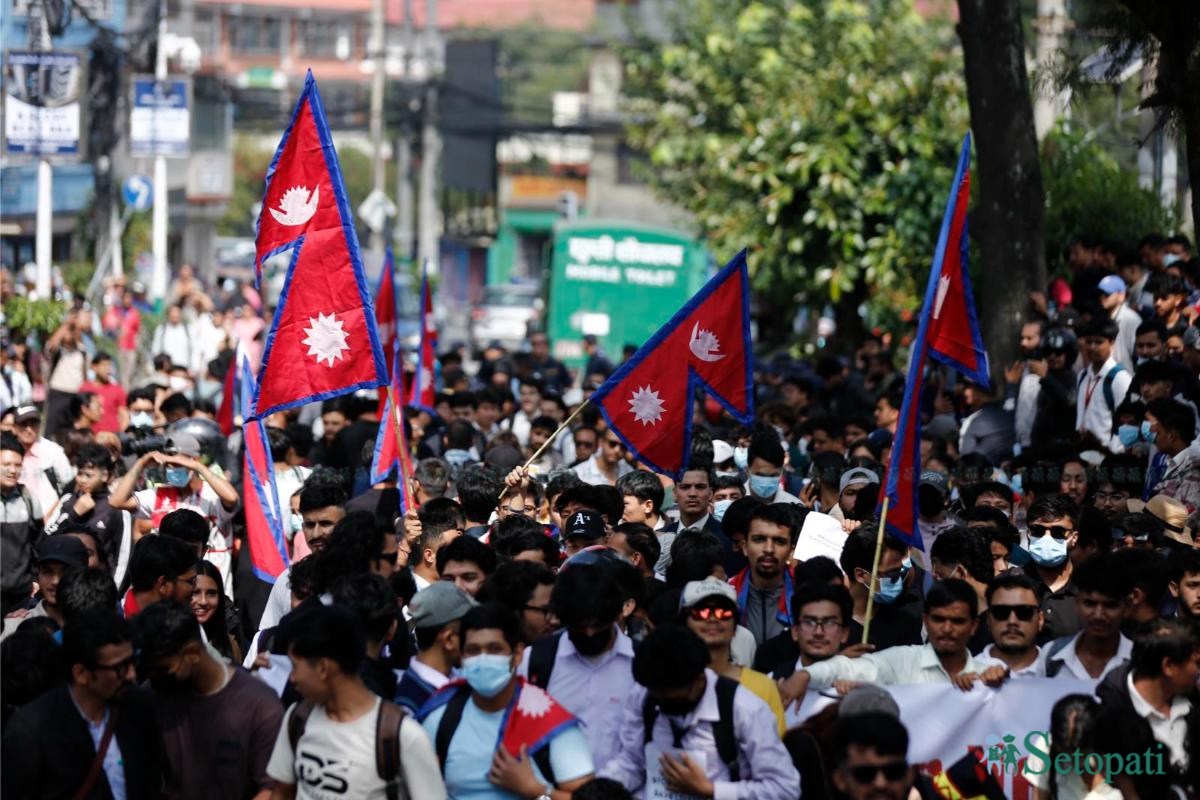
The triggers of last year’s uprising in Nepal were the ban on social media and nepotism but these were only the surface of a deeper problem: a political system that lacked inclusivity.
Good governance, outside a democratic framework, is merely a cold rule of law that has a propensity of turning arbitrary if there are no human-rights-centered anchors embedded within it.
This is the reason why opening up the political space is paramount.
In principle, it means good governance must be inclusive and able to involve and engage all youths, especially the less privileged.
Entering politics should be much easier and reforming political parties is a prerequisite to make liberal, election-based politics more accessible and functional.
But there are not only political parties.
There are also other ways to strengthen a nation’s civic life.
For example, promoting national service centered on the principles of solidarity, cooperation, and altruism and driven through volunteering experiences can play an important role in giving youths new ways to learn and develop their character.
It is sad that this year is celebrated as the International Volunteer Year 2026 but nothing in Nepal has been done to highlight this precious opportunity to reinforce the civic engagement of the nation.
But if volunteerism can boost a youth’s sense of self while also helping her to learn new skills and make new meaningful connections, youths should aspire to a system in which the state has a “duty to involve” them.
If party politics can be reformed, if more volunteering opportunities can support a youth’s journey of self-development and self-discovery, the political space can also open up in new ways.
Enforcing a “state’s duty to involve” would mean finding new ways to enable youths to feel and believe that they matter, even in politics.
Around the world, citizens, including youth, are getting empowered by experiencing, first-hand, the power of deliberative democracy where the people’s voices and opinions are listened to.
Citizens’ assemblies, online deliberative platforms, and local participatory budgets are some of the tools that can bring politics closer to the people.
These are tools that can turn around the traditional ways of thinking about politics and doing politics, nourishing a truly people-centered political space that transforms the way decision-making is carried out.
Meeting youths’ aspirations and needs requires a deep commitment by the state to offer them security, hope, and a real chance of participating in public affairs, both nationally and locally.
This year’s theme for International Youth Day 2026, "Different Contexts, Common Aspirations," reminds us that no matter where they are and regardless of their different contexts, from Rabat to Marrakesh to Ceuta to the cities of India to the urban and rural spaces of Nepal and beyond, common threads to improve their lives do exist.
These deserve our utmost attention.
Even more importantly, we all know that, no matter the ongoing efforts, youths deserve much better and the solutions, while difficult, are not beyond our imagination.