At least three individuals connected to the secretariats of Prime Minister Balen Shah and Home Minister Sudan Gurung visited the police office while Inam Sapkota, who was arrested on money laundering charges, was in custody, a high-level security source has told Setopati.
According to the source, after Sapkota's arrest, Bishal Adhikari, coordinator at the prime minister's secretariat; James Karki, an adviser to the home minister; and Chirag Shrestha, who identifies himself as an information technology consultant to both the prime minister and the home minister, visited the police office.
Setopati has obtained photographs of Karki and Shrestha at the police office. However, the exact dates and times of their visits, as well as whom they met and what they discussed, remain unclear.
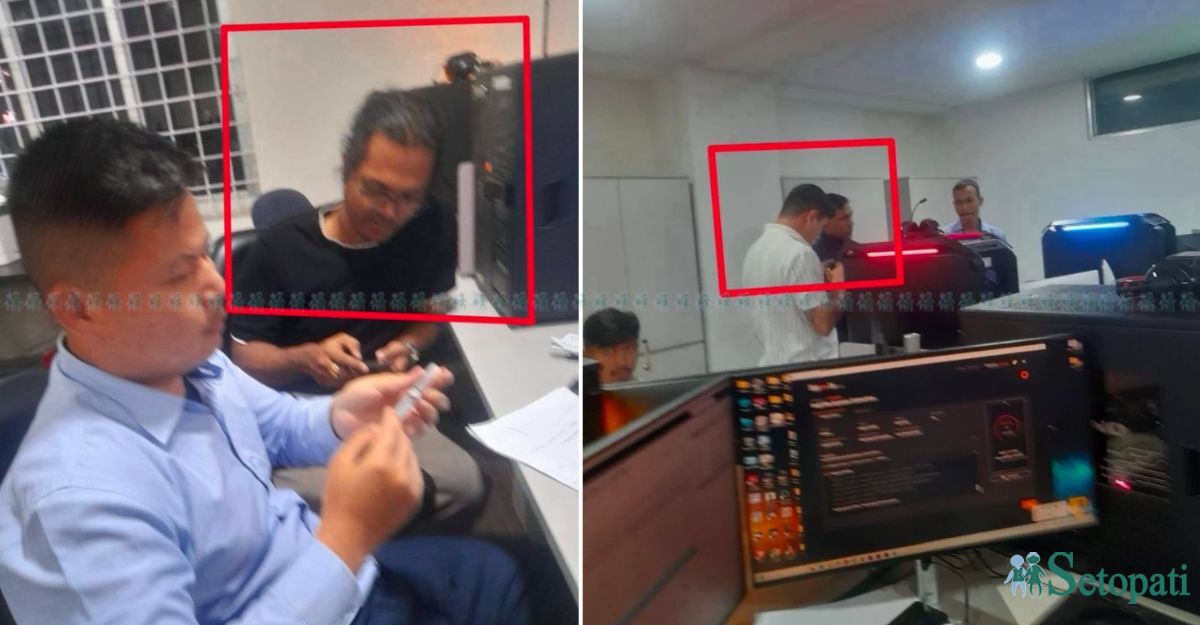 Chirag Shrestha (left) and James Karki (right) at the police office.
Adhikari, who serves as the coordinator of government affairs and planning coordination at the prime minister's secretariat, went directly to the police interrogation room and spoke with officers involved in the investigation into Sapkota.
Setopati has obtained a video of the interaction, which lasts approximately two and a half minutes.
The video, recorded at around 6:30 p.m. on October 2, shows Adhikari and Police Officer Raja Adhikari sitting across a table and talking. Setopati has retained a copy of the footage.
During the conversation, the police officer can be heard saying, "We hope the mobile phones will arrive today." This indicates that the phones seized following Sapkota's arrest were not in the possession of the police office at that time.
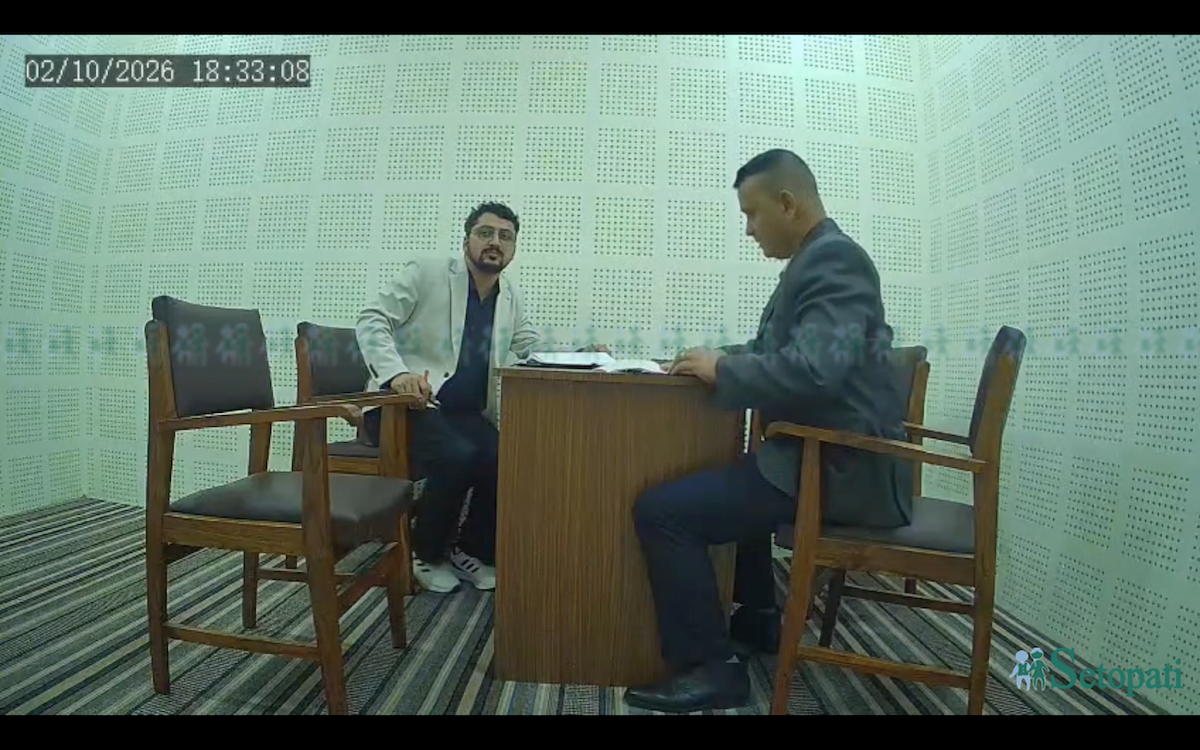 Bishal Adhikari and Police Officer Raja Adhikari engage in conversation. This image is a screenshot taken from the video.
On November 3, Setopati first reported that Kumar Ben, the prime minister's chief adviser, had kept two mobile phones seized from Sapkota at his residence for two days before they were sent for forensic examination.
According to new evidence obtained by Setopati, forensic examination has now established the location of the phones.
The forensic report shows that at around 9:15 pm on October 2, the phones were located at coordinates 27.684922° north latitude and 85.321293° east longitude. According to a source, Google Maps identified the location as an area near the Ganesh Temple in Jwagal, Lalitpur.
A high-level police source said that Ben's private residence is located in the same area.
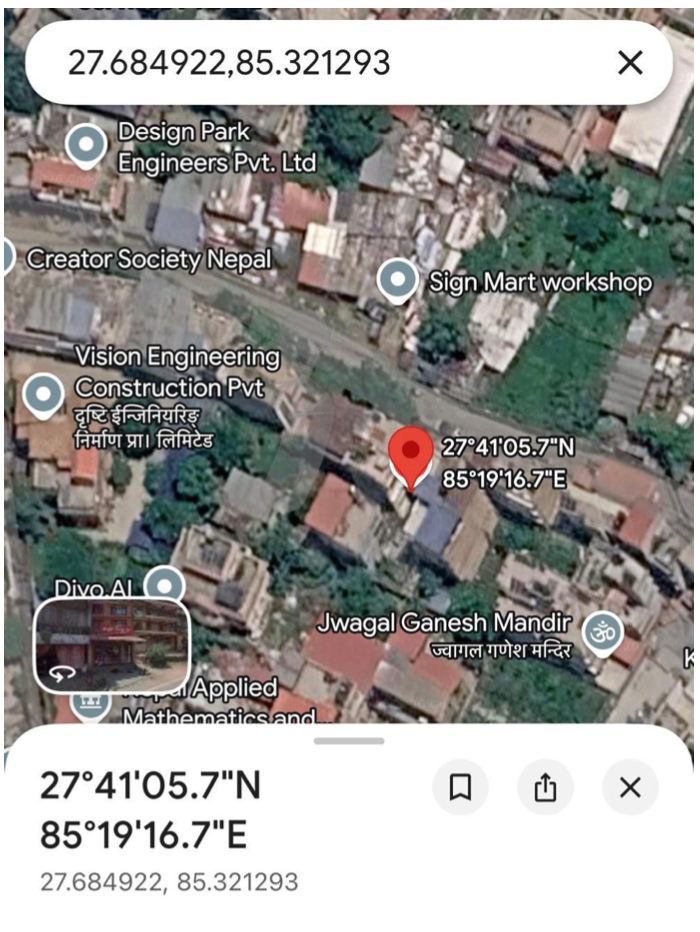
Forensic examination also revealed that WhatsApp and Facebook were accessed and screenshots of various materials stored on Sapkota’s phones were also taken during the period when the devices were not with the police.
Some messages on the phones were found to have been deleted. According to the source, some of those messages had been exchanged between Sapkota and Ben.
Police sources said that the phones contained records of conversations between Sapkota and Ben on various matters over several months. One of the subjects concerned the selection of Rastriya Swatantra Party’s (RSP) candidate for the March 5 election.
"A message was also found in which Inam recommended to Ben that Ananta Raj Ghimire should be given the party ticket from Dang Constituency No. 2," a source told Setopati.
The deadline for filing nominations for the March 5 election was January 20. Based on this timeline, the conversation between Ben and Sapkota appears to have taken place around early January. This indicates that Ben and Sapkota had known each other well for at least the past 10 months.
Recently, details of alleged conversations between Sapkota and several high-ranking officials and judges, reportedly retrieved from his mobile phones, have been made public. Sources claim that screenshots of those conversations were also taken by Ben while he had possession of Sapkota's phones.
The transfer of phones seized during an investigation from the police's official custody into the control of the prime minister's chief adviser has raised serious questions about the impartiality of the investigation and the security of digital evidence.
According to a senior police source, although political leadership had previously shown interest in investigations, there had never been an instance of investigation materials being taken into their control and accessed.
Police sources also allege that individuals from the prime minister's secretariat visited the police office and directly interfered in the investigation and questioning of Sapkota.
Before publishing its November 3 report, Setopati had sought a response from the prime minister's chief adviser, Ben.
It sent him four questions concerning police sources' claims that he had kept the two phones seized from Sapkota at his residence for two days, that some messages on the phones had been deleted, that conversations had taken place regarding the recommendation of a candidate from Dang Constituency No. 2, and that screenshots had been taken from the phones and provided to media outlets.
Ben declined to answer the questions.
"Please write whatever you want. Whatever I say, you will write the news according to your own interpretation anyway. So I have no problem with it, whatever you choose to write," Ben replied to Setopati.
He neither confirmed nor denied the allegations made by police sources.
Previously, after details of communications between Sapkota and Supreme Court Justice Hari Prasad Phuyal became public, Phuyal had also offered an explanation to journalists.
Speaking to journalists at the Supreme Court on October 29, Phuyal said that Sapkota had introduced himself as a person connected to Prime Minister Balen Shah, and that this was the basis on which he had established contact with him.
According to Phuyal, at a time when there were speculations that he and some other judges might face impeachment, Sapkota claimed to have access to the prime minister and assured them that they would not face impeachment.
Phuyal also acknowledged meeting Sapkota at Hotel Himalaya in Kathmandu. He said that he was not alone at the meeting.
Phuyal said that he began to suspect Sapkota after the latter started showing interest in cases pending before the Supreme Court and attempting to exert pressure.
In particular, Sapkota had sent messages invoking the prime minister's name in connection with a case involving Rohit Gupta, Phuyal said.
According to Phuyal, as his suspicions about Sapkota's activities grew, he sent Sapkota's photograph, contact number, and details of their conversations to the prime minister's secretariat.
Phuyal said that he had also informed the police about Sapkota, but that police advised him to exercise caution, citing Sapkota's connections with high-ranking individuals.
He added that Sapkota was arrested just a few days after he provided the information and evidence to the prime minister's secretariat.
After some details of his conversations with Sapkota were made public, Phuyal questioned how the information had been leaked. He expressed surprise, saying the published details were not part of the investigation file and questioning who had disclosed them and how.
The issue was also raised during a full-court meeting of the Supreme Court after details of Sapkota's contacts with judges and alleged financial transactions became public.
At the meeting held on October 30, discussions focused on the need to establish the authenticity of the publicly disclosed information and address questions raised about the judiciary. Phuyal also presented his position regarding his contact with Sapkota during the meeting.
As the controversy raised questions about the impartiality of the judiciary and the conduct of judges, the need for further investigation was highlighted during the meeting.
Sapkota, a resident of Jhapa, was arrested on September 30.
Police took him into custody while investigating his connections with former chief justice Cholendra Shumsher Rana and other high-ranking individuals.
After Rana was arrested, police examined his mobile phone. According to police sources, information obtained from the device led investigators to Sapkota.
A team from the Special Bureau of Nepal Police took Sapkota into custody and questioned him. Investigators examined his relationship with Rana as well as his contacts with Armed Police Force Additional Inspector General Banshi Raj Dahal.
Sapkota was initially held in custody on charges of indecent behavior. Investigations were subsequently expanded to include money laundering offenses.
Sapkota's wife, Kabita Pandey, filed a habeas corpus petition at the Supreme Court, alleging that he was being unlawfully detained. A bench of Justices Hari Prasad Phuyal and Sunil Kumar Pokharel dismissed the petition.