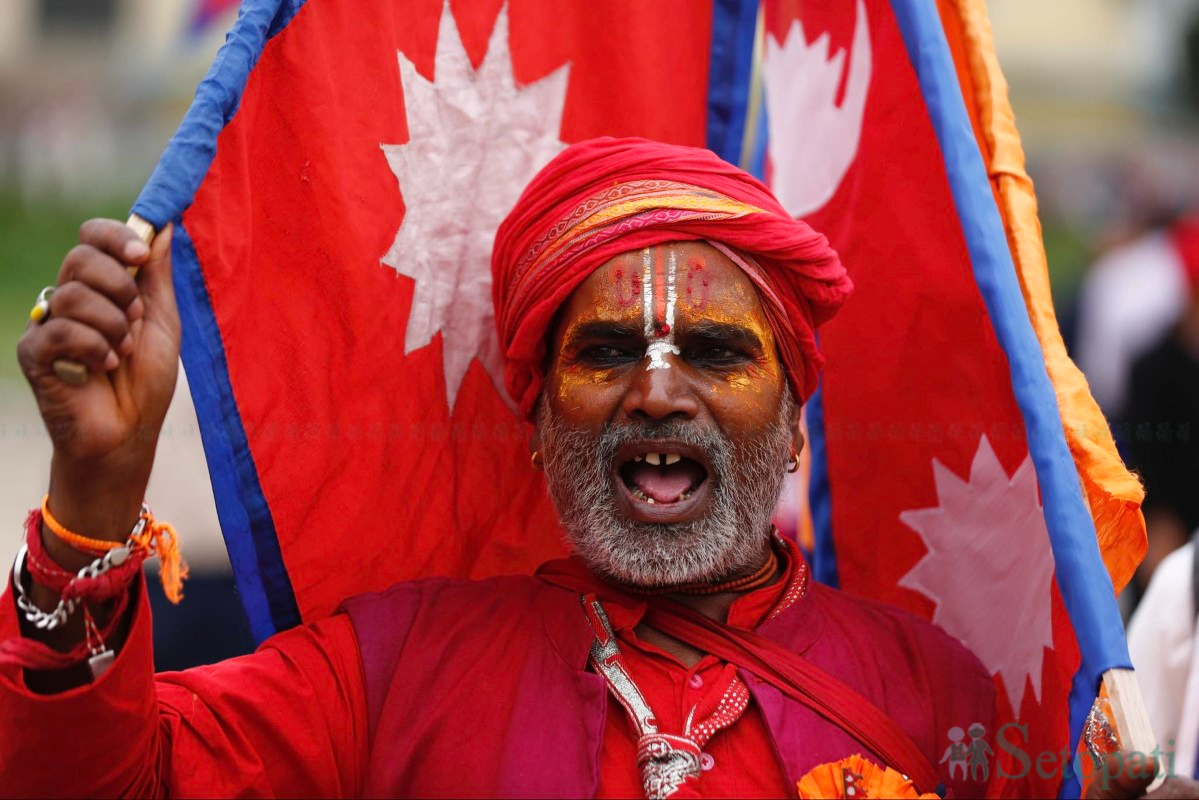
Nepali society has become visibly more religious than the generation before, and there is enormous interest among the public for reconnecting with spiritual practices, astrology, temple visits, tantric practices, spirituality-based podcasts, Vedic philosophy, mantras, meditation, yoga, gurus, Vedanta, nonduality, bhajan programs, and religious ceremonies. This religious awakening will gradually have its socio-political implications; hence, political parties have started to peddle a soft and subtle Hindu image in Nepal to exploit religious identity for political consolidation, vote-bank appeasement, and social influence.
For a majority of people across diverse class, ethnic, caste, and regional groups, Hinduism has become a visible reference point for cultural identity, especially when other religious identities assert their presence in the public sphere. Political and governance systems in Nepal have failed to deliver substantive socio-economic transformation for ordinary people, and this failure has given space to Hindu identity as a political alternative. Revival of Hindu identity in Nepal also reflects mass disillusionment with socialist ideals, crony capitalism, and identity politics based on ethnicity, regionalism, and marginalization. However, without inner retrospection and reform initiatives from the Hindu community on sensitive socio-cultural issues such as caste discrimination, class privilege, and gender inequity, the call for Hindu Rashtra will remain a political project for a vote-bank strategy.
Religious politics without commitment to Hindu philosophy
According to the 2021 Census, within the religious demographic, 81.2% of the population are Hindu in Nepal. However, Hindu identity as a political sentiment has remained on the margins of mainstream Nepali politics. Political parties associated with Hindu nationalism and the pro-monarchy movement have not been able to convert religious identity into vote-bank politics. Hinduism, as Swami Vivekananda articulated through the concept of Daridra-Narayan, indicates that service to the poor, marginalized, oppressed, and destitute is a form of worship. Similarly, the idea of Antyodaya in the political philosophy of Pandit Deendayal Upadhyaya argues for the political commitment to uplift the last person in society. However, political Hinduism in Nepal remains limited to matters of rituals, symbols, ceremonies, us-against-them propaganda, and pro- and anti-monarchy groups, utterly detached from any substantial commitment to moral, spiritual, and ways of living ideals of Hindu political philosophy. In addition, both fringe and political groups associated with Hindu Rashtra movements in Nepal don’t even have a substantive socio-economic vision aligned with their demand for constitutional change.
Moreover, the main weakness of contemporary Hindu culture in Nepal is its superficial engagement with Vedic intellectual traditions. Despite religious differences, Hindus in Nepal must remember that our intellectual practices, as economist Amartya Sen described in his work, The Argumentative Indian, are rooted in public debate, pluralism, and intellectual reasoning. The Vedic intellectual tradition guides us to empathize with others, acknowledge the differences, understand their arguments, find common ground, and respect differing points of view. Hinduism is not a monolithic system built on a single dogma; it is a vast tapestry of diverse, overlapping, and even directly opposed philosophical traditions. Even Orthodox schools of philosophy such as Samkhya and early Mimamsa operate without a personal creator God (Ishvara), while Bhakti schools focus devotion to a personal creator God (Bhagawan).
The absence of contemporary religious reform movements in Nepal
As Hindu culture in Nepal lacks intellectual engagement with Vedic traditions, activism for socio-religious reform from Hindu organizations and individuals in Nepal also remains negligible. By contrast, waves of social and religious reformers and their movements, like the Brahmo Samaj of Raja Ram Mohan Roy; the Arya Samaj, Mahadev Govind Ranade; Mahatma Jyotiba Phule and Savitribai Phule; the Adi Hindu movement of Swami Achootanand; and the Ramakrishna Mission, revitalized Hinduism in India during the 19th-century Hindu Renaissance period and confronted corrupt religious practices like caste discrimination, the Sati practice, gender inequalities, idolatry, hollow priestly rituals and sacrifices, child marriage, and the marginalization of Dalit communities. Their legacy from Swami Vivekananda has continued on with contemporary figures like Acharya Prashant, with his sharp critical analysis of scriptures, use of logical reasoning, and rejection of unverified ritualistic practices.
In Nepal, social ills such as caste discrimination, menstrual taboos associated with Chhaupadi, costly dowry practices, and cultural superstitions continue to hide behind the excuse of religion. Many of these practices are cultural rather than scriptural, yet they continue to draw legitimacy from religion within the public imagination. Hence, apart from religious ceremonies and bhajan groups, we need Hindu reform movements in Nepal to critically examine and reject these scripturally unverified orthodoxies for the socio-cultural and ethical progress of the community.
The sensitive question of caste-based discrimination and religious conversion
Caste-based discrimination derives its tradition from the interpretations of Hindu religious literature, particularly the Manusmriti. However, Manusmriti contains numerous unauthorized interpolations and fabrications inserted over time by dominant groups to preserve their power in a society that was already hierarchical and economically unequal. Although the Puruṣa Sūkta of the Rig-Veda associates different varṇa such as Brahmin, Kshatriya, Vaishya, and Shudra with different parts of the cosmic being, the concept of Jāti as a hereditary caste structure and practices of untouchability developed historically due to social status, marriage, occupation, ritual eligibility, political structures, and relations between varṇas.
In his seminal 1916 work Castes in India: Their Mechanism, Genesis, and Development, Dr BR Ambedkar traced the origins of caste discrimation to the practice of endogamy-marriage within a specific social group. Dr Ambedkar further argued that the annihilation of caste requires socio-cultural transformation that includes inter-caste marriage and the rejection of texts that legitimized social hierarchy. Hence, to overcome caste discrimination, it is necessary to awaken socio-cultural consciousness of Nepali society with the spiritual essence of the Upanishads that affirms intrinsic and unalienable human dignity and unity of existence through teachings such as “ayam ātmā brahma” (This Self is Brahman), “tat tvam asi” (Thou art That), and “sarvam khalvidam brahma” (All this is indeed Brahman), and these statements stand in direct contrast to the social practice of caste-based discrimination.
More importantly, religious conversion away from Hinduism calls for introspection from within. People convert to another religion when they feel that their religious community has failed to respect their human dignity and recognize their socio-cultural aspirations. Hence, without outward rage or the fear of self-criticism, as Hindus, we must collectively acknowledge that for generations, we have allowed our privilege groups, priestly rituals, feudal mindset, the affluent class, social structure, and ruling elites to use religion to justify the marginalization, oppression, and discrimination of people across different classes, castes, creeds, and ethnicities.
Even in a metropolitan city like Kathmandu, caste- and community-based distinctions still influence access to rental housing. Hence, cultural and spiritual awakening, along with advocacy and social activism, is necessary to eliminate mentally embedded social discrimination. And the genuine revitalization of Hinduism in Nepal will only begin when we distinguish spiritual teachings of the Vedas, Upanishads, and the Bhagavad Gita from our historically conditioned social norms and reinterpret religious practices in light of reason, compassion, scientific evidence, ecological crisis, sustainability, inclusion and changing socio-economic realities.
(Gaurav Ojha is a writer, researcher, and educator)