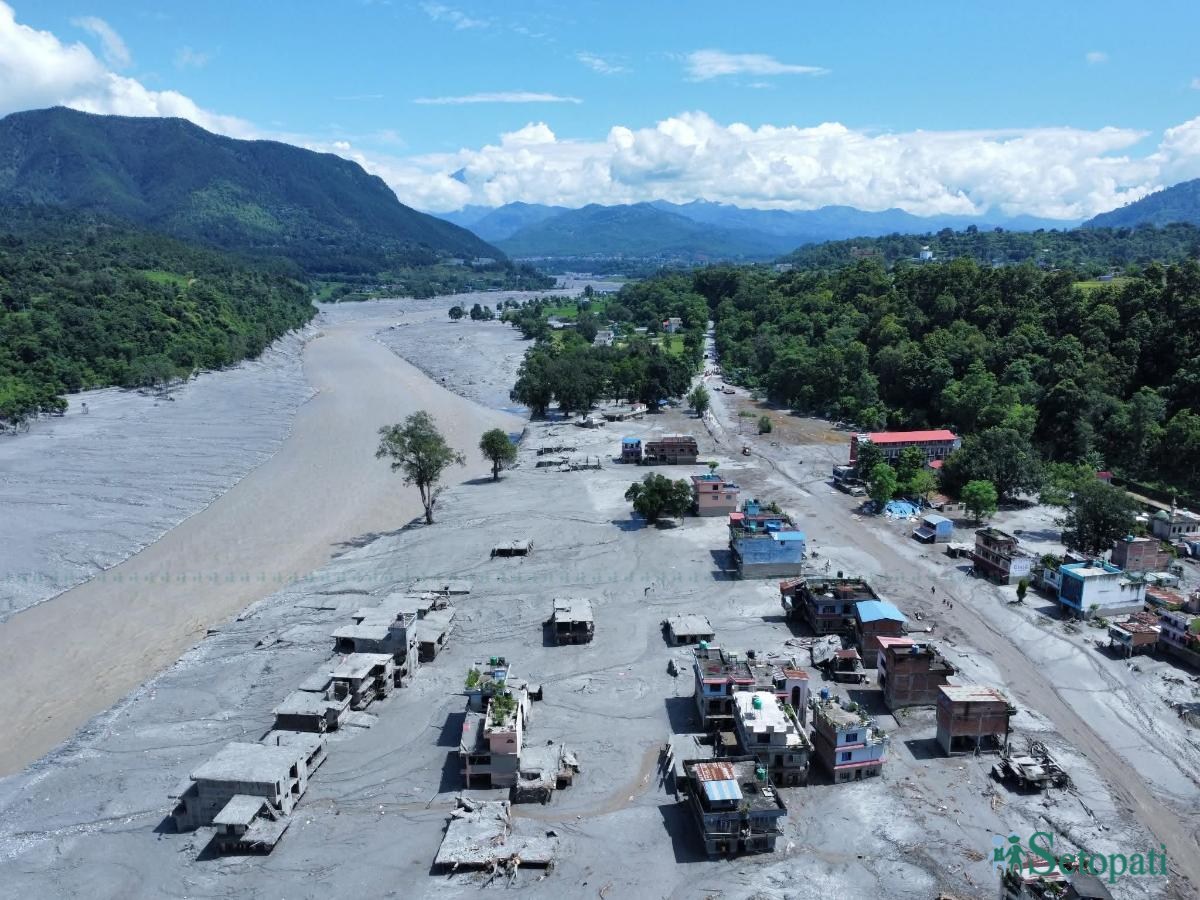
The scale of destruction caused by the 2026 Rasuwa-Bhotekoshi flood has exposed Nepal’s vulnerability to climate-induced disasters. According to the official Rapid Damage and Needs Assessment (RDNA) jointly released by the National Planning Commission and the National Disaster Risk Reduction and Management Authority (NDRRMA), total loss and damage stands at a staggering NPR 723.31 billion (approximately $4.74 billion)—representing roughly 35 percent of Nepal’s national budget. The hydropower sector alone sustained $2.56 billion in damage, accounting for more than 18 percent of the national budget.
Beyond the monetary destruction, the human and infrastructural toll is severe. The flood claimed at least 1,386 lives, left 5,130 people missing, and displaced over 84,000 residents. Infrastructure losses include damage to 281 MW of operational power plants and 388 MW of under-construction projects, the destruction of more than 7,500 homes, and critical damage to roads, schools, and health facilities.
The realities of global loss and damage financing
As Nepal confronts this multibillion-dollar crisis, turning to global climate financing mechanisms is imperative, although structural constraints remain.
The inclusion of Article 8 in the 2015 Paris Agreement, adopted at COP21, was widely hailed as a historic victory for climate-vulnerable nations. It formally established "loss and damage" as a standalone pillar equal to climate mitigation and adaptation. However, to secure the consensus of high-income nations—led by the United States—strict qualifying language was inserted. Article 8 states that it "does not involve or provide a basis for any liability or compensation."
Seven years later, at COP27, when the Fund for Responding to Loss and Damage (FRLD) was established, the words "compensation" and "reparations" were again deliberately excluded. The FRLD is structured purely as a solidarity-based mechanism rather than a legal payout for historical emissions.
As of mid-2026, total global pledges to the FRLD stand at approximately $822 million from 27 contributing entities. Of this amount, just over $250 million has been earmarked for initial deployment while institutional setups are finalized under the World Bank as interim trustee. Crucially, initial FRLD emergency fast-track grants are capped between $5 million and $20 million per project.
These figures highlight an inescapable reality: the FRLD cannot single-handedly fund Nepal's recovery. Pursuing legal liability or demanding mandatory compensation from historical polluters is legally unviable under international treaties and risks delaying immediate aid.
Instead of confining its efforts to demands for financial compensation at global platforms like the UN General Assembly, Nepal must elevate this disaster as a regional crisis for the entire Hindu Kush Himalaya—a critical water tower that supports the lives and livelihoods of two billion people downstream.
A three-tiered financial and technical strategy
To successfully navigate the global climate finance architecture and secure multi-year reconstruction capital, Nepal should pursue a coordinated, three-tiered strategy:
1. Fast-track direct access
Nepal must utilize its existing national designated authorities to immediately access FRLD Phase 1 emergency grants ($5 million–$20 million) via direct budget support to national disaster funds. Because the FRLD recognizes entities accredited by the Green Climate Fund (GCF), Global Environment Facility (GEF), and Multilateral Development Banks (MDBs), Nepal can fast-track these initial funds to address immediate rehabilitation needs.
2. Programmatic co-financing and donor mobilization
Because initial emergency grants are limited, Nepal must combine FRLD Phase 2 multi-year recovery grants (intended for public asset reconstruction and new settlement construction) with larger project pipelines from the GCF and GEF. While the FRLD covers direct post-disaster losses, the GCF and GEF can fund long-term "Build Back Better" resilient infrastructure. Concurrently, a conventional Post-Disaster Needs Assessment (PDNA) led by the World Bank should serve as the foundation for an international donors' conference to rally direct support from friendly cooperative nations and immediate neighbors.
3. Technical support via the Santiago Network
Unlocking larger long-term grant allocations requires empirical, attribution-backed loss data. Nepal should immediately tap into the Santiago Network for Loss and Damage (SNLD) for technical assistance. While the SNLD does not disburse heavy infrastructure capital directly, it provides vital technical support to execute scientific risk mapping for glacial lake outburst floods (GLOFs), satellite-based damage assessments, and technical studies for early warning systems (EWS) tailored to river basins and downstream settlements.
By building an empirical, attribution-backed loss database through the SNLD, Nepal will possess the technical justification required to unlock multimillion-dollar resilience packages across global climate funds.
(The author is a former head of agency for UN-Habitat in Myanmar.)