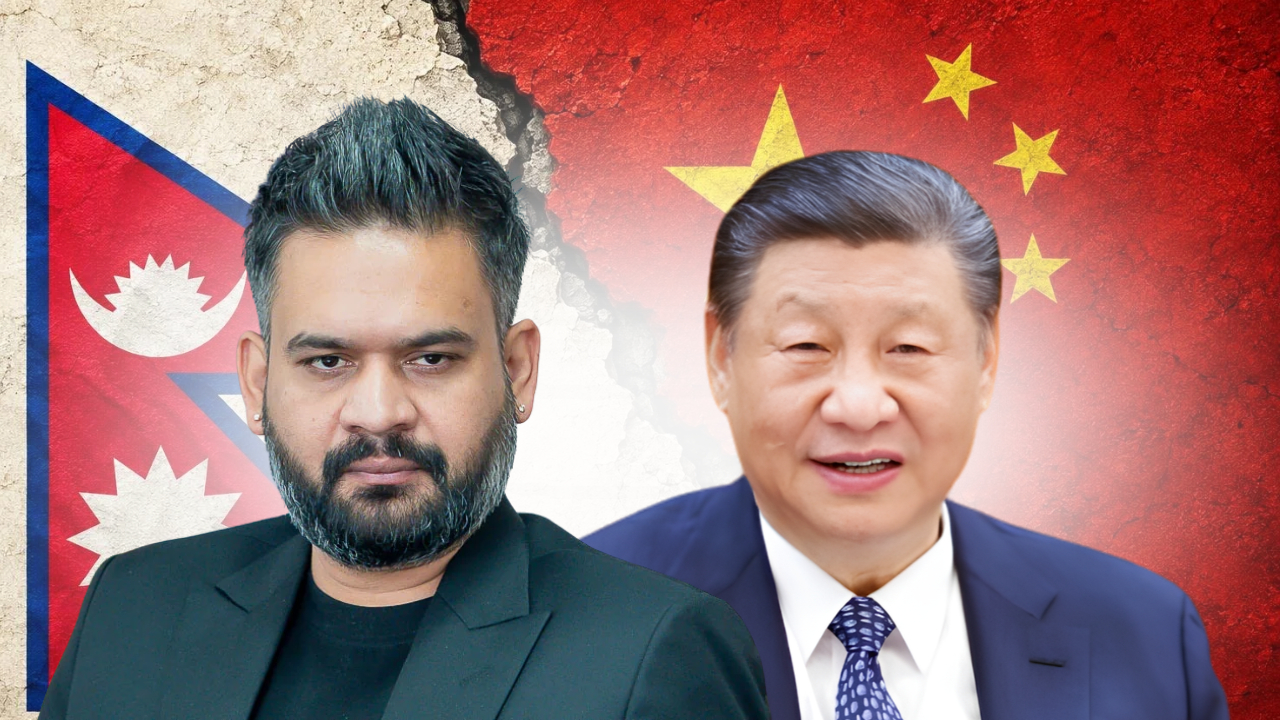
Before 20 lawmakers from the Rastriya Swatantra Party (RSP) departed for China, Prime Minister Balendra Shah had advised them to exercise particular caution on one issue: the Belt and Road Initiative (BRI).
Shah had reportedly told the lawmakers to be careful when expressing their views on the Belt and Road Initiative, Chinese President Xi Jinping's ambitious project, describing it as a controversial issue.
It has emerged that the Chinese side has not taken the prime minister's advice lightly.
China has interpreted the remarks as an indication that the Nepal government is reluctant to move forward with the BRI.
Chinese officials have also expressed dissatisfaction over what they describe as a lack of interest in the initiative from Nepal during recent official engagements.
"The word BRI has not even been mentioned in official meetings so far," a Chinese diplomat told a group of Nepali journalists on Thursday. "The Tokha-Chhahare Tunnel, which was agreed upon during President Xi Jinping's visit, is itself a BRI project for us."
Judging by the diplomat's remarks, China's dissatisfaction extends beyond the BRI.
China appears to have taken seriously the legal proceedings against the Chinese company involved in the construction of Pokhara International Airport, the arson attack on the International Convention Center built with Chinese assistance, Nepal's inadequate preparations for operating border crossings, and delays by government agencies in advancing bilateral projects.
The Chinese diplomat openly expressed Beijing's dissatisfaction with Nepal during the meeting with Nepali journalists on the eve of PM Shah's upcoming visit to India.
According to the diplomat, China is currently more interested in seeing how Nepal implements past agreements than in launching new major projects with the country.
In other words, China is adopting a “wait and see” approach toward its relationship with Nepal.
Despite its dissatisfaction with the Nepal government, China also appears keen to expand ties with the ruling RSP, which emerged as a major political force amid the changed political landscape following the Gen Z movement.
The visit of 20 RSP lawmakers currently in China is being viewed as part of this broader engagement.
China wants to understand the thinking, priorities, and foreign policy outlook of Nepal's new political leadership. It also wants to brief them on its development projects and agreements with Nepal.
Earlier, a proposed visit to China by RSP President Rabi Lamichhane was postponed due to the Bhotekoshi-Trishuli flood.
China subsequently invited lawmakers to visit, continuing its engagement with the RSP.
However, alongside its efforts to build relations with the new political leadership, China is also sending a message to the Nepal government that it should not backtrack on past agreements and commitments.
In particular, Beijing says it wants political commitment regarding projects planned under the BRI.
China seeks commitment on Tokha-Chhahare Tunnel
China considers the Tokha-Chhahare Tunnel an important project linked to the BRI.
An agreement to advance the project was reached during Chinese President Xi Jinping's visit to Nepal.
However, China believes the Nepal government has not put forward a clear position on the BRI at present.
Beijing is also unhappy with the characterization of previous agreements as "old baggage." According to Chinese officials, Nepal should continue implementing projects for which it has already signed agreements.
The reconstruction of the Rasuwagadhi border crossing is also linked to the Tokha-Chhahare Tunnel project.
Following the Bhotekoshi-Trishuli flood, China has concluded that rebuilding the border crossing at its previous location would not be safe.
"The Rasuwagadhi border crossing cannot, and should not, be rebuilt along the riverbank again," the diplomat said. "It must be built at a suitable location in the upper area with a safe tunnel. However, Nepal has so far not submitted any study or proposal from its side."
Political uncertainty over the BRI and delays in technical decisions regarding the reconstruction of the border crossing have left the future of important infrastructure connecting Nepal and China uncertain.
Chinese investors' confidence has eroded following Pokhara airport dispute, China claims
After the BRI, another major issue of Chinese dissatisfaction is Pokhara International Airport.
China has taken seriously the controversy surrounding the construction of the airport, which was built with Chinese loan assistance, as well as the legal proceedings initiated against the Chinese company involved in the project.
The Chinese side alleges that the company involved in construction was prosecuted precisely because it was a project linked to the BRI.
It claims that the case has eroded the confidence of Chinese companies investing in Nepal.
"China's Exim Bank will not invest even a single rupee in Nepal now," the diplomat said. "Chinese investors do not have confidence to invest in Nepal at all."
The diplomat's remarks raise questions about the prospects for future major Chinese loans and investment projects in Nepal.
For now, China has prioritized the second phase of the Kathmandu Ring Road expansion and is preparing to begin the work soon.
However, rather than making fresh commitments to other major projects, Beijing appears inclined to assess how Nepal handles past agreements and projects.
China complains Nepal failed to protect even a building it helped construct
China's dissatisfaction is not limited to economic projects and agreements.
It has also treated the arson attack on the International Convention Center in New Baneshwar during the Gen Z movement as a serious matter in its ties with Nepal.
The building, constructed with Chinese assistance, was set on fire during protests on September 9 last year. No Chinese diplomat has visited the site to assess the damage so far.
This contrasts with China's response following the 2015 earthquake, when it sent a team to assess damage to the building on its own initiative, without prior notification to the Nepal government.
At the time, China had also pledged assistance for reconstruction.
Its response this time, however, has been different.
"We do not know whether Nepal wants to reconstruct the building or not," the diplomat said. "Nepal has not sent us any correspondence or made any inquiries."
The Chinese side views the incident as an example of Nepal's failure to protect infrastructure that China helped build.
It cited the Hetauda Textile Industry as another example.
"Nepal could not operate the Hetauda Textile Industry. The International Convention Center was set on fire," the diplomat said.
He then quoted a Chinese proverb to explain Beijing's changed perspective regarding Nepal.
"Now we are on the path of teaching how to fish, not giving fish. Let Nepal do the work itself," he said.
China maintains position against regular operation of Tatopani border crossing
China's changed attitude toward Nepal is also evident in the operation of border crossings.
Despite repeated requests from Nepal, China has said that the Tatopani border crossing cannot be operated regularly.
The diplomat said Chinese officials had clearly told senior Nepali officials during meetings that "the Tatopani border crossing will no longer be opened."
China has cited natural disaster risks rather than security concerns as the reason.
According to Beijing, the risk of floods and landslides during the monsoon, along with glacial lakes in the upper region, makes regular operation of the crossing unfeasible.
"If there is any important cargo that needs to be brought in, Nepal can inform us," the diplomat quoted the Chinese side as telling Nepali officials. "The crossing can be opened for such cargo. But it cannot remain operational all the time."
China also cited the example of the crossing being opened for three days during the Dashain-Tihar festival period, when only 30 cargo shipments entered Nepal.
Beijing argues that regularly operating a high-risk crossing is not justified by such limited commercial activity.
The Chinese side has made it clear that border security or surveillance issue is not the reason behind not operating the border crossing.
"It is not a security issue," the diplomat said. "The area can be monitored through CCTV. Other technologies are available. It can even be monitored through satellites."
China has therefore linked its position against regular operation of the Tatopani border crossing to natural disaster risks and commercial viability rather than security sensitivities.
Kerung reconstruction uncertain; China questions Nepal's preparations at Korala
The Bhotekoshi-Trishuli flood on August 26 caused extensive damage to the Rasuwagadhi-Kerung border crossing.
In the words of the Chinese diplomat, the flood left the crossing's structures "swept clean as if with a broom."
Following the disaster, China assessed the condition of all border crossings connecting the two countries.
The review was also intended to respond to allegations that China was reluctant to operate border crossings with Nepal. Beijing examined the physical condition of the crossings, associated risks, and Nepal's level of preparedness.
Following the assessment, China concluded that the Korala border crossing in Mustang was comparatively suitable for immediate operation.
However, it has raised questions about Nepal's preparations there.
According to the Chinese side, Nepal has not built the necessary government structures at the crossing. It has not made permanent arrangements for immigration and customs personnel, nor has it blacktopped the approximately 150-kilometer road connecting the border to the country's road network.
Chinese officials have also gathered information that Nepal's immigration office is located eight to ten kilometers below the Korala crossing, while immigration personnel are based in Lo Manthang.
Given these shortcomings, China has questioned whether Nepal is genuinely interested in operating the crossing.
"The Korala border crossing is located at an altitude of 4,000 meters. We are ready to provide Nepal with snow-clearing machines," the diplomat said. "For now, Korala is the safest location. The border crossing can be operated."
However, China has set the condition that Nepal must first complete the necessary preparations on its side.
"Let Nepal manage staff, establish an immigration office at the crossing, and build the road on its side," the diplomat said.
The message from China is clear: Beijing's willingness to open the border crossing alone is not enough. Nepal must also complete the necessary infrastructure and administrative preparations.
China complains Nepal has not written to it about petroleum exploration in Dailekh
Another issue over which China has expressed particularly strong dissatisfaction with Nepal's administrative delays is petroleum exploration in Dailekh.
Petroleum exploration has been carried out in Dailekh with Chinese technical assistance. However, China claims that Nepal has not submitted any formal proposal on how to proceed with the next phase of the work.
The diplomat also clarified the nature of the work completed so far.
"What we have carried out in Dailekh so far is a technical petroleum exploration study. It cannot be called a feasibility study," he said.
According to him, Nepal has not even sent a formal letter clarifying what it wants to do next.
"Nepal's bureaucracy is working extremely slowly. We are frustrated," he said. "Letters have not even moved from one office to another."
The Chinese side has portrayed Nepal's decision-making process and administrative delays as major obstacles to advancing bilateral projects.
China also concerned about Nepal's political stability
Alongside development projects and economic relations, China is closely watching Nepal's domestic political developments.
Beijing's interest has grown in Nepal's changed political equation and new leadership following the Gen Z movement. The invitation to RSP lawmakers to visit China is also seen as part of this interest.
The Chinese side recalled that even when strong political forces emerged in Nepal in the past, they failed to deliver the expected political stability.
"China has always supported stability. When two communist parties merged to form the Nepal Communist Party (NCP), an opportunity for stability was wasted," the diplomat said. "Nepal should not waste another opportunity."
China is seeking continuity of past agreements, policy clarity, and commitment to implementation from Nepal's new political leadership.
However, the current situation suggests that China is not keen to take immediate new political or economic risks in its relationship with Nepal.
As PM Shah prepares for his visit to India, the remarks made by the Chinese diplomat highlight the contrasting dynamics in Nepal's relations with its two neighboring countries.
China is making efforts to understand Nepal's new political leadership. But it is in no hurry to advance additional major projects with the Nepal government.
Its message is clear: implement previous agreements, fulfill Nepal's own responsibilities, and clarify what kind of policy you will adopt in relations with China.