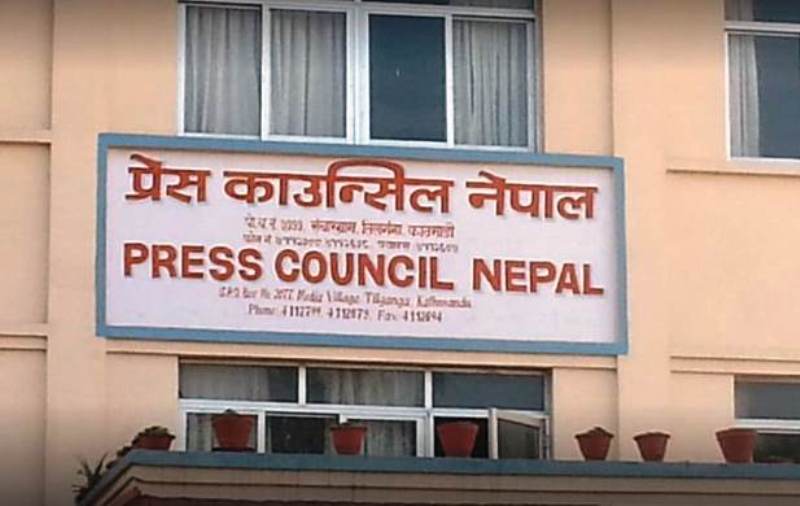
The government has introduced an ordinance expanding the jurisdiction of the Press Council Nepal.
The ordinance empowers the council to monitor and take action against social media accounts operated by media outlets on platforms including Facebook, YouTube, X, and TikTok.
The Cabinet decided to introduce the ordinance on Tuesday.
According to sources at the Ministry of Law, the council has been granted monitoring powers to enforce the journalistic code of conduct because some YouTube channels and Facebook pages register with the Department of Information and Broadcasting as online media outlets but do not publish their content on their websites.
“While there is no content on their websites, videos and news are posted on their social media pages,” a ministry source said. “Therefore, we have given the council the authority to monitor the social media accounts of institutions registered as media outlets – not personal accounts – and take action in cases of violations of the code of conduct.”
The ordinance states: “The provisions concerning the code of conduct, complaint hearings, and disciplinary action under the Act shall also apply to individuals and media outlets engaged in journalism through online platforms, social media, mobile or other applications, as well as other digital or electronic technologies and mediums currently in use or developed in the future.”
The ordinance also establishes editorial responsibility for content published on media outlets’ social media accounts.
“Media outlets shall bear editorial responsibility for news reports, headlines, photographs, videos, thumbnails, captions, and live broadcasts published or aired on social media accounts under their editorial control,” the ordinance states.
The ordinance further stipulates that the journalistic code of conduct will apply to individuals who identify themselves as media professionals and to influencers when they engage in journalistic activities.
Following the Bhotekoshi flood, Suraj Singh Thakuri interviewed two people inside a hospital’s intensive care unit (ICU) for his program Inside the Bunker after they had been rescued from a tunnel.
The Press Council questioned him about the incident. In his response, however, Thakuri identified himself as a media professional and argued that the council could regulate only journalists and media outlets.
“I am a media professional, not a journalist,” Thakuri stated in his response to the council.
Similarly, when Rabi Lamichhane, who is currently the president of the Rastriya Swatantra Party (RSP), was hosting a program on News 24, the Press Council informed him of provisions restricting foreign nationals from working as journalists in Nepal. Lamichhane responded that he was a media professional, not a journalist.
Drawing on these two cases, the government’s ordinance stipulates that the code of conduct will also apply to media professionals, content creators, and influencers when they engage in journalistic activities.
The ordinance authorizes the Press Council to investigate complaints concerning news reports and journalistic content produced, published, broadcast, or disseminated by media outlets and take action where necessary.
It also empowers the council to initiate investigations on its own when it becomes aware of a potential violation of the code of conduct, even if no formal complaint has been filed.
The code of conduct will also apply to Nepali and foreign journalists working within Nepal for foreign media outlets or news agencies, as well as foreign journalists independently engaged in journalism within the country.
For the first time, news agencies will also be held editorially accountable under the ordinance.
The ordinance states: “With regard to content produced or disseminated by a news agency or news committee, both the agency or committee and the media outlet publishing or broadcasting the content shall comply with the journalistic code of conduct to the extent of their respective editorial roles.”
It further states: “If content provided by a news agency or news committee is found to contain factual errors or misleading presentation, the agency or committee must correct the content and promptly inform the media outlets to which it was supplied.”
However, the ordinance specifies that the code of conduct will not apply to personal opinions, views, experiences, or reactions expressed by individuals through their social media accounts.
It also exempts commentary, analysis, or criticism of current affairs, as well as humor and satire, art, literature, and entertainment content.
The ordinance authorizes the Press Council to direct media outlets that violate the code of conduct to publish an apology, clarification, or correction at a specified location within a prescribed timeframe.
The council may set the deadline for publishing such corrections and determine their placement and format.
The ordinance will come into effect after it is issued by the president.