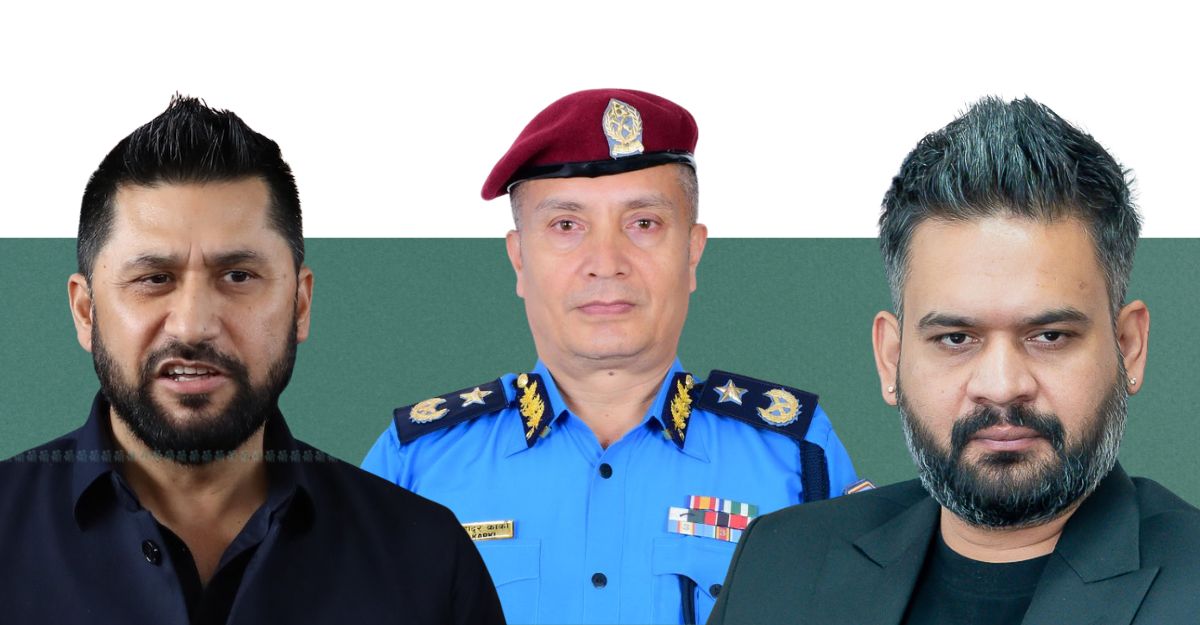
The government has removed Nepal Police Inspector General (IGP) Dan Bahadur Karki and appointed Manoj KC in his place. However, the government has not officially clarified why it was necessary to remove Karki, who was leading the country’s principal security organization, before the end of his tenure.
A Cabinet meeting held on Wednesday decided to appoint Karki as chief security adviser to Prime Minister Balen Shah. Additional Inspector General Manoj KC has been given charge of leading the police organization in his place.
The government created a new post of special security adviser at the IGP level at the Office of the Prime Minister and Council of Ministers and transferred Karki to that position.
This raises a serious question: If Karki was unable to discharge his responsibilities as police chief, what was the basis for appointing him as the prime minister’s security adviser? Conversely, if there was no serious concern about his performance, why was he removed from the leadership of the police organization?
Government spokesperson and Minister for Education and Sports Sasmit Pokharel said that Karki had not been punished and that only his responsibilities had been changed.
“This should not be viewed as disciplinary action. It is simply a reassignment of responsibilities. He has been appointed as a security adviser. There is now a new IGP, who will carry out the necessary duties,” Pokharel said.
However, he did not provide a concrete answer to the question of why Karki had to be removed as IGP.
Was Karki removed because his performance was unsatisfactory? Had he committed a serious mistake? Or was his leadership no longer acceptable because he repeatedly disagreed with the government? These are the questions the government must answer to the public.
The inspector general of police is an official who operates with the confidence of the government. However, the IGP is not merely an officer responsible for following the government's political directives. The IGP also heads an organization responsible for maintaining internal security, leading criminal investigations, and enforcing the law.
Therefore, removing the police chief is not simply a routine administrative decision by the government. It also concerns the institutional stability of the police organization, its professional independence, and the government's accountability.
The decision to remove Karki has also brought to the surface differences between Prime Minister Shah and Rabi Lamichhane, president of the ruling Rastriya Swatantra Party (RSP).
The prime minister and the party president had reportedly disagreed sharply over removing Karki before the end of his tenure. Lamichhane was opposed to removing a serving IGP without sufficient publicly verifiable reasons.
A leader close to Lamichhane told Setopati that he had insisted Karki should not be removed without reasons that could be publicly defended and explained to the people.
According to the leader, Shah and Lamichhane had a lengthy discussion about the matter during their most recent meeting as well. During that discussion, Lamichhane maintained that the rationale for removing Karki had to be justified.
Despite Lamichhane's opposition, the government decided to remove Karki as IGP.
This raises the question of whether Karki's removal reflects a broader disagreement between the prime minister and the ruling party's president. The conflicting statements issued by the government and party spokespersons regarding the appointment of the new IGP also point in that direction.
While government spokesperson Pokharel claimed that the police leadership was changed in accordance with a party directive, RSP spokesperson Jagdish Kharel said that the party did not instruct the government to remove or appoint any particular individual.
“The secretariat meeting held on Saturday issued instructions to investigate and take action over the police entering media offices and arresting journalists. However, it did not instruct the government to remove or dismiss anyone from their position,” Kharel told Setopati.
He added: “The government has not said that today's decision was made because the party called for action over the arrest of journalists. It has simply said that responsibilities have been reassigned. The government will probably clarify why it made such a decision. However, this was not a directive from the party.”
The prime minister's decision to proceed with such a sensitive change in the leadership of the country's principal security organization despite the ruling party president's opposition has raised further questions about the relationship between the two leaders and the government's decision-making process.
Disagreements had existed between PM Shah's government and Karki for some time. Reports had previously emerged of differences between the government and the police leadership over the arrests of prominent political figures, police deployment for investigations, and transfers of personnel.
Then came the Inam Sapkota case.
After Sapkota was arrested as part of a money-laundering investigation, alleged conversations and contact records found on his mobile phones drew senior figures in the judiciary, government, and security agencies into controversy. Karki's name was also linked to the case, and reports emerged that he was under pressure to resign.
Although speculation about his removal intensified following the Sapkota case, disagreements between Karki and the government had begun much earlier.
Karki was appointed inspector general by the government led by Sushila Karki on November 10, 2025. He assumed leadership of the organization on November 13.
Karki began his police career as an inspector in March 1998. Under the applicable 30-year service limit, he could have remained in service until March 2028.
In other words, his leadership tenure was cut short before his regular retirement.
Relations were strained since the formation of the government
After Shah became prime minister in March, questions began to emerge about what his relationship with the police leadership would be like.
Although Karki formally headed the police force at the time, reports suggested that the prime minister placed greater confidence in other senior police officers.
Manoj KC, in particular, was said to have maintained close coordination with the prime minister.
Reports emerged as early as mid-May that regular communication between the prime minister and Karki had become difficult and that the prime minister's advisers were playing an increasingly influential role in police transfers.
These disagreements predated Sapkota's arrest by a considerable period.
Nevertheless, claims that Karki had a poor personal relationship with the prime minister cannot, by themselves, justify his removal. The substantive disagreements between them are what matter.
Subsequent developments revealed several instances in which the government's preferred immediate action differed from the police leadership's position.
One major dispute that arose soon after the government was formed concerned the proposed arrests of former prime minister KP Sharma Oli and former home minister Ramesh Lekhak.
Following the government's decision to implement the report of the inquiry commission formed to investigate the incidents during the Gen Z protests, the process of taking both men into custody was initiated. Home Minister Sudan Gurung and IGP Karki reportedly disagreed over the matter.
The political leadership wanted the arrests to take place immediately. Karki, however, maintained that the commission's report, the evidence obtained through the investigation, and the legal grounds required for arrest had to be assessed.
Before proceeding with the arrests, IGP Karki had requested written instructions.
After Home Minister Gurung issued written instructions through the Home Ministry, Oli and Lekhak were arrested. However, both were subsequently released following a Supreme Court order.
Karki had not taken the position that the investigation should not proceed at all. The disagreement centered on the instruction to make immediate arrests and the procedures required to justify them.
Another disagreement between the government and Karki concerned the transfer of police personnel assigned to the Commission for the Investigation of Abuse of Authority.
Reports emerged that the political leadership had shown interest in, and exerted pressure for, the simultaneous recall of a large number of police personnel working at the commission.
The police leadership reportedly favored phased transfers, arguing that recalling too many personnel at once could disrupt ongoing investigations at the commission.
Ultimately, not all the officers were recalled simultaneously. Only some officers were transferred through the regular process.
This episode also demonstrated differing views between the government and police leadership over institutional decision-making procedures.
Another confrontation over the detention of a former chief justice
On the night of September 27, police took former chief justice Cholendra Shumsher Rana from his residence in Kathmandu's Bansbari area to Teku.
He returned home the following day.
Police clarified that Rana had not been formally arrested and had been brought to their office for security-related reasons. However, questions arose about the legal basis for taking a former chief justice into custody from his home at night.
Reports also emerged of disagreements between IGP Karki and Home Minister Gurung over this incident.
According to sources, Karki questioned the legal basis for the instructions to take Rana into custody. The political leadership at the Home Ministry, meanwhile, wanted to proceed with action.
The reported conversation between Karki and the home minister has not been independently verified. However, the incident in which Rana was taken into custody at night, followed by an official explanation that he had not been formally arrested, is a matter of public record.
The investigation that followed this episode led to another controversy, ultimately placing Karki's own leadership under scrutiny.
The Inam Sapkota case deepens the crisis
After Inam Sapkota was arrested at Tribhuvan International Airport on September 30, the scope of the police investigation widened.
Reports began to emerge that Sapkota, who had been arrested for investigation into an alleged money-laundering offense, had connections with influential figures in the government, judiciary, and security agencies.
Messages and documents reportedly recovered from his mobile phone linked the names of serving and former judges, senior police officers, and political figures to the case.
Karki's name also emerged in this context.
According to sources, Karki and Sapkota had also communicated through WhatsApp. A source close to Karki acknowledged that the two had been in contact but claimed that no improper assistance had been provided.
As Karki's name became associated with the Sapkota case, reports began to emerge toward mid-October that he was facing pressure to resign.
Claims surfaced that the prime minister's secretariat had sought his resignation and that discussions were underway about removing him if he refused to step down.
However, Nepal Police Headquarters denied those reports.
On October 29, Karki convened a meeting of the Police Coordination Committee (PCC), inviting deputy inspectors general heading all seven provincial police offices.
At the meeting, Karki said that he had not been asked to resign. The participants also discussed the public controversy surrounding the reputation of the police organization and the investigations in question.
There were calls for the organization to confront its problems collectively. Some officers argued that individuals should respond to allegations directed at them personally. Questions were also raised about whether a PCC meeting had been necessary merely because of reports appearing in the media. PCC meetings are generally convened to address policy matters within the police organization.
The episode suggests that the police leadership, which had repeatedly been drawn into controversy, considered it necessary to clarify its position within the organization.
However, another serious development emerged in the Sapkota case, raising questions not only about the police leadership's handling of the investigation but also about the role of the prime minister's secretariat.
Sapkota's phones were at the home of prime minister's chief adviser Kumar Ben
On November 3, Setopati reported that two mobile phones seized from Sapkota by police had remained in the possession of Kumar Ben, PM Shah's chief adviser, for two days before undergoing forensic examination.
According to senior police sources, Ben had kept the phones seized from Sapkota at his residence in Jwagal, Lalitpur.
Sources claimed that when police checked the phones' locations during that period, both devices appeared to be at Ben's residence.
The phones were returned to police two days later. A subsequent digital forensic examination reportedly found that WhatsApp, Facebook, and other social media platforms had been accessed on the devices, screenshots of various contents had been taken, and some messages had been deleted, according to police sources.
Sources further claimed that some of the deleted messages included conversations between Sapkota and Ben.
According to police sources, the phones also contained records indicating that Sapkota and Ben had been in regular contact for several months.
One alleged exchange reportedly involved Sapkota recommending to Ben that Ananta Raj Ghimire be selected as the RSP candidate for Dang Constituency No. 2 in the most recent election.
Sources also claimed that some screenshots subsequently made public from Sapkota's phone may have been taken by Ben while the devices were in his possession.
If the phones seized during an investigation were taken out of formal police custody, this raises serious questions about the security of digital evidence and the impartiality of the investigation.
How did the phones seized by police end up with the prime minister's chief adviser? On whose instructions were they handed over to him? What activities took place on the devices during those two days? Who will be held responsible for the alleged alteration of their contents?
These questions remain unanswered.
The case also suggests that disagreements may exist within the police organization over the handling of investigative information and evidence.
On the one hand, Karki's name was linked to his communications with Sapkota. On the other, the prime minister's chief adviser was accused of keeping investigative evidence in his possession.
The revelation that Ben allegedly held Sapkota's phones for two days before the forensic examination has also been viewed as a possible factor in Karki's removal. However, this raises another question: why was the head of the police organization removed when the person alleged to have held the phones should also be held accountable?
No public response has been given to the questions raised about the prime minister's chief adviser.
The government has also not disclosed what role, if any, the Sapkota case played in the decision to replace Karki.
Transfer delays created further friction with the government
The rift between the government and Karki had also been growing over routine administrative matters within the police organization.
Regular transfers of officers from the rank of police inspector to superintendent had been disrupted since August.
Reports indicated that police headquarters had prepared transfer proposals but could not implement them because political approval had not been forthcoming.
The delay in transferring officers who had remained in the same positions for more than a year had fueled dissatisfaction within the organization.
Police regulations give the IGP authority to transfer officers at certain ranks. In practice, however, transfers can be difficult to implement without the approval of the Home Ministry and the political leadership.
The same problem persisted during Karki's tenure.
Considered alongside the earlier dispute over police transfers at the anti-corruption commission and the more recent stalling of routine transfers, these incidents suggest that the political leadership's role in police administrative decisions has remained a source of controversy.
Karki was not free from controversy himself
It would nevertheless be wrong to dismiss all the questions raised about Karki simply because he disagreed with the government.
In July, a matter concerning the procurement of uniforms for election police personnel was raised at the House of Representatives' Public Accounts Committee.
During the discussion, ruling RSP lawmaker Khagendra Sunar alleged irregularities in the procurement process and questioned the police leadership.
A heated exchange took place between Karki and Sunar during the meeting.
The Public Accounts Committee subsequently formed a subcommittee led by lawmaker Manish Jha to investigate the uniform procurement issue.
However, an allegation of wrongdoing is not the same as proof that Karki committed corruption. His involvement has not been established through the investigation’s findings. The government decided to remove him before the subcommittee had completed its work.
Some of the language Sunar later used about Karki during a parliamentary session was removed from the official record at the speaker's direction.
Similarly, Karki's name being linked to the Inam Sapkota case cannot be presented as proof of a criminal offense established through an investigation.
If the government had concerns about Karki's conduct or performance, it should make the substantive grounds for those concerns public. Without such an explanation, both the allegations against him and his disagreements with the government remain open to competing interpretations.
Questions the government must answer
The government, which appoints the head of the police organization, is also responsible for evaluating their performance.
The inspector general is accountable to the government. The government, in turn, must be able to implement its security policies and lawful directives.
However, the IGP's responsibilities do not simply involve carrying out every action the political leadership wants to pursue immediately. They also include ensuring that there are sufficient legal grounds for taking people into custody, that investigations are impartial, and that the organization operates in accordance with the law.
Therefore, when assessing Karki's removal, the legal and institutional grounds for the decision matter more than the personal relationship between him and the government.
If Karki committed a serious act of misconduct, it should be investigated and appropriate action should follow. If the government concluded that his performance was unsatisfactory, it should clearly explain the basis for that conclusion.
But if he was removed simply because he disagreed with the political leadership over investigations or arrests, the decision raises serious questions about the professional independence of the police organization.
Although the police operate under the government, criminal investigations and law enforcement should not be directed by personal preferences or political interests.
The government spokesperson has described the decision as a reassignment of responsibilities rather than disciplinary action. That explanation, however, does not answer the fundamental question.
Why did the government change the leadership of a sensitive organization such as Nepal Police before the incumbent's tenure had ended, and on what legal basis did it do so?
Why did the prime minister proceed with the police leadership change when even the president of the ruling party had reportedly objected, arguing that there were no publicly verifiable grounds for removing Karki?
The responsibility for answering these questions rests with the government.