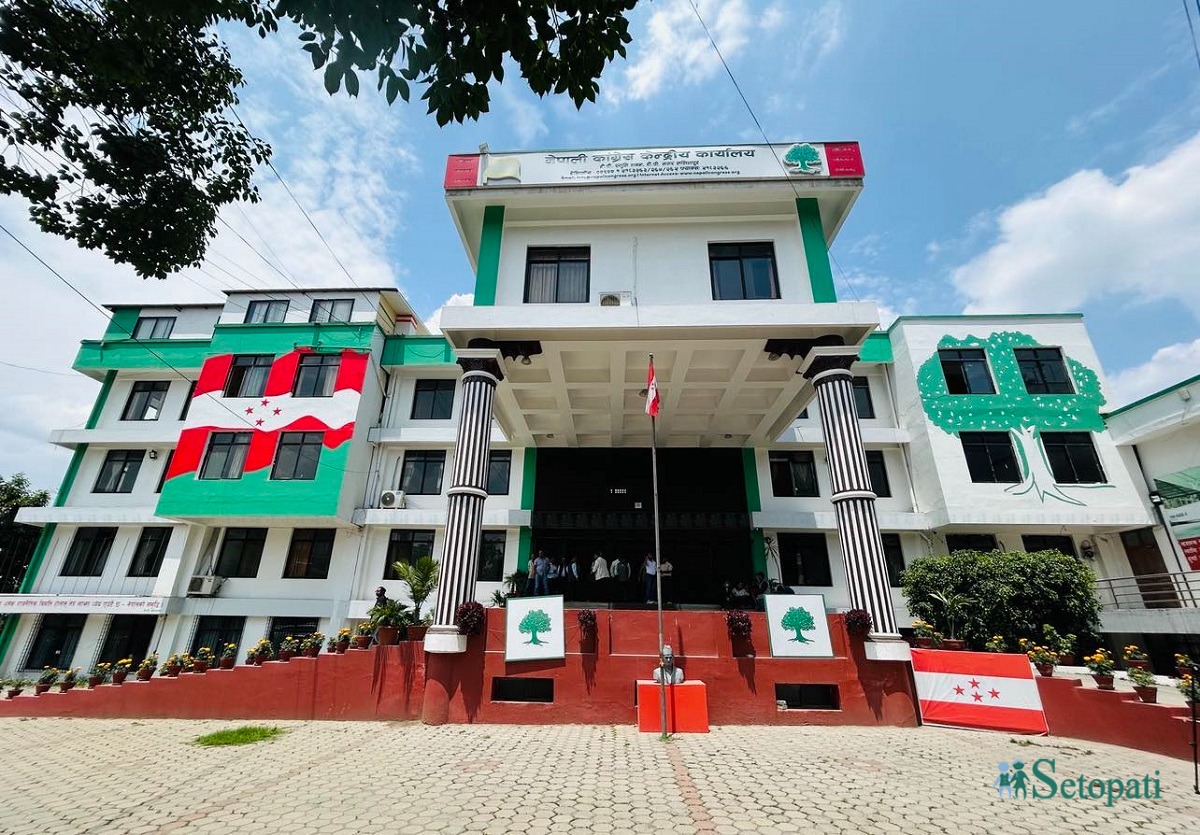
The main opposition party, Nepali Congress, has decided to file a writ petition in the Supreme Court challenging provisions in the House of Representatives Rules regarding constitutional amendments and special privileges to the rules.
On Friday, party office-bearers including President Gagan Thapa held discussions with legal experts on the proposed petition. Following the meeting, the party assigned lawyers to prepare the petition.
NC General Secretary Pradip Paudel confirmed the decision to Setopati.
"We have already consulted lawyers, and preparations for the writ petition are underway," Paudel said. "We will register it in the Supreme Court within this week."
The House of Representatives passed the rules on June 4. At the time, the Nepali Congress had argued that the draft should have been sent to a parliamentary committee for deliberations after the process had advanced.
Amid protests by the Nepali Congress, CPN-UML, Nepali Communist Party and other opposition parties, Speaker Dol Prasad Aryal passed the rules the same day.
What are the Nepali Congress' objections?
The party has objections to the provisions in Rule 140 and Rule 259 of the House of Representatives Rules.
Rule 140 lays out the procedure for amending the Constitution.
Nepal's Constitution has been amended twice. On both occasions amendment proposals were introduced separately in the House of Representatives and the National Assembly, where each chamber approved them by a two-thirds majority of its total membership.
The newly adopted House Rules, however, authorize the speaker to determine whether the combined votes of the existing members of both chambers amount to the required two-thirds majority. According to the Nepali Congress, this goes beyond the Constitution by allowing the speaker to calculate the combined votes of both Houses rather than requiring each chamber to separately meet the constitutional threshold.
The party argues that this provision is unconstitutional.
It has also objected to changes concerning the suspension of lawmakers facing criminal prosecution.
Under Rule 247, a lawmaker will be suspended only if they are detained while facing charges carrying a sentence of more than three years' imprisonment or involving offenses of moral turpitude.
As a result, lawmakers charged with serious criminal offenses such as corruption, money laundering, or human trafficking will not be suspended merely because charges have been filed against them.
They would be suspended only if a court orders their detention pending trial. This means lawmakers accused of corruption and other serious crimes could continue participating in parliamentary proceedings until they are remanded in custody.
The party further objects to Rule 259, which it says weakens the application of other laws by giving the speaker exclusive authority to interpret the House Rules and effectively elevating those rules above other legislation governing members of Parliament.
According to the Nepali Congress, this would make the parliamentary regulations a "super law" overriding other applicable laws. These two issues will form the core of its constitutional challenge before the Supreme Court.
Party preparing its position on constitutional amendments
The Nepali Congress is set to make public its official position on constitutional amendments later this week.
The party has not nominated a representative to the constitutional amendment task force led by Asim Shah, the prime minister's political advisor.
Instead, the party has constituted its own task force to study constitutional amendments. The task force is headed by Vice-president Pushpa Bhusal, and it is expected to release the party's position on constitutional amendments within the week.