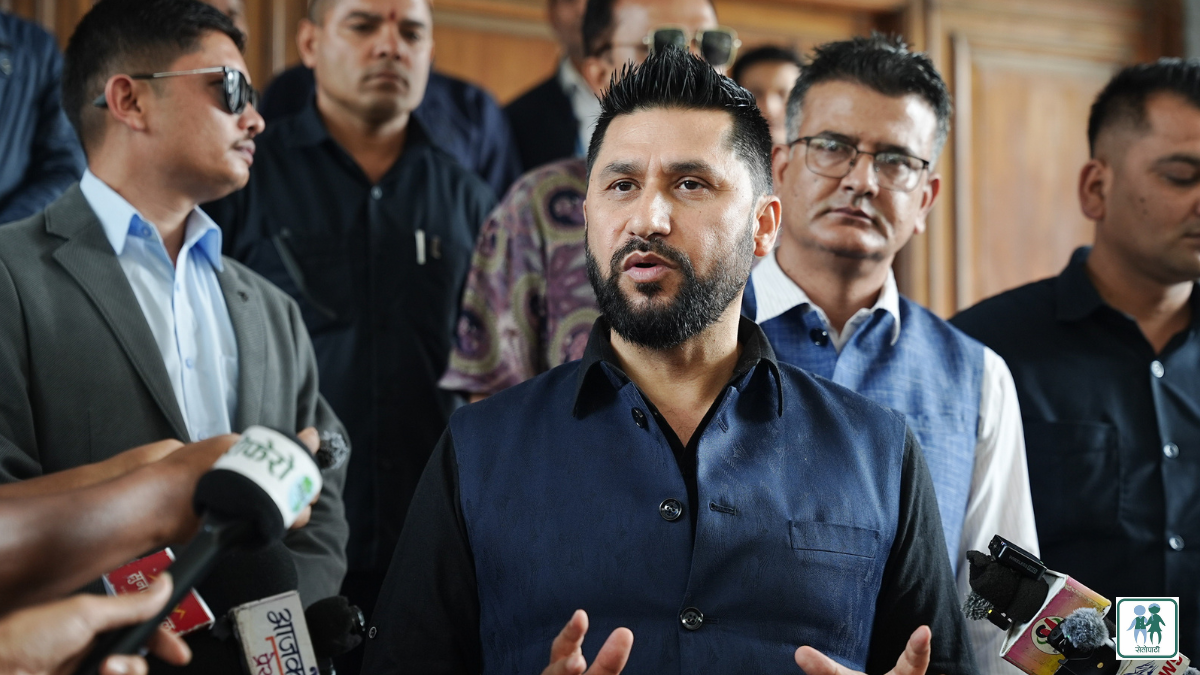
If the bill to amend the Passport Act, registered by the government in the House of Representatives, is passed in its current form, Rastriya Swatantra Party (RSP) President Rabi Lamichhane also appears likely to directly benefit from it.
A writ petition seeking prosecution of Lamichhane for allegedly obtaining a passport by submitting false details is currently sub judice in the Supreme Court.
If the proposed law comes into force, Lamichhane would not have to serve a prison sentence even if the Supreme Court orders his prosecution in the case. He would only have to pay a fine. However, the proposed amendment would not apply to him if the Supreme Court upholds an earlier decision by the attorney general not to prosecute him for passport misuse.
Section 21(a) of the existing Passport Act, 2019, prohibits obtaining a passport or travel document by submitting false details. Anyone committing the offense faces a fine of Rs 200,000 to Rs 500,000 or imprisonment for one to three years, or both.
However, the new amendment bill proposes removing imprisonment as a punishment for this offense.
Section 21(f) of the bill states that no person may obtain a passport by submitting false information. However, it proposes only a fine of Rs 100,000 to Rs 200,000 for anyone who obtains a passport by submitting false details. The director general of the Department of Passports would have the authority to impose the fine.
The bill would also prevent the government from investigating and prosecuting people who obtain passports by submitting false information.
Under Section 29 of the existing law, the Government of Nepal is a plaintiff in all offenses punishable under the act, meaning the government has the authority to investigate and prosecute such cases. Under the proposed bill, however, the government would be a plaintiff only in offenses other than those for which the director general is authorized to impose a fine.
If the proposed provision making the offense of obtaining a passport by providing false information punishable only by a fine is passed, the government would no longer be able to prosecute such cases.
What Is Lamichhane’s passport case?
A complaint was filed with the Ministry of Home Affairs seeking an investigation and prosecution of Lamichhane on allegations that he obtained a Nepali passport while still holding a valid United States passport. The Home Ministry forwarded the complaint to the District Police Range, Kathmandu, for investigation.
On March 20, 2023, then-attorney general Din Mani Pokharel decided not to prosecute Lamichhane for passport misuse.
Before that decision, the District Government Attorney’s Office, Kathmandu, and the High Government Attorney’s Office, Patan, had submitted reports to the Office of the Attorney General stating that there was no need to prosecute Lamichhane.
Under the current law, obtaining a passport by providing false information is considered a criminal offense.
What does the Foreign Ministry say?
Setopati spoke to around five officials at the Ministry of Foreign Affairs about whether the proposed changes to the Passport Act could be a “Rabi Lamichhane effect.”
Although the officials declined to speak on the record, they maintained that the bill was introduced to address practical problems faced by the general public.
“The draft of the bill had already been prepared a year ago,” one Foreign Ministry official said. “The bill was introduced to resolve administrative problems rather than to benefit any particular individual.”
According to another Foreign Ministry official, the bill was drafted on the principle that since passports are issued solely on the basis of citizenship certificates and national identity cards, any false information would originate in those underlying documents. Therefore, the official said, the proposed law envisions only a fine for false information in passport applications.
The bill registered in Parliament also removes “traveling abroad without obtaining a passport and visa” from the list of offenses. Similarly, the provision under which failure to comply with an order or directive issued by the Government of Nepal constitutes an offense has been removed through the proposed amendment.
Another Foreign Ministry official said that the proposed fine was intended to reduce the hassles citizens face when obtaining passports.
According to the official, since the discovery of false information can sometimes lead to lengthy procedures from District Administration Offices to courts, the proposed amendment seeks to simplify the process by imposing an administrative fine instead.
What do legal experts say?
Legal experts say Lamichhane would be the direct beneficiary if the proposed bill is passed.
They say that even if the Supreme Court orders his prosecution, the new punishment regime would apply to Lamichhane.
According to legal experts, while jurisprudence recognizes that cases are prosecuted according to the law in force at the time the offense was committed, a later law providing a lighter or reduced punishment is applied when determining the sentence.
In other words, even if Lamichhane is prosecuted and convicted after the new law comes into force, he would only have to pay a fine.
Foreign missions may no longer have to be notified of passport cancellations
Section 15 of the existing act allows a passport to be canceled if it was obtained by submitting false information. When a passport is canceled on these grounds, the Department of Passports is required to notify the relevant government agency, foreign diplomatic missions in Nepal, and the Interpol office in Nepal.
The proposed bill provides for passport cancellation if the passport holder obtained it by using a fake, forged, another person’s or dual citizenship certificate, national identity card, or minor identity card, or by submitting false information.
However, if the original canceled passport cannot be obtained by the Department of Passports, the proposed law would require notification only to Interpol.
Thus, the bill proposes removing the mandatory requirement to notify foreign missions in Nepal when a passport is canceled.
The bill will become law after it is passed by both the House of Representatives and the National Assembly and authenticated by the president.