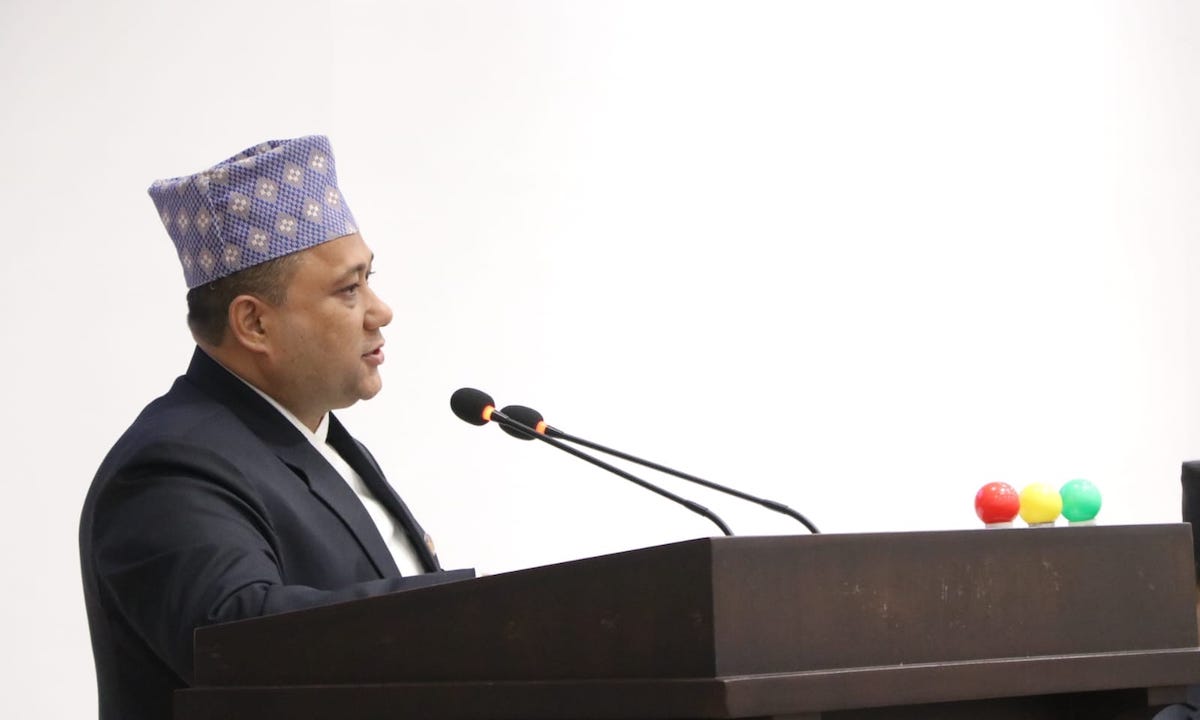
Foreign Minister Shishir Khanal has said that the government does not have clear information on whether Nepal possesses the original official copies of the historic treaties signed with Britain and India.
Khanal made the statement while responding to a question raised by Nepali Congress Chief Whip Nishkal Rai during Monday’s meeting of the House of Representatives.
During the question-and-answer session with lawmakers, Rai asked whether Nepal has the original copy of the 1816 Sugauli Treaty with Britain and the 1950 Treaty of Peace and Friendship with India.
The Sugauli Treaty has recently drawn renewed attention after Prime Minister Balendra Shah told Parliament that Nepal was in talks with the British government regarding the Lipulekh and Limpiyadhura border dispute with India. Shah also said that Nepal believes the British government should have a role in the matter.
The Lipulekh and Limpiyadhura border dispute is linked to the Sugauli Treaty signed between Nepal and British India on March 5, 1816.
Following the prime minister’s statement in Parliament, it was reported that the government had informally requested the British government to provide historical maps and documents related to the boundary established during the Sugauli Treaty.
Responding to Rai’s question, Foreign Minister Khanal said that although some documents related to both treaties are available at the National Archives, the government does not know whether they are the formal original treaty documents.
“As far as I know, we have some documents related to the 1816 and 1950 treaties. However, the Nepal government does not have clear information on whether these are the formal treaty documents themselves,” Khanal said.
He added that the National Archives has records related to some treaties, but it remains unclear whether they constitute the original official treaties.
Lawmaker Rai also asked when the Ministry of Foreign Affairs would be able to operate from its own building.
"Over the last 20 years, the Ministry of Foreign Affairs has been shifted at times to Sheetal Niwas, at times to the Narayanhiti Palace Museum, and at times to the Ministry of Finance building. During these relocations, some historical documents have been lost, and some are at risk of being lost. When will the Ministry of Foreign Affairs get its permanent building?" he asked.
In response, Minister Khanal said that construction work on the Ministry of Foreign Affairs' own building would begin from the upcoming fiscal year.
Stating that preliminary work for the building's construction had already moved forward, he said, "Preparations are underway to build the Ministry of Foreign Affairs building on the land currently occupied by the Ministry of Home Affairs. Consultants have been selected for the architectural drawing, design, and engineering work of the building, and the preliminary design has already been prepared."
He said that the architectural drawing and design of the building are currently under discussion at the ministry and are in the stage of approval.
According to Minister Khanal, a budget of Rs 500 million has been allocated for the construction of the Ministry of Foreign Affairs' own building in the fiscal year 2026-27. He said that work would commence in the next fiscal year by inviting tenders for the construction of the building.
Minister Khanal clarified that although the Ministry of Foreign Affairs has been relocated at various times due to administrative requirements, building availability, and structural management, the preservation of historical documents, papers, facts, and evidence has been taken seriously.
He said that legal provisions are in place for the preservation and management of treaties and agreements to which Nepal government is a party.
Khanal noted that under the Nepal Treaty Act, 1990, the Ministry of Foreign Affairs handles treaties, negotiations, diplomatic communications, and other treaty-related work at the international level on behalf of the government, Khanal said.
He added that under the Government of Nepal (Allocation of Business) Rules, matters concerning treaties, agreements and their records fall within the jurisdiction of the Ministry of Law, Justice, and Parliamentary Affairs, while the responsibility for long-term preservation and management of historical documents of national importance has been assigned to the National Archives.
"The Ministry of Foreign Affairs is coordinating with relevant bodies for the search, verification, digitization, and safe preservation of historically and diplomatically important documents," he said. "For this, work has been moved forward by forming a separate archive management branch at the ministry."
Minister Khanal said that old treaties and agreements signed by Nepal with various countries and international organizations would be gradually reviewed, revised, and renewed.
The progress report presented under Article 53 of the Constitution mentions that there are a total of 655 treaties and agreements – 412 bilateral agreements with neighbors and friendly nations, and 243 multilateral agreements with regional organizations and other parties. Among these, 55 treaties and agreements have been completed or revised so far.
Minister Khanal said that the government's policy is to review, revise, and renew the remaining 600 treaties and agreements based on necessity and justification.
He added that the review of treaties and agreements would take place at an appropriate time, keeping Nepal's national interest at the center, in cooperation and agreement with the relevant friendly nations and international organizations.
He clarified that according to international law and diplomatic practices, the review, revision, or renewal of bilateral or multilateral treaties and agreements depends on the mutual consent and approval of the state parties or international organizations concerned.
To make the review of treaties and agreements systematic, effective, and time-bound, coordination would be maintained between the Ministry of Foreign Affairs, the Ministry of Law, Justice, and Parliamentary Affairs, and relevant ministries, Minister Khanal said.
He added that proposals and negotiations would be advanced through diplomatic channels with the countries or organizations concerned, and treaties and agreements that achieve mutual consent would be gradually finalized.