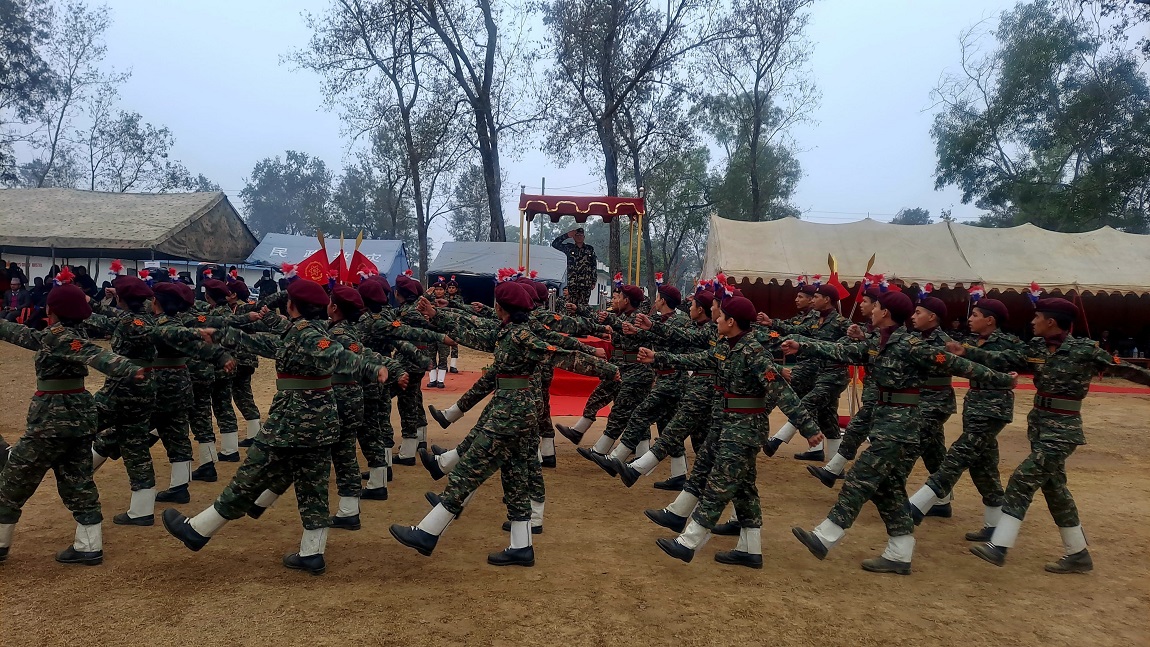
The government has registered the National Service Corps Bill in the House of Representatives, which includes provisions allowing the Nepal Army to provide training to any individual.
The bill, registered by Prime Minister Balen Shah, who also holds the defense portfolio, makes arrangements to provide two-tier training to students aged 13 to 21 years.
Section 18 of the bill states that “if the Government of Nepal, Council of Ministers deems it necessary, the Service Corps may also provide training to other individuals and institutions on the basis of of national necessity.”
The bill also includes a provision that would allow deploying students and other trained individuals as volunteers in national service.
However, the bill does not clearly specify where and under what circumstances volunteers would be deployed. It only states that the Council of Ministers will determine the authority for such deployment.
The concept paper on the National Service Corps, registered along with the bill, mentions that such volunteers could also be deployed in security-related duties.
“Regarding the use and deployment of National Service Corps cadets, the functions, duties, and rights of the National Service Corps shall include addressing public service, infrastructure development, disaster management, epidemic control, nature and environment protection, culture and heritage preservation and promotion, security, service, sports, and various other areas deemed necessary in the prevailing situation,” the bill states while explaining the need for a new law.
The bill also states that “volunteers shall be prepared who can be mobilized under the Nepal Army in special circumstances as prescribed.”
Although the bill uses indirect language to include provisions for training to “other citizens,” the concept paper explicitly states that in the event of internal conflict or war, any Nepali citizen could be given training by the Service Corps.
“Notwithstanding anything contained elsewhere in the Act, in special circumstances and during times of war or internal conflict, any Nepali citizen may be provided training by the Service Corps,” the concept paper submitted with the bill reads.
According to the bill, such training would be provided by serving Nepal Army personnel. The director general of the Service Corps would be a retired lieutenant general of the Nepali Army. The chief of army staff would recommend the director general, and the appointment would be made by the Cabinet.
The head of the training academy for students and other individuals would be a military officer designated by the army chief. If additional staff are needed for the Service Corps, they would be deputed from the Nepal Army, civil service, or other services.
The bill proposes a six-member committee for policy decisions of the Service Corps. The defense minister would chair the committee, with the director general serving as member-secretary.
The steering committee would include the chief of army staff and lieutenant general of the Nepal Army as members. The secretaries of the Ministry of Defense and the Ministry of Education and Sports would also serve as members.
The bill includes provisions for two levels of training in the Service Corps. Students from Class 8 to 10 (aged 13 to 18) would be able to participate in the junior division, while students aged 16 to 21 could take in the senior division training.
The uniform for cadets would be determined by the Nepal Army. The bill also allows for the formation of an alumni group of those who complete the training. However, the bill is silent on the exact duration of such cadet training.
The National Service Corps Act was originally formulated in 1970 during King Mahendra’s direct rule. However, the new bill has removed one important provision from the existing law.
The current act states: “A person enrolled in the Service Corps shall not be compelled to serve in the military service solely because of enrollment in the Service Corps.” This protective provision has been removed in the new bill.
The existing act describes the Service Corps training as “military training” in its preamble. The new bill makes no mention of the nature of the training.
The bill states that senior division cadets would receive weapons handling training as well.
The Defense Ministry would not have the authority to give direct instructions to the Service Corps, as the bill requires such directives to be issued through the Nepal Army.