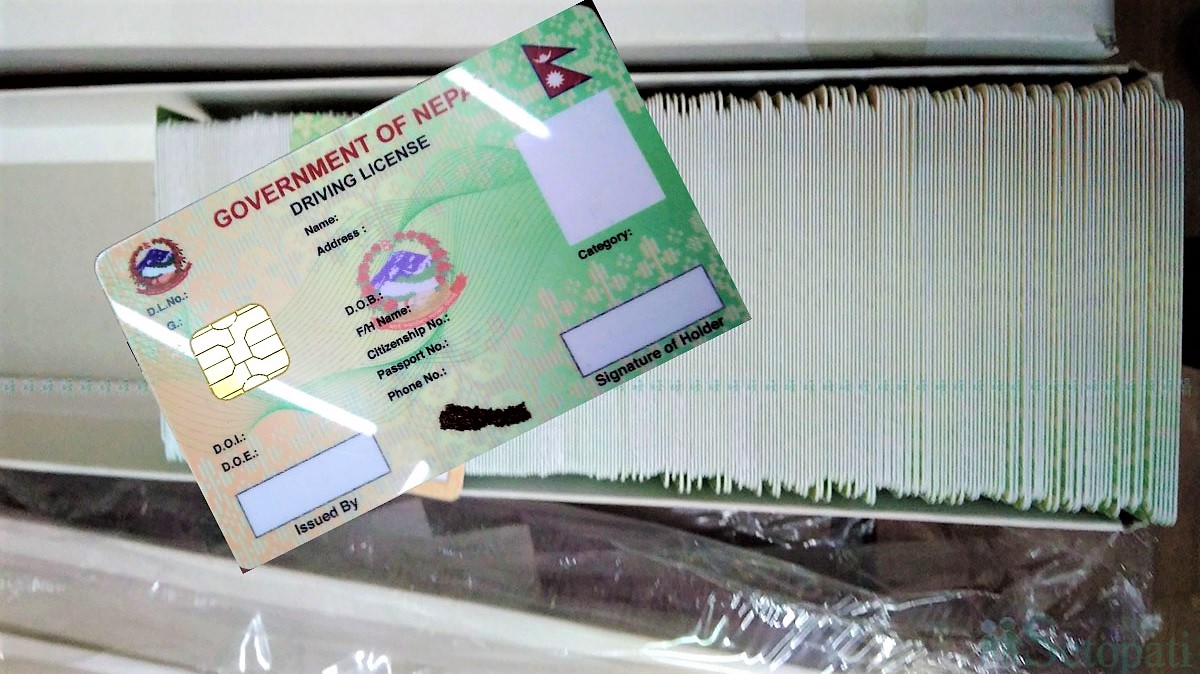
The government led by Prime Minister Balen Shah has made remarkable progress in the driving license-related provisions announced in the 100-day governance reform agenda.
In the governance reform agenda issued by the Cabinet meeting held immediately after the swearing-in ceremony on March 27, it was stated that "passports, citizenship certificate copies, licenses, and other government documents will be delivered to homes within 100 days."
Setopati spoke with Keshav Khatiwada, information technology director at the Department of Transport Management, about the progress on license distribution.
According to him, when this government was formed, 2.9 million licenses remained to be printed. Of these, approximately 2.4 million licenses have been printed in the last three months (until Tuesday evening).
"We have already sent the printed licenses to the respective offices for distribution. Many service-seekers have already received their new licenses," Khatiwada told Setopati. "By Friday (July 3), 2.6 million licenses will be printed. After that, the long-pending printing work will be completed."
He added that a public notice will be issued on Friday regarding the remaining 300,000 licenses to be printed.
When asked why a public notice is being issued for the remaining licenses, he explained: "Previously, the validity of licenses was 5 years. After July 30, 2026, it was changed to 10 years. Therefore, we have put on hold the 300,000 service seekers whose old licenses have less than one year of validity remaining."
He said that they were put on hold because printing them now would mean new passports would need to be reprinted again after a short period.
For these 300,000 individuals, a public notice will be issued offering two options: either print new licenses immediately or print 10-year licenses once the remaining validity period is over.
"We have put them on hold only so that service seekers do not face double hassle and do not have to renew their licenses again after a short time," he said. "If anyone comes and says they want it printed even for six months, we will do it immediately."
According to him, printing licenses frequently increases costs for those with less than one year of validity period left. Currently, the renewal fee is Rs 1,500 for two-wheeler licenses and Rs 2,500 for four-wheelers. Obtaining a new license now would mean paying the fee twice in a short period.
Khatiwada said that the government has completed the long-pending work by printing 2.6 million licenses within three months, and is also promptly processing new license applications received during this period.
Along with resolving the issue of remaining licenses to be printed, the department is now also working on implementing the "home delivery" service mentioned in the government's agenda.
Khatiwada said that work is underway with the target of delivering licenses to service seekers at their homes from July 17.
For this, the department has developed a new system for license distribution. From July 17, those applying for licenses will have to fill in the delivery address in the form itself. The department will deliver the licenses via postal service based on that address.
"We have built a system for this. How effective it will be remains to be seen," he said. "But we have started it."
Concerns have also been raised that since the department printed the licenses in such a short period, they do not contain the necessary chips, making them easy to counterfeit.
When asked about this, Khatiwada explained that traffic police and transport offices require appropriate scanning equipment for chip-enabled licenses. Since the government currently does not have a sufficient number of such equipment, they have produced excellent licenses using the systems and equipment currently available with the government, he added.
"If we had gone for chip-based licenses like before, we would have had to go through a tender process, which would have taken a long time. So we printed them at Nepal's own printing center in a way that could be done quickly," he said.
He denied the possibility of counterfeiting even without chips.
"We have placed QR codes instead of chips. While chips had 17 security features, the current ones have 37 security features and use 7 different types of colors," he said. "Therefore, it is easy to verify during inspection whether a license is genuine or fake."
According to him, the QR codes used in the currently printed licenses contain information in three layers.
When scanned by the service seekers themselves, only limited details are visible. When scanned by traffic police, the details they need (including renewal and fines) appear. Finally, when scanned by the transport office, the full details of the service seeker can be viewed.
Additionally, the license holder’s photo has been placed on both sides of the license. Everyone can see the photo on one side, while the photo on the other side requires special equipment to view. The letters used in the name are also of different types. Khatiwada says these security features make counterfeiting very difficult.