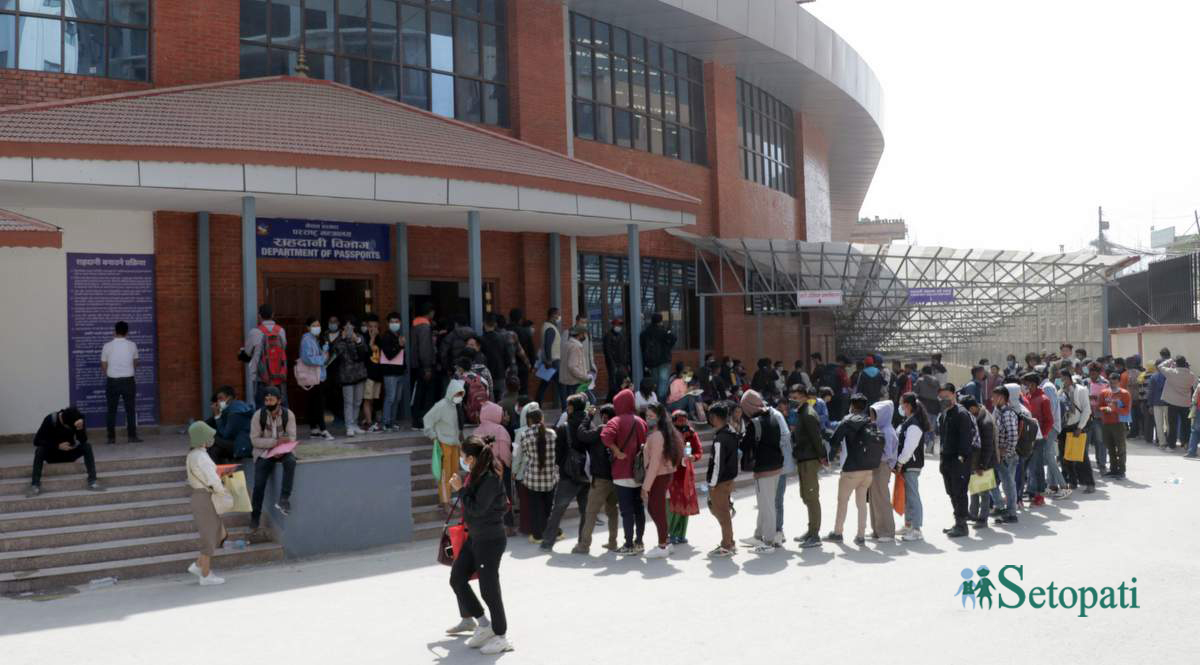
After the Commission for the Investigation of Abuse of Authority (CIAA) filed corruption charges against employees of the Department of Passports and two German companies awarded the contract for printing new passports, concerns have grown over how many old passport booklets remain in stock and how long they will last.
According to a source at the Department of Passports, as of Wednesday, the department has around 65,000 copies of 34-page passport booklets and a total of about 70,000 old passport booklets, including 66-page versions.
The source said that the department is currently issuing between 3,000 and 4,000 passports per day.
Based on an average daily demand of 3,500 passports, the existing stock is sufficient for around 20 days. Taking into account the two weekly public holidays, the current stock of passport booklets is expected to be exhausted within the next 25 to 30 days.
The German companies have said that preparations for printing new passports have been completed. They have also said that the migration of data from the old French company's server has been finalized.
On June 16, Prime Minister Balen Shah's advisors Asim Shah, Bibek Mishra, and Madhav Khanal visited the Department of Passports. German engineers filled out Shah's application form, took his photograph, recorded his retinal scan and other biometric details, and immediately processed and printed a sample passport in his name.
The German companies had earlier demonstrated similar sample passports to the department in April. After the prime minister’s aides claimed that the companies were not yet ready to print passports, the companies invited the team, including Shah, and demonstrated the process.
In a letter sent to the Department of Passports on June 19, the German firms said that they had completed all preparations to begin live printing of new passports from July 15, as previously agreed.
They also requested security arrangements for their engineers and other staff, along with the completion of all tasks required from the department.
However, the department source said that although all preparations for printing new passports using German machines have been completed, they cannot start printing new passports immediately due to the existing old stock.
"We cannot simply discard the more than 70,000 passport booklets currently in stock and start printing new ones. Before printing new passports using German machines, these old passports must be largely utilized," a source said.
At current prices, the stock of 70,000 passport booklets is worth around Rs 110 million.
To avoid a shortage of passports, the government led by Sushila Karki had earlier purchased 700,000 passport booklets from the previous French supplier.
Since those booklets have not yet been fully utilized, new passports have not been printed. The old and new systems cannot be used simultaneously to print passports.
On June 15, CIAA officials were summoned to the Prime Minister's Office, where they were kept for nearly nine hours by aides to the prime minister and pressured to file a corruption case over alleged irregularities in the passport contract.
Amid that pressure, two officials who had gone to Singha Durbar for discussions were arrested by the CIAA in connection with the same case.
The CIAA has since filed a case at the Special Court over the passport contract.
Following the filing of the case, the government must now decide how to proceed with the passport contract, However, it has not made any decision yet.
If the government allows the German companies to proceed with printing new passports while the case remains under judicial review, it would ensure availability of passports for citizens.
However, if the government cancels the contract with the German firms, it could create further uncertainty. The companies would most likely take the matter to arbitration.
If the government loses such a case, it may be required to pay compensation to the German companies.
Furthermore, if a contract involving a German state-owned company is terminated at the final stage, the German government is likely to formally protest to the Government of Nepal.
Scrapping the contract would also create the challenge of finding an alternative source for new passports.