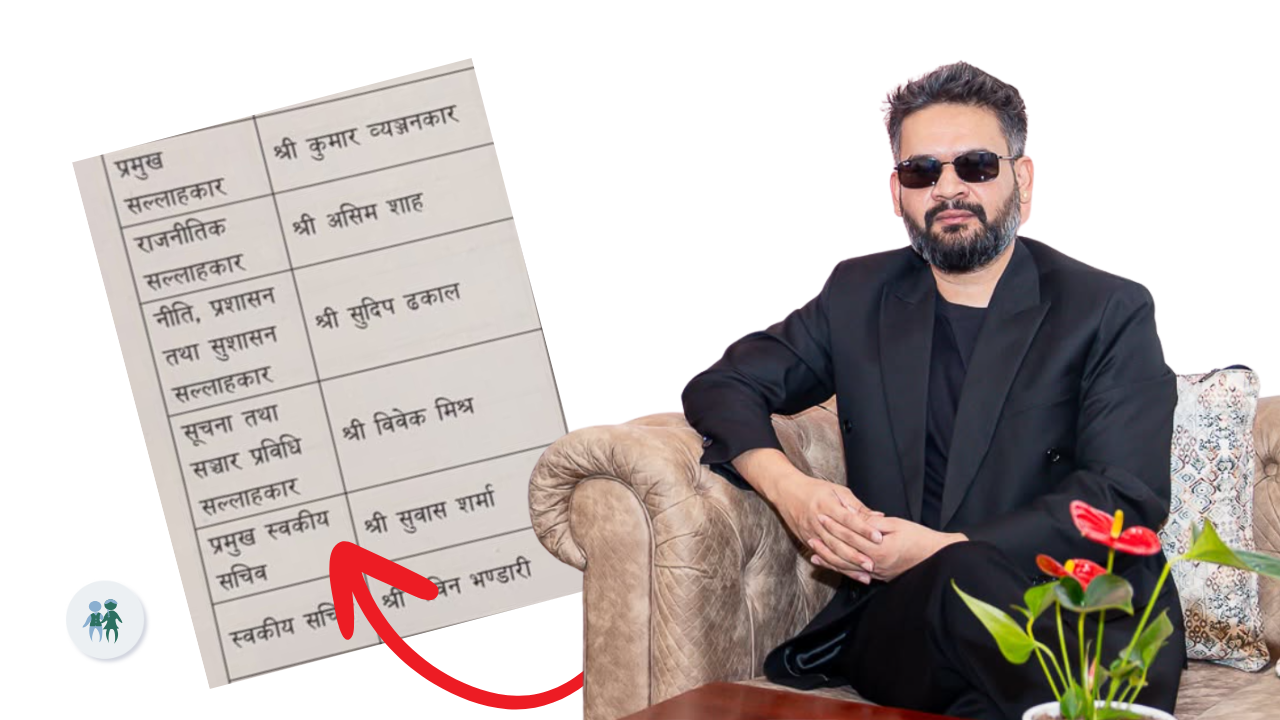
It has emerged that Prime Minister Balen Shah has appointed 27 people to his secretariat.
The Office of the Prime Minister and Council of Ministers disclosed the number of appointments made to the secretariat in response to a written question submitted under the House of Representatives Regulations by Sita Thapaliya (Urmila), a lawmaker from the main opposition Nepali Congress.
PM Shah has appointed Chief Advisor Kumar Ben and Political Advisor Asim Shah with perks and benefits on a par with those of a minister.
He has also appointed two people with perks and benefits on a par with those of a ministers of state. The appointees are Policy, Administration, and Good Governance Advisor Sudeep Dhakal and Information and Communication Technology Advisor Bibek Mishra.
PM Shah had reduced the number of ministries from 22 to 18, but has appointed two people with ministerial-level facilities and two with state minister-level facilities to his own secretariat.
The prime minister’s secretariat is allowed to have up to 48 staff members.
Former prime minister KP Sharma Oli had previously appointed up to 66 people to his secretariat. Sushila Karki, who became interim prime minister after the Gen Z movement, initially appointed 20 people, but later decided to have a six-member secretariat following protests by Gen Z activists.
One honorary health advisor has also been appointed to the prime minister’s secretariat.
In her question registered with the Parliament Secretariat, NC lawmaker Thapaliya had asked under which law and at what levels people had been appointed to PM Shah’s secretariat, as well as what facilities they were entitled to. She had also asked whether they received vehicles.
In response, Secretary at the Prime Minister’s Office Pushkar Sapkota said that the appointments of ministerial-level advisors had been made under the Prime Minister’s Advisor and Secretariat Management Procedure, 2017. The Prime Minister’s Office also provides vehicles and drivers to secretariat members appointed with facilities equivalent to those of ministers and ministers of state.
However, Secretary Sapkota does not appear to have provided a specific answer to several questions raised by Thapaliya.
Although Thapaliya had asked how many vehicles were being used by the secretariat, no answer was provided.
Similarly, the Prime Minister’s Office did not answer the question about the secretariat’s monthly expenditure. It also did not respond to the question regarding how much the expenses including telephone, snacks, and petroleum amount to in the secretariat.
The government, formed under the slogan of good governance following the Gen Z movement of September 8 and 9, 2025, is found to have even concealed the answers to questions submitted in writing by the lawmaker.
Thapaliya had asked how much burden the secretariat’s facilities placed on the state treasury. However, the Office of the Prime Minister and Council of Ministers did not answer that question either.
Thapaliya told Setopati that the response from the Prime Minister’s Office was unsatisfactory.
“The answers to my questions were neither adequate nor satisfactory,” Thapaliya said. “I am allowed to ask questions again, and I will ask the same questions again until I receive satisfactory answers.”
She also expressed dissatisfaction over the lack of response to questions regarding the burden caused by the secretariat on the state treasury and the number of vehicles being used by the prime minister’s secretariat.
Secretary Sapkota said that office-bearers and employees are entitled to facilities provided under the law to the corresponding category of employees of the Nepal government.
Secretariats of other ministers
The government recently decided that ministers of the Ministry of Energy, Water Resources, and Irrigation; the Ministry of Infrastructure Development; and the Ministry of Agriculture, Forests, and Environment may appoint up to five advisors, including one paid advisor equivalent in rank to a special-class government official.
According to the decision, other ministers may appoint up to three advisors, including one paid advisor equivalent in rank to a special-class government official.
In addition to advisors, ministers are provided with personal secretariats. The staffing structure allows ministers to appoint up to nine people to their secretariats.