Former president Bidya Devi Bhandari’s appearance as the chief guest at a recent CPN-UML event has fueled speculation over whether her political rift with party Chairman KP Sharma Oli has come to an end.
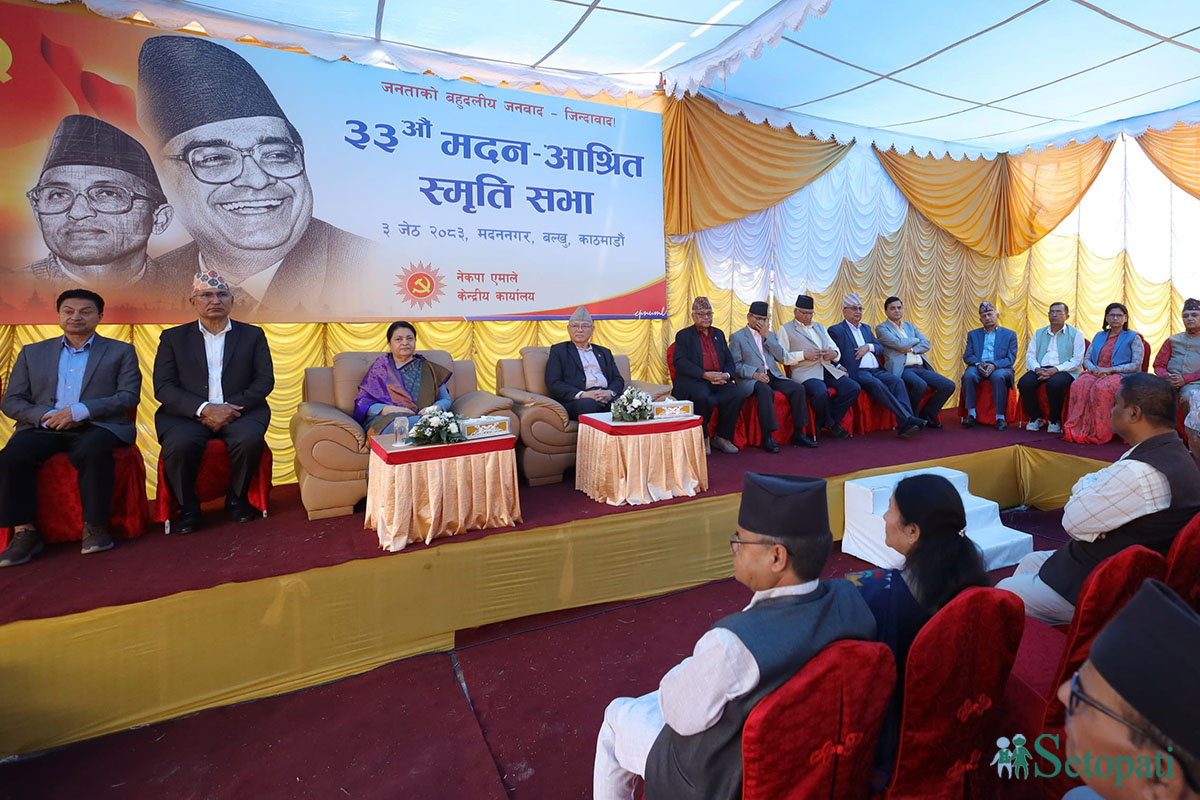
Bhandari, whose party membership had previously been revoked, was the chief guest at the 33rd Madan-Ashrit Memorial Assembly organized on Sunday by the UML at the ruins of its former headquarters in Balkhu, Kathmandu.
Although political rift between Oli and Bhandari had reportedly widened in recent months, party insiders say the decision to invite her as chief guest was made in accordance with Oli's own wishes.
Oli, who is currently recovering after undergoing gallbladder and hernia surgeries, said that he would not attend Sunday’s event and suggested making Bhandari the chief guest instead, according to party leaders.
"Two days ago, office secretary Dr Bhishma Adhikari called Bhandari’s personal secretary, Rajkumar Rai, asking about the former president’s current residence to deliver the chief guest invitation card. How could the office secretary decide on the event’s chief guest without the chairman's explicit instruction?" a leader close to Bhandari told Setopati.
Oli has recently stayed away from public events and is recovering at his residence in Gundu, Bhaktapur. A UML secretariat meeting scheduled for Saturday was also postponed to Monday citing Oli’s health condition.
Sunday’s event was chaired by Vice-chairman Ram Bahadur Thapa and attended by senior UML leaders including Vice-chairman Bishnu Prasad Paudel and General Secretary Shankar Pokharel. They had earlier supported revoking Bhandari’s party membership.
When asked whether Oli's health was the sole reason behind Bhandari suddenly becoming the chief guest or if it also carried a deeper political message, a UML office-bearer argued that his health was not the only reason. The leader said that this development should be understood as a reconciliation between Chairman Oli and Bhandari.
"In fact, this scene should have unfolded earlier. The way the central committee meeting last August revoked Bhandari's renewed party membership was a blunder," the leader said. "People remarked that even a former party vice-chairman, who had played a crucial role in bringing them to power, could be treated like this. Making her the chief guest today was a course correction."
The leader said that the establishment faction is pleased with the improving relationship between Oli and Bhandari.
"Albeit late, something that should have been done yesterday has finally happened today. We are happy," said the leader considered close to Oli.
However, another UML office-bearer refused to accept this narrative, claiming that Oli was forced by circumstance to mend fences with Bhandari.
According to him, Oli is currently facing a crisis. Following the party's ouster from power during the Gen Z movement, the UML has been severely weakened. In the House of Representatives election held on March 5, the UML managed to win only nine first-past-the-post (direct) seats. The party has 25 lawmakers in the House of Representatives, including 16 under the proportional representation system.
Concluding that the party movement cannot be revived under Oli’s leadership, several leaders from the establishment faction have begun looking for alternatives.
With heavyweights like Vice-chairmen Bishnu Paudel, Prithvi Subba Gurung, and Raghuji Panta, along with General Secretary Shankar Pokharel, seeking an alternative, Oli is facing both a political and moral crisis. It is natural for Oli to feel cornered when the very leaders who pushed for his leadership renewal during the 11th general convention last November are now demanding that he step down and accept the role of a guardian.
UML insiders say Oli is seeking Bhandari's support to defuse this crisis, a theory that many leaders believe was confirmed by Sunday's event.
Oli, who was arrested on charges of culpable homicide due to negligence during the Gen Z movement, was released on April 9. Even before his release, debates regarding a leadership change had begun within the UML. Right after the elections, Vice-chairman Paudel had advised Oli to pave the way for a successor – a stance General Secretary Pokharel also agreed with.
Faced with mounting pressure, Oli then initiated dialogues with Bhandari, say leaders close to him.
Their communication gained momentum when Bhandari visited Oli at Tribhuvan University Teaching Hospital during his illness. Following his discharge on April 19, Bhandari traveled to Gundu to meet Oli, where they held an extended discussion.
"Bhandari is well aware of the internal friction and the growing discontent within Oli’s own camp," a UML leader noted.
Therefore, leaders noticed a shift in Bhandari's tone recently. She reportedly told visiting leaders that Oli was not solely responsible for the party's crisis and electoral defeat, hinting instead at the need for collective accountability.
Bhandari hinted at this improved relationship even during her speech on Sunday. She did not talk about the ongoing debate regarding leadership change or party restructuring, choosing instead to emphasize the need for an ideological revival.
"I sincerely urge everyone to view this Memorial Day not just as a formal event, but as an opportunity for ideological revival and new resolve," she said. She added that the UML must practice a people-oriented working style, self-discipline, and a spirit of service to regain public trust.
The UML central committee meeting held on July 21-22, 2025, had revoked Bhandari’s renewed membership based on three primary grounds.
The party argued that since Bhandari had ascended to the prestigious, supra-party constitutional post of president, her party membership automatically became inactive upon taking office.
The party contended that to maintain the dignity of the former president's office and strengthen the democratic system, it was inappropriate for her to return to active politics.
Interpreting Articles 8 and 9 of the party statute, the leadership argued that Bhandari’s return to active politics could undermine the dignity of the former president’s office.
Oli himself had put forward these arguments, standing firm on them during both the second statute convention and the 11th general convention. At the 11th general convention, Bhandari went head-to-head against Oli, with Ishwar Pokharel – whom she supported – contesting against Oli for the party chairmanship.
Yet, less than six months after the conclusion of the general convention, Oli is moving swiftly to bury the old animosity.