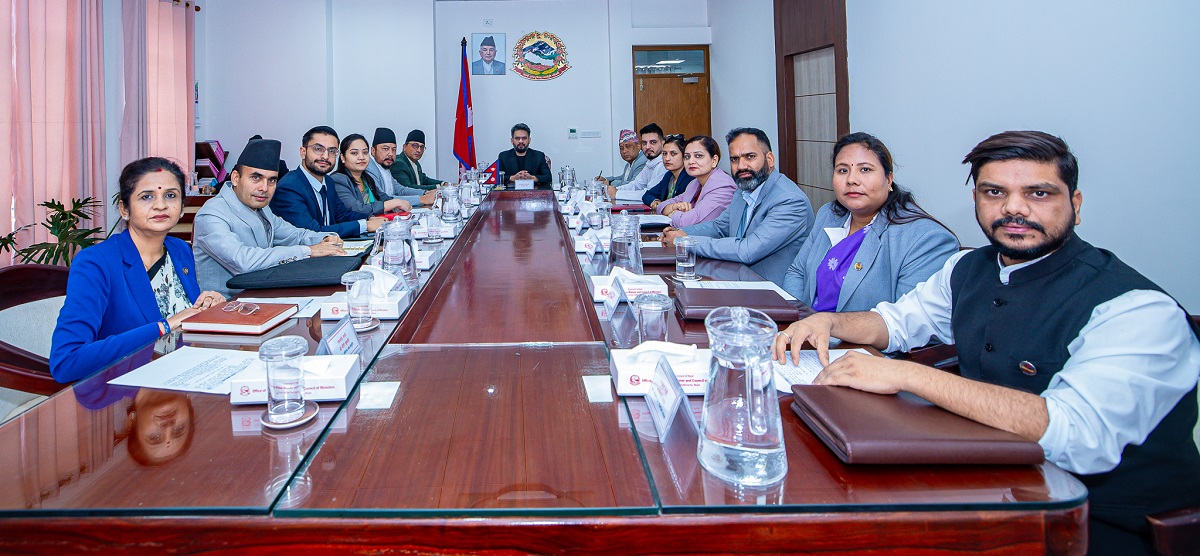
The government has decided to reduce the number of federal ministries from 22 to 18.
A Cabinet meeting held on Wednesday approved the Government of Nepal (Allocation of Business) Rules, 2026, formalizing the reduction.
According to Dipa Dahal, press and investigation expert to Prime Minister Balen Shah, the ministries of Finance, Home Affairs, Foreign Affairs, Defense, and Law, Justice, and Parliamentary Affairs remain unchanged. Similarly, the ministries of Industry, Commerce and Supplies; Culture, Tourism and Civil Aviation; and Energy, Water Resources and Irrigation have been retained in their current forms.
Prioritizing technology and invention, the government has established a separate Ministry of Science, Technology and Innovation by removing the science and technology portfolio from the former Ministry of Education and adding new innovation-related responsibilities.
Other ministries have undergone extensive reorganization, with those of a similar nature being merged. Under the new structure, there will be a Ministry of Education and Sports; Ministry of Communication; Ministry of Youth, Labor and Employment; and Ministry of Land, Cooperatives and Human Resources.
Furthermore, the government has formed the Ministry of Women, Children, Gender and Sexual Minorities, and Social Security; Ministry of Health and Food Security; Ministry of Infrastructure Development; and Ministry of Agriculture, Forests and Environment.
Information technology-related functions, previously handled by the Ministry of Communication and Information Technology, have now been merged into the Office of the Prime Minister and Council of Ministers.
This plan to review the number of ministries for administrative reform and cost-cutting was part of the 100-point Governance Reform Agenda issued immediately after the formation of the new government.
Dahal said that the restructuring, renaming, and merging of ministries were based on a report submitted by the Restructuring Management Secretariat led by Secretary Govinda Bahadur Karki.
The government said that this step was taken to address the issue of rising recurrent expenditure caused by an unnecessarily large number of ministries and to make the state machinery more lean and efficient.