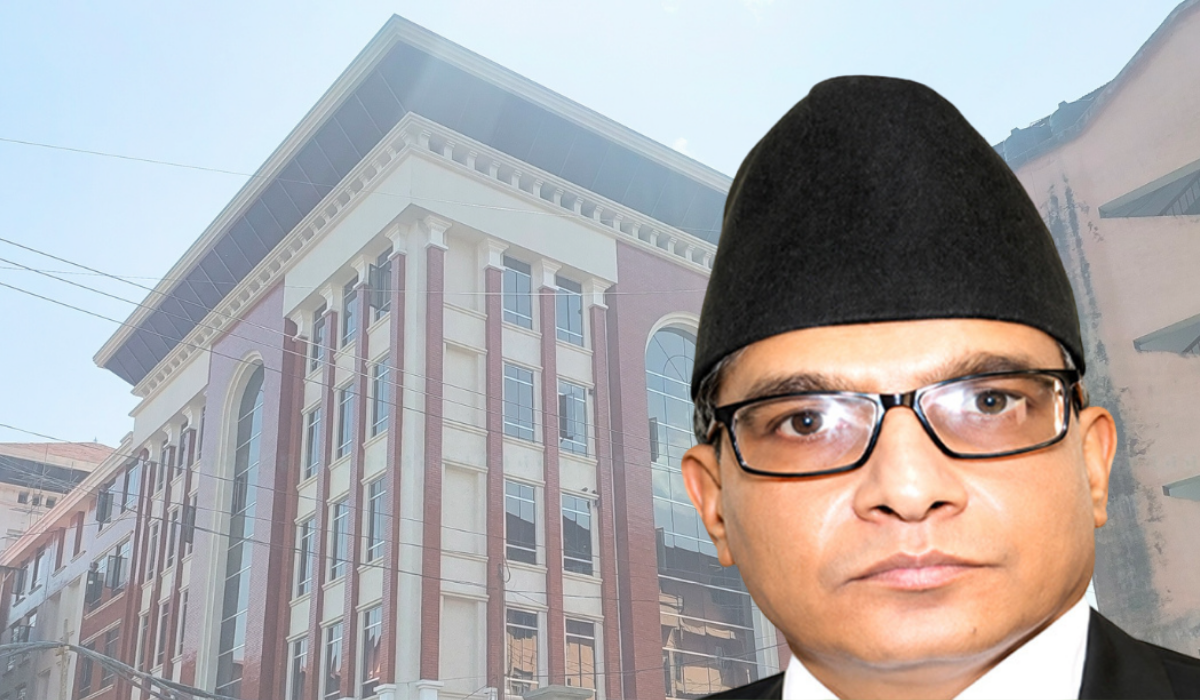
After being recommended for the post of chief justice, Supreme Court Justice Manoj Sharma has not heard any cases.
Although he has been coming to the Supreme Court almost every day, he has not participated in the bench-allocation process, saying he would not sit on any bench.
Since Justice Sharma has not been part of any bench since last Friday, we asked Supreme Court spokesperson Arjun Koirala about the matter.
Koirala said that since Justice Sharma had notified them that he has other work and would not be sitting on any bench, the lottery draw is being conducted only among the other remaining justices.
"Generally, when justices have other court-related responsibilities, they do not participate in the lottery process for selecting a bench," he said. "That is exactly what he is doing right now. He has been coming to the court, but he hasn't been sitting on any bench."
A week ago, the Constitutional Council recommended Sharma for the position of chief justice, bypassing the seniority order.
A four-member majority of the Constitutional Council, including its chairman, Prime Minister Balendra Shah, recommended Sharma, saying he had settled more cases than other Supreme Court justices.
Among the council members, National Assembly Chairman Narayan Dahal and opposition leader Bhishma Raj Angdembe wrote a note of dissent against his recommendation, arguing that tradition and established practice were breached in the chief justice's appointment.
Although PM Shah recommended Sharma by claiming that he is the justice to have settled the highest number of cases, Sharma does not actually top that list at the Supreme Court. Based on court data up to the end of Chaitra (April 13) following Sharma’s recommendation, the justice who has settled the highest number of cases is Hari Phuyal.
The ruling Rastriya Swatantra Party and supporters of PM Shah have defended Sharma’s recommendation by claiming that justices senior to him were previously appointed through political power-sharing arrangements. However, when Sharma himself was appointed as an appellate court judge 12 years ago, it was done under the quota of the CPN-UML. Moreover, he was appointed by his uncle, then-chief justice Damodar Sharma.
Later, Sharma was elevated to the Supreme Court by Cholendra Shumsher Rana, the most controversial chief justice to date. It is alleged that Rana promoted Sharma to repay a favor to former chief justice Damodar Sharma, who had earlier helped Rana become a Supreme Court justice.
Not only that, senior advocate Shambhu Thapa had filed a writ petition at the Supreme Court arguing that Sharma did not meet the constitutional qualifications required to become a Supreme Court justice.
According to the Constitution, to be appointed as a Supreme Court justice, an individual must hold a bachelor's degree in law and have continuously practiced law for at least 15 years, or served as a high court judge for five years, or made a distinguished contribution after at least 15 years of study and research in the legal field.
Thapa argued that Sharma had practiced law for only 12 years, mostly as a legal advisor to various companies rather than as a courtroom lawyer, and had served as a judge for only two years, making him constitutionally ineligible. The Supreme Court dismissed the petition at the very first hearing.
Since then, Sharma has served in the Supreme Court for six years.