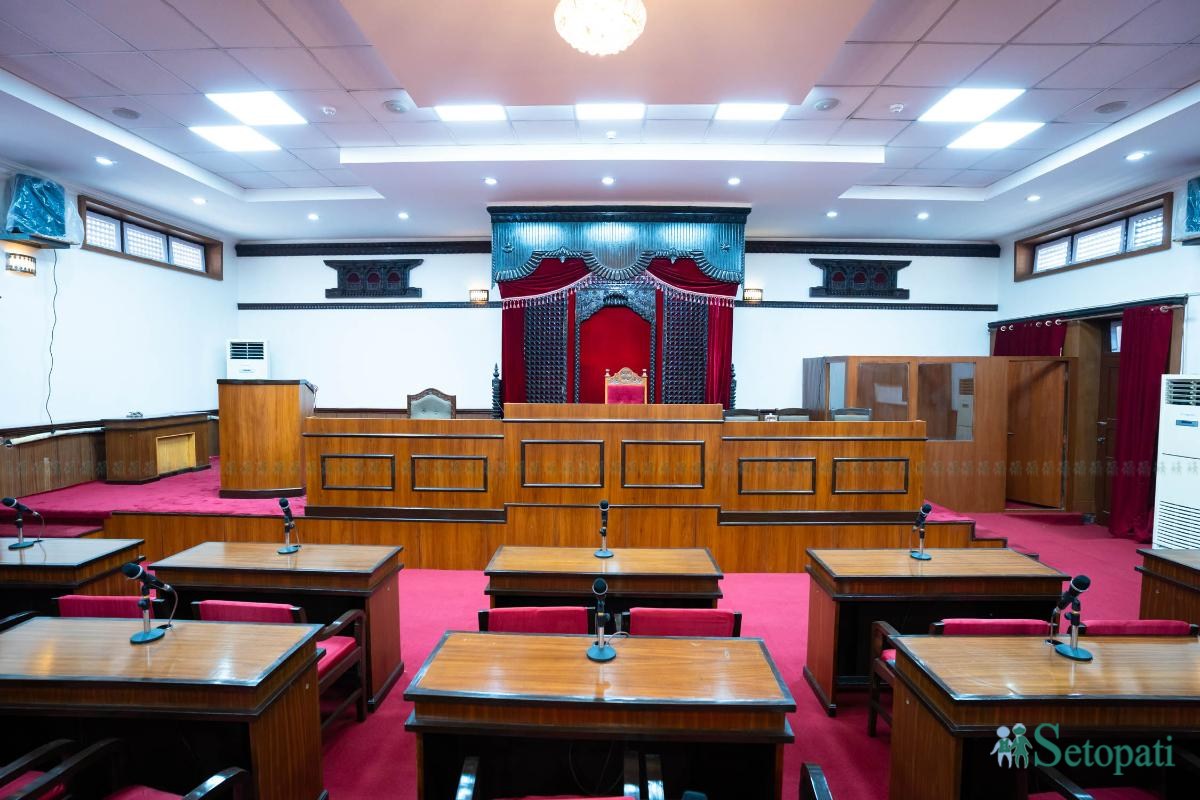
The eight ordinances introduced by the government, including the one related to the Constitutional Council, while Parliament was not in session may pass easily in the House of Representatives, but they face a difficult path in the National Assembly. As a result, there is growing interest in what their fate will be.
The ruling Rastriya Swatantra Party (RSP) holds a near two-thirds majority in the House of Representatives, so getting the ordinances passed is not an issue there. However, since the RSP has no representation in the National Assembly, the fate of these ordinances depends on the positions taken by other parties.
According to Article 114 of the Constitution, the government can introduce ordinances at any time except when both houses of the Federal Parliament are in session. However, once issued, such ordinances must be presented to both houses. If both houses reject them, the ordinances automatically become inactive. The Constitution stipulates a 60-day period for Parliament to accept an ordinance.
Let’s look at which parties have registered motions against which ordinances. Based on this, we can predict what the fate of each ordinance is likely to be.
The Nepali Congress (NC), the largest party in the National Assembly, has registered a motion to reject the Ordinance Related to the Constitutional Council and the Ordinance to Amend Some Nepal Acts.
The Nepali Communist Party (NCP), the second-largest party, and the CPN-UML, the third-largest party in the upper house, have also registered motions to reject these two ordinances.
Since the three major parties of the National Assembly have registered such motions, these two ordinances are almost certain to be rejected.
NC lawmaker Ranjit Karna says the party is not in favor of rejecting all ordinances.
"We are not in favor of approving the Constitutional Council ordinance, which was brought to ensure a majority with just three members," Karna told Setopati. "However, we do not view all ordinances brought by a government with a fresh mandate in the same light."
The NCP, the second-largest party, has issued notices of opposition against four ordinances, including these two.
Jhakku Prasad Subedi, leader of the NCP parliamentary party, said that they have proposed the rejection of the Constitutional Council ordinance, the Ordinance Related to Some Nepal Acts, the ordinance related to universities, and the ordinance related to the removal of public officials.
The third-largest party, CPN-UML, is also in favor of rejecting these four ordinances.
However, the chances of all four ordinances becoming inactive are low, as these two parties alone do not command a majority in the National Assembly.
There are currently 57 lawmakers in the 59-member National Assembly. One seat is yet to be filled through nomination, and another seat is vacant following the death of NC lawmaker Baldev Bohara. Therefore, a majority requires 29 members.
The NCP has 17 members and the UML has 10. If Anjan Shakya (nominated from the UML) is included, their total reaches 28. Thus, they need the support of one more lawmaker to reject all four ordinances.
If they gain that support, all four ordinances will become inactive.
The Janata Samajwadi Party (JSP) has two members in the National Assembly, while the Rastriya Janamorcha and the Loktantrik Samajwadi Party have one each. If they side with the NCP and UML, all four ordinances could be rejected.
The UML has actually registered motions to reject all eight ordinances.
"We cannot accept ordinances brought by bypassing Parliament," said Prem Dangal, UML party leader in the National Assembly. “We cannot accept any ordinance.”
The Constitution requires ordinances to be approved by both houses of Parliament. However, if it chooses, the government can continue operating under the ordinances for 60 days without tabling a motion for approval or rejection. If not approved within 60 days, they automatically become inactive. However, even if an ordinance becomes inactive, actions taken under it are considered valid.
For example, even if the ordinance related to the removal of public officials expires, those who lost their positions because of it will not be reinstated.
Previously, the CPN-UML had brought a land-related ordinance during the NC government’s tenure, which it could not get approved by the National Assembly, leading to its expiration. The government later brought a Land Bill, but before it could be passed, Parliament was dissolved following the Gen-Z Movement.
The government led by Prime Minister Balen Shah introduced the following ordinances: Public Procurement (Second Amendment) Ordinance, Ordinance on Special Provisions Related to the Removal of Public Officials from Office, Constitutional Council (Functions, Duties, Powers, and Procedures) (First Amendment) Ordinance, Asset (Money) Laundering Prevention (Third Amendment) Ordinance, Ordinance to Amend Some Nepal Acts, Cooperatives (First Amendment) Ordinance, Ordinance to Amend Some Nepal Acts Related to Health Science Academies, and Ordinance to Amend Some Nepal Acts Related to Universities.