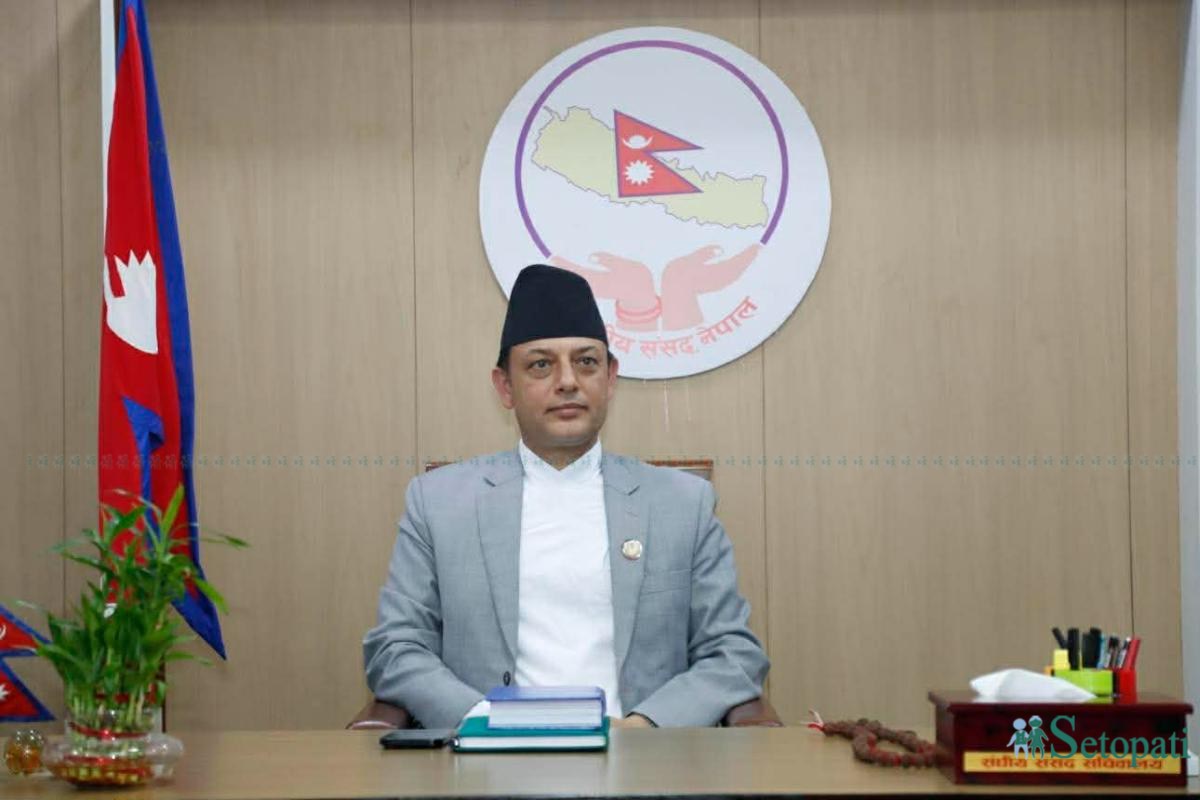
The election for deputy speaker of the House of Representatives has become uncertain.
According to a source at the Federal Parliament Secretariat, there is no consensus within the Rastriya Swatantra Party (RSP) on which party should be given the deputy speaker position.
The Constitution requires the speaker and the deputy speaker to be from different parties and genders. RSP Vice-president Dol Prasad Aryal was elected unopposed as speaker.
Now, whichever party the RSP supports is certain to secure the deputy speaker post.
According to Article 91 of the Constitution, members of the House of Representatives must elect both the speaker and the deputy speaker from among them within 15 days of the first House meeting.
The first House meeting was held on April 2, meaning the deputy speaker must be elected within the next 10 days – by April 17.
However, the RSP has not yet decided which party to support for the post.
According to an RSP lawmaker, the government is preparing to end the current parliamentary session by April 12, citing delays in convening the budget session.
Before the session ends, President Ram Chandra Paudel will address a joint sitting of the Federal Parliament, possibly on April 10.
Talking to Setopati, three RSP lawmakers expressed doubts that the deputy speaker will be elected within the constitutional deadline, though they emphasized the need to hold the election immediately.
“The government plans to call the budget session three weeks after ending the current session,” one lawmaker told Setopati, adding that it would be appropriate to elect the deputy speaker within the constitutional timeframe.
Another RSP lawmaker stressed that the election should proceed without delay, saying, “There has been discussion in the party, but the election for deputy speaker must be held on time. If we fail to work within the constitutional timeframe, what makes us any different from the old parties?"
A third lawmaker warned that delaying the election could also prolong the controversy.
“If we start deferring work in this manner, there will be problems. There is no reason to defer the election for deputy speaker at present,” the lawmaker said.
Meanwhile, Speaker Aryal said that he would consult with political parties regarding the election. “I have just been elected speaker. I will consult with parties regarding the election for deputy speaker,” he said.
The Federal Parliament Secretariat publishes the schedule for deputy speaker’s election under the speaker’s direction.
According to the Constitution, the deputy speaker is one of six members of the Constitutional Council, which recommends appointments for Supreme Court chief justice, justices, and heads and commissioners of constitutional bodies.
The council, chaired by the prime minister, can proceed with decisions by majority.
Currently, the prime minister and speaker from the RSP are members of the council, while the leader of the main opposition has yet to be selected. Once the Nepali Congress elects its parliamentary party leader, that person will become the leader of the main opposition.
In the National Assembly, Narayan Prasad Dahal serves as chairperson, He was elected to the National Assembly from the then CPN (Maoist Center).
At the Supreme Court, Sapana Pradhan Malla is currently serving as acting chief justice. She previously became a lawmaker from the CPN-UML under the proportional representation system.
In such a situation, the prime minister cannot recommend appointments of his choice to the Constitutional Council.
The chief justice position is currently vacant. In the council’s meetings held to recommend the chief justice, the law minister participates as a member.
If the deputy speaker position remains vacant, the Constitutional Council will have only five members, meaning three members could recommend a chief justice. However, if the deputy speaker represents another party, the prime minister may need broader consensus, potentially complicating decisions.
Another RSP lawmaker argued that a delay in the deputy speaker election should not necessarily be seen as a failure to uphold the Constitution.
“The Constitution provides that recommendations for the appointment of chief justice or office-bearers of constitutional bodies must be made one month before the positions become vacant. Just as these provisions have not always been followed in practice, a delay in the election for deputy speaker cannot be called a failure to implement the Constitution,” the lawmaker said.