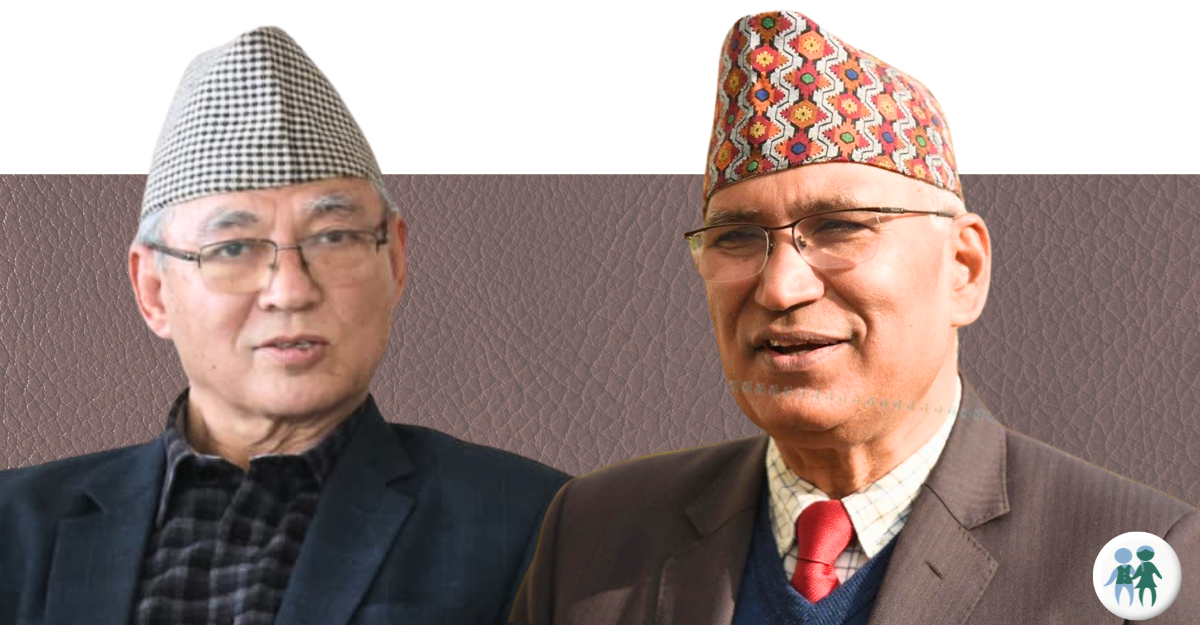
CPN-UML parliamentary party leader Ram Bahadur Thapa, who also serves as the party’s acting chairman, spoke in Parliament on Thursday. Differing opinions have since emerged even within Chairman KP Sharma Oli’s own faction regarding Thapa’s remarks, signaling a possible shift in the power balance inside the UML.
Speaking during the first meeting of the House of Representatives on Thursday, Thapa claimed that the Nepal Army, bureaucracy, and other institutions had played a decisive role in the Rastriya Swatantra Party’s (RSP) victory in the recent election.
Thapa accused these institutions of helping the RSP secure a near two-thirds majority with 182 seats.
“Who played the decisive internal role in this unprecedented victory? The facts make it clear that the Nepali Army, the bureaucracy, the Sushila Karki government, the Karki Commission, the Barbara Foundation, NGOs and other such institutions and individuals had a decisive role in this victory,” Thapa said in the House meeting.
The Nepal Army has not yet issued any public statement regarding Thapa’s remarks. However, former bureaucrats have voiced strong disagreement with the party leader’s remarks.
Former chief secretary Bimal Koirala has criticized the statement, asking why party leader Thapa blamed civil servants for the UML’s election defeat.
“Why has Ram Bahadur Thapa ‘Badal’ called the civil servants – who conducted the election without hindrance during a time of crisis – the cause of defeat? Did the civil servants actually defeat the UML?” he questioned, directing the query at the party.
The Oli faction is defending Thapa’s statement. Leaders from the Oli camp argue that since the Gauri Bahadur Karki-led commission itself has already spoken about the role of institutions such as the Nepal Army and TOB, raising questions over Thapa’s remarks is equivalent to helping the opposition.
However, leaders including Vice-chairman Bishnu Paudel, Yogesh Bhattarai and former vice-chairman Surendra Pandey have publicly expressed their disagreement.
They have said that Thapa’s remarks have sent a message of UML’s distrust toward key state organs such as the Nepal Army, the bureaucracy, and the judiciary, and that the statement must be corrected immediately.
A UML secretariat meeting was called for Friday for “damage control.” The meeting, scheduled for 1 p.m., will see secretariat members raise questions and demand answers regarding Thapa’s statement. The secretariat will also formulate an institutional position on the matter.
Party Chairman Oli is currently in custody on charges of causing deaths through negligence during the Gen Z movement on September 8 last year. He is undergoing treatment at Tribhuvan University Teaching Hospital after developing serious health complications. Police are recording his statement after the court granted his remand – initially for five days, and for two more days on Thursday.
The other faction does not believe Thapa would have made such a statement on behalf of the UML without consulting the party’s chairman, who is currently in custody, and general secretary. They say the general secretary must provide the answer.
Their analysis is that by seeking revenge against the Nepal Army, the entire bureaucracy, and the judiciary for its lost power, the UML will become isolated on all fronts and the party’s movement will suffer further collapse.
According to sources, immediately after Thapa’s remarks in Parliament on Thursday, three secretariat leaders – Vice-chairman Paudel, Gokarna Bista, and Deputy General Secretary Yogesh Bhattarai – discussed the matter. They concluded that a meeting should be called immediately to correct the statement and urged the acting chairman and general secretary to convene the secretariat. Friday’s meeting was scheduled accordingly.
“What was the army’s role in the movement? It is yet to be reviewed within the party why we faced this election result. But reaching a conclusion and presenting it in Parliament is not only serious but also objectionable, and must be corrected immediately. The UML cannot spread distrust or level accusations at the country’s institutions and the judiciary,” said one UML leader.
Friday’s secretariat meeting is expected to reach a conclusion on the issue. However, this sequence of events has clearly exposed the shifting power balance within the UML.
Right after the Gen Z movement, questions were raised inside the UML not only about Oli’s working style but also his leadership style. There were calls for party reorganization. The then vice-chairs Yuvaraj Gyawali, Ashtalaxmi Shakya, Surendra Pandey and others raised such demands.
Immediately after the movement, Paudel also demanded party reorganization. However, to suppress the growing calls for reorganization within the party, Chairman Oli proposed an early general convention. He proposed holding the 11th general convention from December 13 to 15, first in Pokhara and later in Kathmandu. The issue of party reorganization became the general convention’s agenda.
At that time, if Vice-chairman Paudel, Prithvi Subba Gurung, Raghubir Mahaseth, Lekhraj Bhatta, Chhabilal Bishwakarma, Padma Aryal and other leaders had not supported him, Oli would have faced a major crisis.
Since Oli still maintained a strong grip on the party structure, the six leaders including Paudel openly sided with him out of fear that fighting from outside the group would lead to defeat. As a result, Oli won the election by a very wide margin.
However, he had to face a challenge from Ishwar Pokharel, who had stood like a pillar in his support in the past.
The Oli faction, which was already divided at that time, has become even more fragmented after the March 5 election results. Leaders from the other faction say the old power balance no longer exists there.
Immediately after the election results, Vice-chairman Paudel publicly declared on Facebook that he would support party reorganization.
“I express my commitment to seriously review the mistakes and weaknesses on our part in the past, to transform ourselves according to the people’s expectations, and to take the initiative to reorganize the policy, leadership, organization, and working style of the CPN-UML according to public expectations, while remaining unwaveringly dedicated to the service of the people and the nation,” he said at the time.
Since then, he has been holding informal discussions within the party. He has concluded that neither the party nor the movement can now move forward under Chairman Oli’s leadership.
Some leaders including Paudel believe that after the government’s decision to implement the inquiry commission’s report on the incidents of September 8 and 9 led to the detention of Chairman Oli, the party movement has become even more defensive.
The have concluded that the party needs to move forward in a new way to provide relief from this, renew the movement, and connect with the new youth. They have begun to say that the starting point for this is bidding farewell to Chairman Oli from party leadership.
After the last general convention, Oli had become even more unchallenged in the party. In the 19-member secretariat, only two members (Vice-chairman Gokarna Bista and Deputy General Secretary Yogesh Bhattarai) were from the other group. Among office-bearers and the central committee, around two-thirds are from the Oli faction. However, after the election results, many have reached the conclusion that “Oli can no longer be carried forward.”
The fact that this sentiment has begun from within the Oli faction itself is an even greater challenge for him.
According to one leader, in Wednesday’s parliamentary party meeting, Oli’s position was that Thapa should be elected parliamentary party leader unanimously. He had given instructions to the general secretary accordingly. The previous day’s secretariat meeting had assigned Thapa the responsibility of coordinating the parliamentary party meeting. However, some leaders including Bishnu Paudel had a different desire.
In the party meeting, Suhang Nembang also staked a claim for the leadership position. That day, Paudel himself played a key role to take the meeting to the election process.
After Nembang refused to withdraw his claim, General Secretary Shankar Pokharel, and Vice-chairmen Bishnu Paudel and Prithvi Subba Gurung held discussions and entrusted election department chief Niraj Acharya with publishing the election schedule.
“Nirajji, prepare the schedule to complete the election within one hour and move the process forward,” General Secretary Pokharel instructed.
A leader close to Nembang said that the election process moved forward that day because of Bishnu Paudel.
“It is not clear what Prithvi Subba Gurung wanted. He did not speak out. But Bishnu Paudel definitely played a role in creating an atmosphere for election atmosphere and gave us energy,” the leader said.
However, after Nembang failed to secure even a proposer and seconder, Thapa was elected unopposed as parliamentary party leader. Yet Thapa’s statement in the very first session of Parliament has landed in controversy.