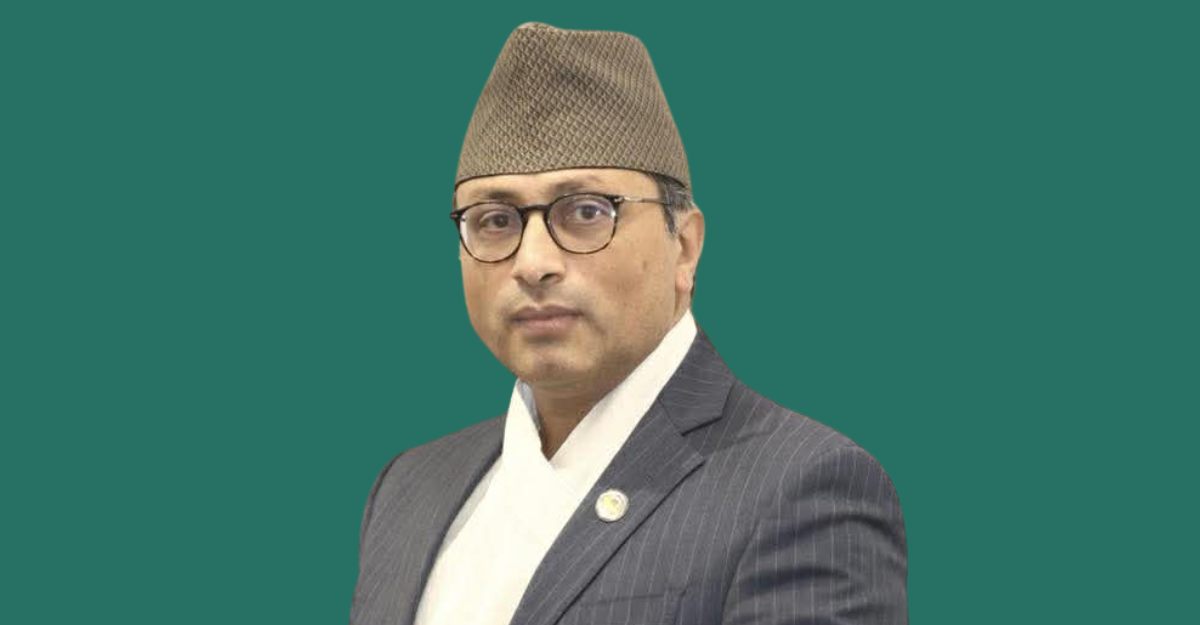
Finance Minister Swarnim Wagle has said that the prime minister's recent remarks in Parliament have opened the door for dialogue on border disputes between Nepal and India.
During a discussion with party leaders in the National Assembly, Finance Minister Wagle said that although border talks had stalled after Nepal issued its updated map, the prime minister's remarks in Parliament had reopened the possibility of negotiations.
"The door to talks on border disputes had been closed. Now the door has opened," a source quoted Wagle as saying. "The prime minister expressed his views in a positive manner in Parliament. How others interpreted it, I do not know."
Wagle held consultations with leaders of various parties represented in the National Assembly regarding efforts to end the obstruction of the upper house's proceedings.
The National Assembly had scheduled discussion on Wednesday on the Alternative Development Finance Mobilization Bill. The upper house was required to deliberate on the bill and send its recommendations to the House of Representatives by the June 7.
Following the suggestion of the National Assembly chairperson, Wagle met with party leaders to discuss the matter.
During the meeting, party leaders argued that Prime Minister Balen Shah should personally appear before Parliament and clarify his statement suggesting that Nepal had encroached on Indian territory.
However, Wagle maintained that the statement issued by the Ministry of Foreign Affairs was the official position of the Government of Nepal.
"The position of the Ministry of Foreign Affairs is the official position," the source quoted Wagle as saying. "This is not a matter that requires the prime minister to come and provide clarification."
Party leaders, however, insisted that the prime minister should appear before Parliament and explain his remarks. In response, Wagle reportedly said that if the National Assembly did not pass the bill, the House of Representatives would proceed on its own.
Speaker Dol Prasad Aryal has categorized the Alternative Development Finance Mobilization Bill, which was tabled by the finance minister, as a money bill. As a result, the National Assembly has the authority to only provide recommendations on the bill rather than amend or reject it.
The speaker has the constitutional authority to determine whether a government bill qualifies as a money bill.
Article 110 of the Constitution states that a money bill may be introduced only in the House of Representatives.
The National Assembly may only make recommendations on a money bill. Under Article 111 of the Constitution, if the National Assembly does not return a money bill to the House of Representatives within 15 days of receiving it, the speaker may forward it to the president for authentication.
The 15-day deadline will expire on June 7, meaning the bill could be sent to the president for authentication without any recommendations from the National Assembly.
If that happens, the Alternative Development Finance Mobilization Bill will become the first bill since the promulgation of the Constitution to be authenticated without recommendations from the National Assembly.
National Assembly Chairman Narayan Prasad Dahal informed lawmakers during a session that such a precedent could be set if the bill proceeds without input from the upper house.
During Wednesday's National Assembly meeting, lawmakers also demanded that the prime minister resign on moral grounds over his statement that Nepal had encroached upon Indian territory.