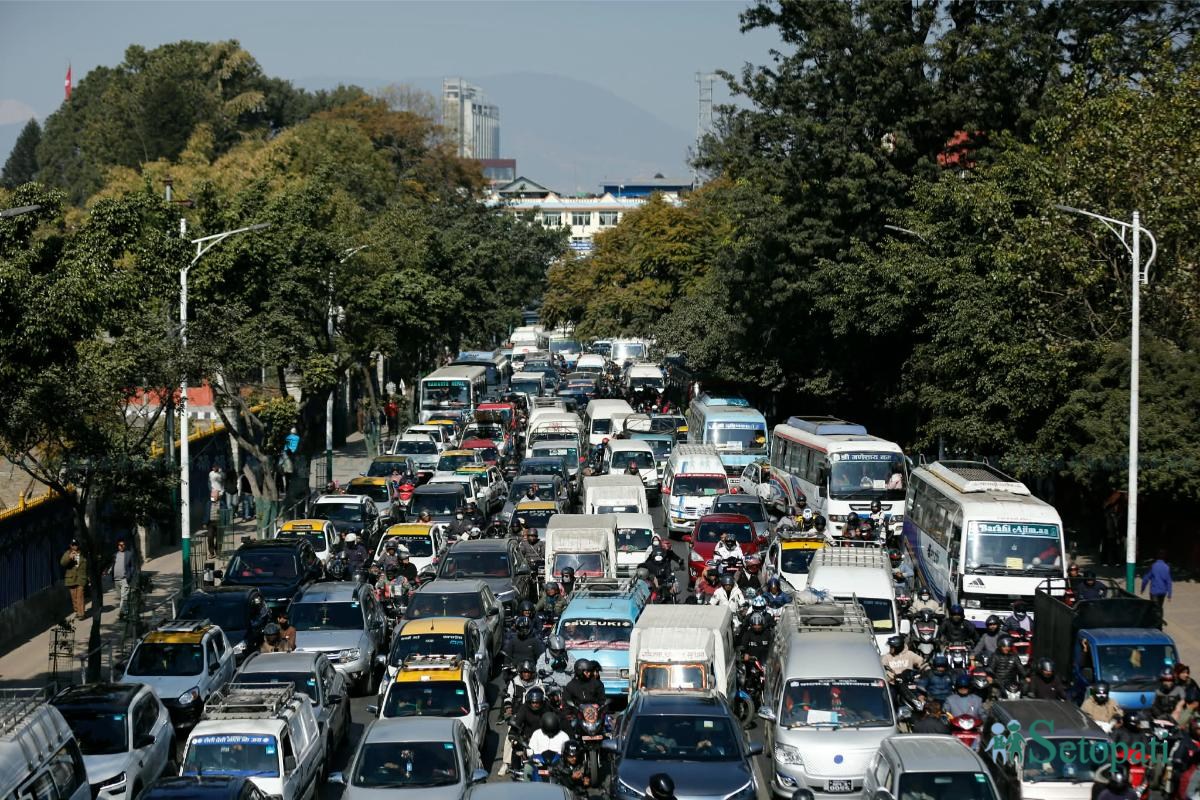
The Election Commission has announced that all public and private vehicles will be prohibited from operating from midnight on March 4 until voting concludes on March 5.
The High-level Election Security Committee formed under Section 3 of the Election Security (Management) Directive, 2021, held a meeting to discuss effective security arrangements for the House of Representatives member election to be held on March 5. The meeting decided to ban the operation of all public and private vehicles from midnight on March 4 until the evening of March 5 when voting concludes, except for vehicles providing essential services (ambulances, fire engines, hearses, blood transfusion service vehicles, security agencies’ vehicles, vehicles used for electricity repairs, drinking water and sewage repairs, and telecommunication service repairs), vehicles of diplomatic missions, and vehicles that have obtained passes for use on election day, said Joint Secretary Narayan Prasad Bhattarai, spokesperson for the Election Commission.
The commission has also decided to write to the Ministry of Home Affairs to impose a nationwide ban on the sale, distribution, and consumption of alcohol starting seven days prior to the voting date until the final election results are announced.
The meeting further decided to strictly prohibit the sale and consumption of alcohol in all 77 districts for election security purposes.
Through the Ministry of Home Affairs, letters have been sent to all District Administration Offices directing them to mobilize designated personnel and mechanisms to prevent acts prohibited under Section 24 of the Election (Offenses and Punishment) Act, 2016, and Sections 17 and 18 of the Election Code of Conduct, 2026. The DAOs have been directed to take immediate legal action against any violations and inform the commission accordingly.
Based on a review of plans, assessment of the security situation, and guidelines and recommendations related to security arrangements, the committee decided to instruct the ministry to ensure that the election is conducted in a free, fair, credible, and fear-free environment.
The Ministry of Home Affairs has also directed all chief district officers and security agencies to fully enforce the election code of conduct during the election silence period, which begins at midnight on March 2.
According to the spokesperson, arrangements have been made for the operation of international and domestic flights as usual on election day. Passengers holding valid air tickets will be allowed to travel between the airport and their homes or hotels using private vehicles or vehicles provided by the respective airlines.
As per Section 6 of the Election Security (Management) Directive, 2026, and specifically clause (i), the commission has instructed, through the Ministry of Home Affairs, all 77 District Administration Offices to close international border points in the respective districts 72 hours prior to the election date.
Under Sections 43 and 84 of the House of Representatives Member Election (Voting) Directive, 2026, voters must carry at least one of the following documents to vote: voter ID card, Nepali citizenship certificate, national identity card, passport, land ownership certificate, or driver’s license. Security personnel, election staff, and all relevant authorities have been instructed to disseminate this information so that eligible voters listed in the voter roll can exercise their right to vote.
In accordance with the Procedure Related to Vehicle Permit, 2026, a pass distribution unit will be set up on the premises of the commission’s secretariat to provide vehicle passes issued by the commission and the District Administration Office, Kathmandu, on election day. Two staff members from the commission and two from the District Administration Office will be assigned to the unit.
The commission has urged all stakeholders concerned to ensure necessary facilitation and coordination for the effective implementation of these decisions.