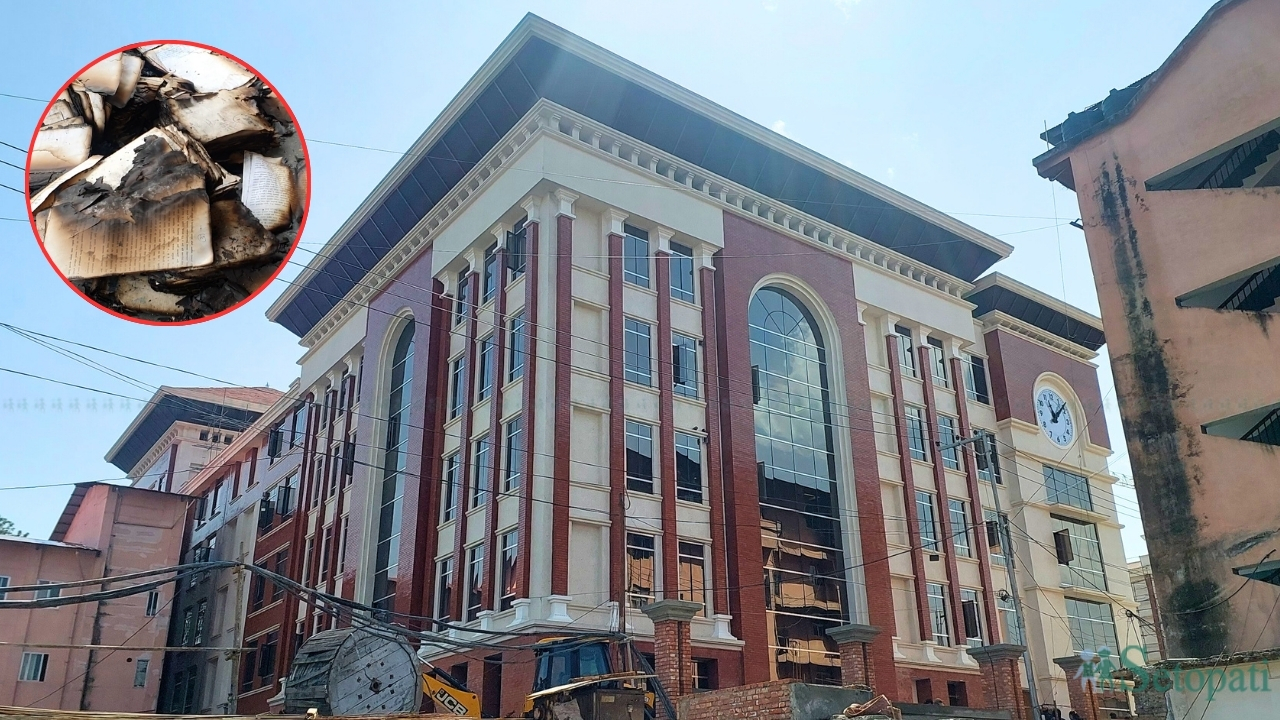
During the Gen Z protests on September 9 last year, arson at the Supreme Court destroyed thousands of case files. Six months later, the court has managed to recover 19,102 case files, according to the court’s information officer and deputy registrar Nirajan Pandey.
Among the recovered files, 3,366 were obtained through the Office of the Attorney General, Pandey said.
The Supreme Court had also issued a public appeal for the recovery of lost case files. Following that, 15,736 files were returned by service seekers, Pandey added.
The court has also been issuing letters of appreciation to those who return the files.
To facilitate recovery, the court introduced a directive titled “Guidelines on Retrieval and Verification of Case Documents Destroyed Under Special Circumstances, 2025,” and formed a three-member committee led by the registrar overseeing the case management division.
According to Pandey, 10,000 of the recovered case files have already been verified, with the rest also in the process. “Most of the files have been recovered, and the recovery work is ongoing,” he said.
As of September 9, 2025, there were 24,234 active case files, of which 20,034 were completely destroyed in the fire. Around 4,200 files were saved, including 2,509 writ petitions and 1,691 other cases.
Additionally, 197,000 documents in the Supreme Court’s archives were also destroyed.
Along with the Supreme Court, arson attacks also caused damage in high courts and district courts across the country. Nationwide, 6,533 active case files were burned, along with 706,071 archived files and 4,185 revenue-related files.
Efforts to recover case files are ongoing in courts across the country.
On September 9 last year, Gen Z youth held a protest from Maitighar to New Baneshwar in Kathmandu. Police gunfire that day resulted in the deaths of 17 people. That sparked further outrage the following day, leading to widespread vandalism and arson across the country.
During the unrest, the Supreme Court was also set on fire. Nearby offices, including the Office of the Attorney General and the Nepal Bar Association, were also torched, severely disrupting ongoing cases for a long period.
Just two days after the arson at the Supreme Court, a full court meeting was held to decide how to proceed. Within a week of the protests, the Supreme Court resumed hearings on habeas corpus petitions.