Balen Shah's first political address in Janakpur, the capital of Madhesh, carries three significant messages.
One, for the first time, he publicly declared himself a "son of Madhesh." Second, he did not just express support for federalism for the first time but also advocated for making provincial governments stronger than they currently are and bringing centralized powers from Kathmandu to the provinces. Third, in Janakpur—the land where Ram and Janaki married—he shared a plan to bring in 10 million tourists annually.
In this story, we critically analyze Shah’s socially established image by revolving around these three messages. We also critically examine his actions and performance as the mayor of Kathmandu Metropolitan City over the past three years. This analysis is necessary because Shah has begun his parliamentary political journey as a future prime minister of the country. When he joined Rastriya Swatantra Party (RSP) as a senior leader, his sole condition was that if the RSP wins a majority, he must be the prime minister.
This analysis is also vital because, although he has been tested through three years as mayor, many do not have clear information about who Shah is, what kind of person he is, his political ideology, or his vision for socio-economic transformation.
Many say Kathmandu underwent a metamorphosis after he became mayor. They praise him, saying he achieved progress that Kathmandu had never seen before in a short three-year tenure.
Many credit him for liberating Kathmandu from piles of garbage, expanding sidewalks to create a model city, enforcing rules and laws strictly, providing relief from dust and smoke, stopping public encroachments, building public parks everywhere, and ending irregularities in public schools.
To brand Kathmandu as having made unprecedented progress under Shah’s rule, his supporters have even nicknamed this cultural city "Balen City." Many wonder: if someone could transform Kathmandu in just three years, what could they achieve for the country as prime minister? These voices come not only from people within Kathmandu but also those without.
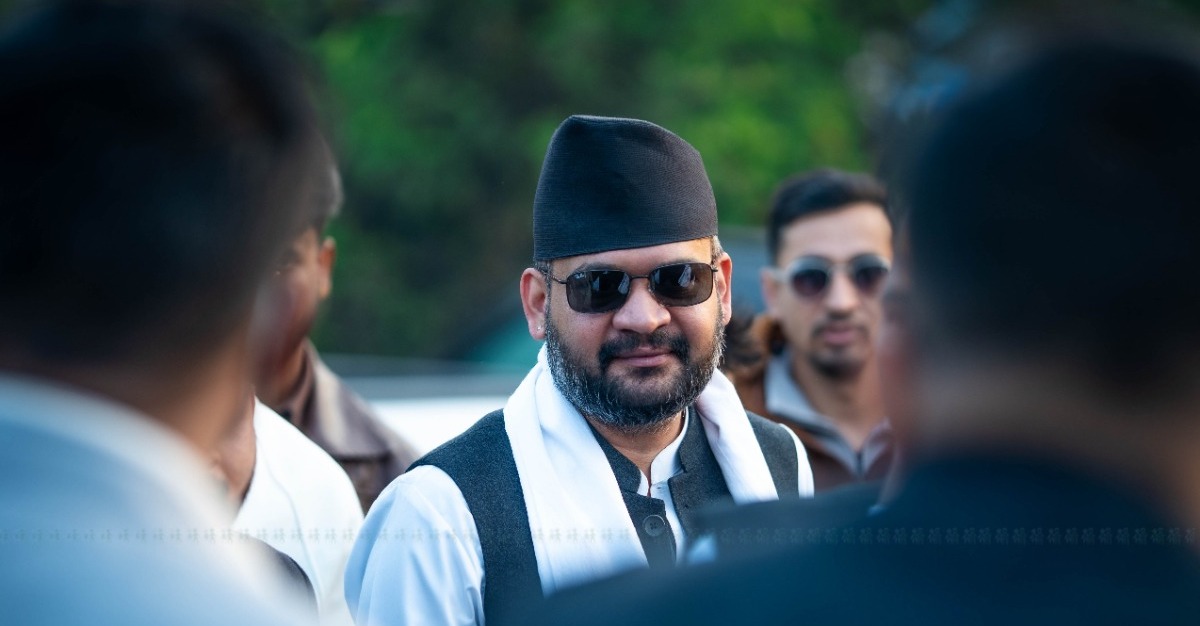
However, while saying this, we must not forget that much is hidden behind the black sunglasses he always wears. As we envision him as a future prime minister, it is essential to uncover what lies behind those glasses and evaluate his three years of work as mayor. This story is an attempt to know and introduce Shah personally and politically based on his performance over the last three years.
The Positive Side: Courage and Integrity
Before critically analyzing Shah's personality, let’s discuss his positive aspects. Shah’s most positive traits are his courage and his integrity.
A structural engineer by training and profession, and a rapper by hobby, Shah is someone who had never done politics in his life. In Nepal, most leaders begin their careers in their student days. Many started their political journeys by participating in movements for democracy. In Shah's case, he neither did politics as a student nor participated in democratic movements. For someone who never did politics to enter the electoral field claiming he will become mayor of Kathmandu is no small feat of courage.
He also appears courageous because, unlike many other candidates in the mayoral race, he wasn't just contesting. He moved forward with a strategy to win. He and his team worked day and night to implement that strategy. He didn't have a large team. He didn't have the support of a whole party organization like other leaders do. He didn't have a mass of cadres to campaign for him.
He only had his close associate Kumar Ben (Byanjankar) and a few well-wishing friends. Three years ago, in an interview with Setopati, Kumar Ben said, "We met 150 to 200 people a day starting five months before the election. We probably met 30,000 people directly in those five months. Sometimes we'd go to a neighborhood, sometimes a tea shop. We’d sit there and talk to local youths for hours. Shah would explain his vision to those youths." He continued, "Since he was a rapper, he was already popular among the youth. When he stepped forward to talk, youths flocked to hear him. This made it easier to get our message across to the local community, especially the youth."
Some youths voting for the first time would listen to Shah and say, "Brother, our vote is for you. We will also try to convince our parents and siblings to vote for you." While visiting neighborhoods, Shah and Ben didn't just pick voters. They shared their plans with whoever they met. Some were from outside Kathmandu, living here as tenants. Those people would say, "Brother, we can’t vote for you, but we will convince our landlords to vote for you this time."
Thus, Shah showed the courage to campaign by walking the neighborhoods, squares, and alleys of Kathmandu with fewer than a dozen well-wishers—and he won.
For an individual with no prior political or social image to believe he could defeat party representatives as an independent, and then to actually do it, is no mean feat. Initially, many thought Shah's attempt was reckless audacity, but he proved it was genuine courage. Shah is a living example of how much a person can achieve if s/he tries honestly.
Even after winning and becoming mayor, he did not bow down to any leader of the old political parties. He made no compromises. Instead, throughout his tenure, he didn't give a damn to almost any leader of any party. At times, he even challenged them. In the municipal executive, where every representative was elected from a political party, he stood alone, defended his decisions solo, and fearlessly implemented them.
Even when friction occurred with ward chairs on various issues during executive meetings, he never seemed to back down from his stance. There are many instances where he moved forward by convincing ward chairs to agree with his plans. Specifically, in the plan to remove parking from New Road to widen the sidewalk, he had a fallout with some ward chairs. He was criticized in executive meetings. New Road businessmen protested against him. But he didn't flinch out of fear that ward chairs would get angry or businessmen wouldn't support him. Instead, he rapidly advanced the work of widening the New Road sidewalk, the result of which is before us today. Kathmandu residents have praised this work highly.
Not only this, despite being the independent mayor of just one of the 753 local levels across the country, Shah took public fights with political leaders across the country like an opposition leader, criticized Singha Durbar while taking responsibility for the country's mismanagement, and cursed leaders of both new and old parties as thieves on Facebook. Many have praised this behavior as rebellious and courageous.
However, within this courage was a cocktail of unilateralism, audacity, and arrogance—the belief that there is no one else besides him and no one else can do it. His Facebook posts were heavily criticized. But Shah never learned from criticism or deleted his status out of fear. He treated what he spoke or wrote as absolute truth. He constantly sent the message: "I am different from other leaders."
The pedestal that Shah is on today, his popularity among the common people, and his status as a heartbeat of the youth are largely due to that rebellion, courage, or audacity. Because of this, he became established in the eyes of society as a Messiah who wasn't afraid to expose veteran leaders. He became a hero who didn't bow to the parties or leaders the society viewed as corrupt, and criticized them sharply. He became sort of a sole savior to liberate Nepal from decades of corruption, bad governance, and irregularities.
Most importantly, the way he is now contesting the election against the powerful CPN-UML Chairman and former Prime Minister KP Sharma Oli in Oli’s own political stronghold is also, in a way, his courage or audacity. He could have won easily had he contested from any constituency in Kathmandu. There is no doubt about that. But he chose Jhapa-5, the most difficult constituency in the country for him to win. Behind this choice lies a "courageous" ambition to become prime minister by defeating Oli and advancing as a national leader. He wants to establish his central-level politics by defeating the prime minister who was ousted by the Gen-Z Movement, using the strength of that same Gen-Z Movement.
For Shah, who is contesting a parliamentary election for the first time with only three years of mayoral experience, this is courageous in itself.
After courage, financial integrity is his other strong suit. During his three-year mayoral tenure, Shah was not implicated in any form of corruption or financial embezzlement. There is no example of him serving his own interests when passing or rejecting plans. Because of this financial integrity, he made several decisions swiftly. At a time when cases of even small and big leaders being involved in corruption and financial transactions are made public daily, Shah has set a "rare" example that public work can be done without misappropriating a single paisa and one can be a leader without corruption.
His own party president Rabi Lamichhane is facing allegations of cooperative fund embezzlement. There are allegations that Lamichhane’s past personal financial life was not clean either. In comparison, there is no room to raise questions about corruption or irregularities against Shah. Shah has stood firm on this standard of good governance, which even the president of the newly emerged RSP could not establish. This integrity is one reason Shah is popular among the youth.
However, as he joined the RSP as a senior leader, he has remained silent about the charges of financial embezzlement against President Rabi Lamichhane and the tens of millions of rupees in bail requested by four or five courts, while acknowledging the seriousness of those charges.
Other Side of the Coin: Performance and Style
These were Shah's positive aspects, but there is another side to the coin. Just as there is a bright side to his performance and style of work, there is an equal dark side. Now, based on the three messages from his Janakpur address, let’s examine the flaws hidden in his personality.
The first message of the Janakpur address is linked to Balen Shah’s Madheshi identity. It is significant that Shah, wearing a white kurta-paijama with a gamchha on his shoulder and addressing the public in Maithili, declared "I am a son of Madhesh." This is because he had not only kept this identity hidden until now but had also flatly denied it in interviews.
He never used the surname "Sah" commonly used by Madheshis. Instead, he used "Shah," used by Thakuris or royalty. In a conversation with Setopati three years ago, he explicitly stated that he was not a "Teli Sah of Madhesh" but a "descendant of the Suryavanshi King, a pure King."
At that time, Setopati had projected that Shah would be elected mayor of Kathmandu. In the third week of May 2022, while the victory was already certain and the final counting was underway, we had a long conversation with Shah. Countering public statements about his ethnic identity, he told us that day, "I never wanted to link ethnic identity to my name. The people also never raised questions about my identity. This came up only after Keshav Sthapit (mayoral candidate from UML) said I was from Madhesh. After that, many called me a Teli Sah of Madhesh. I accepted it happily. Some called me a Thakuri of Jumla, I accepted that happily too."
Clarifying further, he said, "I am not a Teli Sah of Madhesh. I am also not a Thakuri Shah of Jumla. I am not a Shah like former King Gyanendra. I am a descendant of the Suryavanshi royal family. I am the son of a pure King." There was intensity in his voice as he said this. His gestures seemed very agitated. When we asked how he knew this, he replied, "It is in our genealogy."
When asked if their history links to Simraungadh, he said, "Older than Simraungadh. Older than King Harisinha Dev. Our kingdom included Mithila, Hetauda, Kathmandu, and many places here." While Shah said this with full confidence, he couldn't say for sure when we asked for more details about his genealogy. He said, "It’s from a very long time ago. Before Prithvi Narayan Shah."
The details of the Suryavanshi royal family shared by Shah and the claim that they ruled Kathmandu, Mithila, and Hetauda do not align with our history. Lichchhavis called themselves Suryavanshi, but that is a history over a thousand years old. No one has been seen so far claiming to be of the Suryavanshi Lichchhavi clan. After that, no other Suryavanshi clan is seen to have ruled this region.
At that time, it was natural for Shah to hide his Madheshi identity as the mayoral candidate of the Newar-majority Kathmandu Metropolitan City. His close aides say he never identified as Madheshi even before entering politics. Especially when running for mayor of Kathmandu, there was no political gains to be made in identifying as Madheshi. Had he carried a Madheshi identity, he might have found it difficult to win the mayor's office.
But today, as he begins his parliamentary political journey from the capital of Madhesh, he needs that very Madheshi identity. This is because, compared to other provinces, RSP is currently weakest in Madhesh. It appears he is presenting that ethnic identity with pride to build a national leader persona, present himself as a future prime minister, contest against Oli in Jhapa-5, and bolster the RSP’s weak standing in Madhesh.
The topic of federalism mentioned in Shah's Janakpur address is linked to a political issue close to the heart and soul of Madhesh. This is an issue on which Madhesh province never compromises because federalism is a contribution of the Madhesh Movement. Two movements occurred in Madhesh to achieve federalism, and a third ensued against an "incomplete Constitution" when the Constitution was issued. About a hundred Madheshis were martyred in these movements. The two phases of the Madhesh Movement is a major reason the Constitution of Nepal embraced federalism.
For Kathmandu and other provinces, especially for the so-called upper castes like Brahmins and Chhetris, federalism might just be a political slogan. But for Madheshis, it is linked to their existence, their identity, and the blood shed for that identity. However, as the mayor of Kathmandu, Shah had not accepted federalism until now. Not only did he not accept it, but when he voted in the 2022 parliamentary elections, he only voted for the House of Representatives. He even refused to take the ballot paper for the provincial assembly.
Thus, for Shah—who had been denying the existence of the provincial government—to go to the capital of Madhesh and say that the provincial government must be strengthened and that "one should go to Kathmandu for travel, not to ask for rights" is meaningful in itself. Even more significant is that Shah started his parliamentary political campaign by laying wreaths at the statues of the Madhesh Movement martyrs who sacrificed their lives to establish the very provincial assembly for which he didn't even cast a vote in 2022.
It is unclear how much of Shah's presentation in favor of federalism is for electoral purposes, and how much he has genuinely grown to understand that federalism is needed in Nepal and accepted its political importance from his heart. This will only become clear from the policies RSP will adopt if Shah becomes prime minister or RSP comes to power in the future.
The third point of the Janakpur address connects to the romantic imagination Shah sold Kathmandu three years ago. He said in Janakpur, "Hundred million tourists annually visit Ayodhya, the birthplace of Ram. Ten million tourists can also be brought to Janakpur, the land of Ram and Janaki (marriage)."
Shah shared the dream of bringing 10 million tourists to Janakpur, but the annual figures for tourist arrivals in Nepal show how romantic this dream is. According to the Nepal Tourism Board, only slightly more than one million tourists enter Nepal annually. In this, the number of Indian tourists is about 300,000. Indian tourists mostly come to visit Kathmandu and Pokhara, while tourists from third countries mostly come for mountaineering and trekking.
With these figures in mind, claiming that 10 million tourists can be brought to Janakpur alone shows how fluffy the claim is. The majority of those who come to Janakpur are Indian tourists. When and how will the number of Indians be drastically increased from 300,000 to 10 million? What magic wand does Shah have that he can achieve the goal of 10 million at once by waving it?
The dream of 10 million tourists shown to Janakpur doesn't seem new if we remember the promises Shah made while contesting the election for mayor of Kathmandu. Three years ago, he sold similar romantic dreams and plans to Kathmandu. Kathmandu residents have not tasted most of the plans he announced back then. Some plans were so fantastical that they had no relation to practicality whatsoever.
We had even questioned him, citing examples from various countries, about how some of those plans were practically impossible. But he didn't accept that his plans were impossible to implement. Instead, he kept claiming, "I will fulfill them anyway." None of the fantastical plans included in Shah's election manifesto have materialized. In his three-year tenure, he not only failed to start those plans but didn't even utter a word about them. He didn't provide an explanation as to why they couldn't be implemented.
First among these is the waste management plan. Shah put forward short-term and long-term plans for waste management. He said, "600 tons of waste is produced daily in Kathmandu Metropolitan City. 70% of it is biodegradable. My plan is to make organic fertilizer from such biodegradable waste and sell it not only within Kathmandu but also in districts like Dhading and Kavre."
"We can make money from this waste," he said, "We can export organic fertilizer to Dhading and Kavre." In some television interviews, he even said this organic fertilizer could be exported nationwide, after which Kathmandu could eat pesticide-free vegetables, and the youth across the country would get jobs and wouldn't have to go abroad.
Where the Shah’s plan for organic fertilizer production and export in Kathmandu has reached, no one knows. No one knows whether he even made a small effort to implement this plan.
Not only this, Shah had claimed in his election manifesto and in conversation with us that he would install incinerator machines to burn the remaining 30% of waste. This was an impossible plan to implement in itself.
Discussions had previously been held about placing similar incinerators at the Banchare Danda dumping site built to manage waste in the Kathmandu Valley. It wasn't implemented after environmental experts said burning waste in incinerators could lead to pollution problems.
According to environmentalists, while making organic fertilizer from biodegradable waste is possible, burning it in an incinerator is a very complex process. This is because the waste collected in Kathmandu during the monsoon is wet. To burn it, the temperature must be around 1,000 degree Celsius. If the temperature isn't perfectly maintained, toxic gases harmful to health are emitted.
While this plan is well-operated in countries like China and Singapore, it had been opposed in India due to pollution problems. India brought a plan to place about a hundred incinerator machines a decade ago. They were installed at some places but didn't work well. Problems were seen in such machines in various places in Delhi, and they were shut down. India's technical capacity is much stronger than ours. But if even they couldn't successfully use the method of burning waste, environmentalists' opinion was that using incinerators in Nepal on a whim could be fatal.
We had questioned Shah about the problems of installing incinerators, citing the failed experiments in Delhi and the arguments of environmentalists. Shah shrugged them off. "It’s because Delhi didn't implement it properly. We can make such incinerators ourselves," he said. He was extremely confident in his opinion. He showed the confidence that we could easily do what Delhi couldn't.
Technical complexity is a harsh reality. Shah tried to generalize that harsh reality. This reflects his nature of not accepting facts contrary to his own and sticking to his own words, no matter how baseless his claims are. Ultimately, the confidence he showed by saying "We will show how to do what Delhi couldn't" proved to be just a water bubble. He didn't utter the word incinerator even once during his three-year tenure. He didn't make an effort to implement that plan in which he had shown extreme confidence. Had he tried and failed, one could say "he tried, but couldn't" but he didn't even try. He never admitted that what he said back then was wrong. He never brought up the subject again.
Regarding waste management, Shah had said he would implement a system of keeping biodegradable and non-biodegradable waste separate in every household. He shared a plan where Kathmandu Metropolitan City (KMC) would send trucks on different days to collect these two types of waste. Though challenging to implement practically, this plan was possible. KMC had even issued a notice for this. Based on that notice, Kathmandu residents even started keeping biodegradable and non-biodegradable waste separate for some time. But the trucks to collect that separated waste never came. Shah never seemed serious about realizing a plan that was possible to implement.
We had discussed the practical difficulties of this with Shah three years ago during the conversation. We said it might be hard to form this habit suddenly. But he said with great confidence, "Our citizens are very obedient. When told not to blow the car horn, no one did. If such people are told to keep biodegradable and non-biodegradable waste separate, they will surely obey." What Shah said was correct—the citizens of Kathmandu had obeyed. The irony is that he himself did not stick to and implement what he called upon the city residents to do.
Kathmandu's waste problem remains the same today as it was three years ago. But many are under the illusion that as soon as Shah arrived, the piles of garbage disappeared and the city suddenly became clean.
There is a reason for this illusion. A happy coincidence for Shahwas that the Banchare Danda dumping site, built by the federal government for the Kathmandu Valley, was ready exactly when he became mayor. That’s why the garbage piled up in Kathmandu before his arrival started being collected automatically and managed at Banchare Danda.
But because he didn't work to separate biodegradable/non-biodegradable waste as mayor, both types of waste are still being dumped together at Banchare Danda. This has caused the Banchare Danda dumping site to fill up. Had the biodegradable waste been separated and only non-biodegradable waste taken, Banchare Danda wouldn't have filled up so quickly. The problems of stench and pollution wouldn't have arisen. Because of that problem, Banchare Danda is still disgruntled with Kathmandu. The locals block the path of waste trucks from time to time. The day a dissatisfied Banchare Danda protests again as before, Kathmandu will again become foul-smelling with garbage. Shah has left this waste problem pending and shifted it onto the head of the mayor who follows him.
Shah had also announced he would have vehicles entering the city washed near Thankot to make Kathmandu dust-free and would continuously clean the city streets. Cleaning the streets wasn't a new task. As for the plan to wash vehicles entering Kathmandu, that has also not been implemented to date.
True, in these three years, Kathmandu isn't shrouded in dust and smoke as before. Many have credited Shah for this too. But the real reason is that before he took charge, work on the eight-lane Ring Road expansion was happening rapidly. Work on laying the Melamchi project pipeline was also ongoing. That had shrouded Kathmandu and Lalitpur in dust. Once both those tasks were completed, a large portion of the dust naturally disappeared. Shah's contribution to this is zero.
Returning the heritage and culture of Kathmandu's core city to its old form was also in Shah's plan. He said he would lay bricks instead of stones on the streets of inner settlements from New Road and Basantapur to Thamel and Thahiti. He also shared a plan to prohibit vehicles in inner settlements and encourage every household there to run businesses of local delicacies in front of them. He promised to increase spending for all festivals and guthis because of the lack of money to celebrate local festivals, and to create an environment where the whole of Kathmandu participates in these festivals.
He said, "The Kathmandu I saw as a child is not what today's children get to see. Kathmandu has a distinct scent. With the aarati in the temples, the sound of bells, and the vibrancy of festivals, it feels as if music is always echoing through the city. I want to show today's kids the Kathmandu I saw when I was young. I want to introduce the world to the original scent of Kathmandu."
He shared a plan to build Kathmandu's heritage sites through public participation using local artisans, much like Bhaktapur has done. "Temples and heritage have their own meaning. If a contractor brings in hired labor to do the work, that spirit does not remain alive. For this, you need artisans who understand the local art style. Therefore, heritage work must be done through public participation," he had said.
How successful these plans were, and how much they failed, is clear before us.
Yes, he took the initiative to increase the budget for Kathmandu's festivals. He assisted in reconstruction of some guthi buildings. He extended a helping hand on behalf of the metropolis to celebrate festivals. However, the start of this work was actually made by his predecessor Bidya Sundar Shakya. Shah merely continued it.
The work of culture and heritage conservation in Kathmandu is not particularly extraordinary as evidenced by the work done by Mayor Sunil Prajapati of Bhaktapur Municipality and Mayor Chiri Babu Maharjan of Lalitpur Metropolitan City. Even today, compared to the Basantapur Durbar Square area, Patan’s Mangal Bazar Durbar Square and Bhaktapur Durbar Square are far more beautiful and authentic. Even people from Kathmandu say "Wow" when they visit Mangal Bazar in the evening. They are mesmerized if they go to Bhaktapur on holidays.
In terms of core-city conservation as well, Patan and Bhaktapur are far ahead and much more enriched than Kathmandu. Bhaktapur has even revived Malla-era architecture in private houses within the core city. This work could have been done in Kathmandu as well. While Shah has enriched the culture and heritage of this federal capital city, Patan, Bhaktapur, or Bungmati have become equally, if not more, enriched.
Shah had also put forward traffic management plans. His plan was to lease department stores and malls that were running at a loss and convert them into multi-story parking lots. For traffic management, he said he would also shift the opening and closing times of various offices. "Right now, Kathmandu wakes up all at once and tires all at once. If this schedule is changed and all schools open by 8:00 in the morning, then school buses would have already dropped off students and returned to their places before that. Two hours after that, government offices would open. After that, if markets, shopping complexes, New Road's gold shops, and clothing stores open only around noon, the traffic problem would be solved to some extent," he had said.
Similarly, he claimed that if Information Technology (IT) companies and other similar offices opened only around 2:00–3:00 in the afternoon, the traffic pressure would ease. This was the Balen-vision to keep the city awake until late at night. To keep the city awake, he said he would arrange security by adding more city police and monitor the city round the clock by installing tens of thousands of CCTV cameras.
But Kathmandu still wakes up at its own pace and sleeps at its own pace. Neither did the city's schedule change as Shah said, nor could this city stay awake all night.
Another major problem in Kathmandu is public transport. People are forced to travel in crowded dilapidated vehicles. Shah had announced a way to solve this as well. His plan was to bring all public vehicles under one company and have that company operate vehicles as a single brand. He said that by doing this, a prepaid-card system could be implemented, and by paying daily, weekly, or monthly, one could travel throughout the city with a single card. "The metropolis itself will promote electric vehicles," he had said. "Existing entrepreneurs involved in public transport will also be encouraged to retire old vehicles and buy electric ones."
How much the Balen-plan to improve the public transport system was fulfilled is well known to the residents of Kathmandu. Even those who only come to visit Kathmandu have experienced it.
One very good piece of work done during Shah's tenure is the expansion of sidewalks in various parts of the city, including New Road. I have already mentioned above how he even fought with ward chairs to expand the New Road sidewalk. Beyond that, the Kathmandu metropolis has made good progress in the plan to widen the sidewalks of other major roads and pave them with patterned bricks. This is the biggest achievement of Shah's three-year tenure. However, similar achievements have also been made by Lalitpur and Bhaktapur.
Running a campaign to remove roadside parking and emphasizing underground parking are also positive works by Shah. Similarly, he has implemented programs such as providing scholarships to students in Kathmandu's schools and providing skill development training. Our law states that scholarships must be given to poor and marginalized students. In the past, this law was not properly implemented. Now, after even private schools came under the local level according to the law, Shah implemented this effectively in Kathmandu. And, compared to other local levels, he made good progress.
When talking about whether development has happened in Nepal, financial resources should also be considered. After the country moved to a federal structure and the local levels became empowered, local governments across the country have made good progress in physical infrastructure. Especially in metropolises and municipalities, exemplary works such as tidying up sidewalks, building gardens along the roadside, and urban sanitation have happened throughout the country. Some rural municipalities have also made good progress in education, health, and other areas. The office buildings of local levels across the country have become much better than before.
Therefore, from the perspective of urban infrastructure, saying that extraordinary work was done within Kathmandu during Shah's tenure would be an exaggeration. Looking at the ratio of resources and means, the Kathmandu metropolis actually did much less work compared to the budget it had. In its capacity as the federal capital, Kathmandu has no shortage of development budget. Billions in budget sit idle because work cannot be done. This is not a problem that started after Shah became mayor to be fair. It has existed since before that.
But a mayor like Shah, who came with fantastical plans and claimed to have good knowledge of development and construction as a structural engineer, also could not increase development spending. Compared to other metropolises in the country, Kathmandu is the one that spends the least of its development budget. In the year Shah started his tenure, the capital budget of KMC was Rs 14.48 billion, of which only Rs 3.75 billion was spent. In the same year, Lalitpur spent Rs 2.53 billion out of a Rs 5.11 billion budget, while Bharatpur spent Rs 2.34 billion out of a Rs 3.18 billion budget.
Kathmandu does not seem to have made much progress in capital expenditure even by the last fiscal year 2024/25. During that period, Kathmandu spent only Rs 6.73 billion out of a Rs 15 billion budget. In comparison, data shows Lalitpur spent Rs 2.70 billion out of a Rs 4.5 billion budget, while Bharatpur spent Rs 1.68 billion out of Rs 2.72 billion.
During our conversation with Shah three years ago, we raised many questions about the development plans he brought. Shah gave answers to every question without hesitating. He spoke as if he had the answer to all questions. Not all the answers or arguments he gave us were correct. But he seemed absolutely confident in the answers he gave. A person who knows is good, but sometimes a person who knows too much or knows everything is not very good. Shah has gone on to prove this during his three-year tenure.
The darkest side of Shah is that he shows inhumane arrogance backed by power. There are dozens of examples of the inhumane arrogance he has shown as the mayor of Kathmandu. He has shown such arrogance equally toward the rich and the poor, and he has also shown it toward his rivals.
Let's first talk about the inhumane suppression of street vendors in Kathmandu during his three-year tenure. In the last three years, under Shah's direction and the leadership of Raju Pandey, whom he appointed the Kathmandu City Police Chief, the carts of small businesses trading on the roadsides were chased and seized. Many such videos are viral on the social media. The people of Kathmandu directly saw and experienced those incidents, and people outside Kathmandu can still watch such videos on the social media.
Some scenes of the crackdowns Shah carried out on small and subsistence businesses selling vegetables, food, and miscellaneous items are heartbreaking. Those vendors plead with folded hands and shed tears, but their efforts are futile against the inhumanity of the city police. Shah left no stone unturned in displacing the street vendors, who had come to the capital city for their livelihood, by uprooting their carts and the foundation of the business they had built upon them.
Watching those videos, Shah seems like a sadist who is making the poor living in Kathmandu cry. And he is killing the harmonious, inclusive, and participatory civilization of Kathmandu. Those videos also reflect the pride and ego that has blossomed in Kathmandu's city police, who threaten citizens by pointing fingers right at their faces. They push and shove citizens. They engage in scuffles with them. The source of this level of arrogance and ego in the city police is Shah himself, who never showed any pity, love, or sympathy toward those street vendors.
Two types of economies run in parallel in any city. One is the economy of the affluent class who shop in big malls and department stores. The other is the economy of the lower-middle class and the poor whose consumption needs are met cheaply through street vendors. By seizing the carts of street vendors and making them jobless, Shah was attacking not only their livelihood but also the lives of all the lower-middle class and poor people living in Kathmandu.
A great irony of life for Kathmandu's street vendors is that the Mayor Shah sitting in the revolving chair of the metropolis did not understand the value of their struggle, their compulsion, and their tears which the rapper Shah understood.
Before coming into politics, Shah sang many raps. Among them, one rap created hiss image—"Garibko Chameli boldine kohi chhaina. (There is no one to speak for the poor's)..." Created by the Ralfa group during the political movement against the Panchayat regime, this song carries the sentiment of liberating the poor from centuries of poverty and oppression. Shah brought that fire against poverty and oppression to the new generation through rap. Perhaps that also helped him reach the chair of the Kathmandu metropolis.
But Shah's actions as mayor sought to free Kathmandu city not from poverty, but from the poor. His campaign killed the soul of Kathmandu city, which for centuries had been giving shelter and hope of survival to the poor. Lately, the crackdown on street vendors has decreased. The reason for this is not a sense of compassion that blossomed in Shah, but the voice raised in favor of street vendors by some social activists like Iih. It is the voice continuously raised by the media. It is the movement launched by the street vendors themselves against the KMC. Because of that movement, a rule has now been set where street business in Kathmandu can be done early in the morning and after 9:00 in the evening.
Even for such a simple thing, Shah caused many to shed tears for three years, snatched away many people's livelihoods, and kicked many in the stomach. Meanwhile, this very rule already existed in Lalitpur, Bhaktapur, and other local levels.
Another inhumane arrogance shown by Shah was taking bulldozers to uproot the shacks of squatters. There is no doubt that fake squatters, who have illegally encroached on the riverbank land, should be removed. But displacing genuine squatters in the name of removing the fake ones is not justifiable. As the mayor of Kathmandu, Shah ignored the method and process of distinguishing between genuine and fake squatters. And in the spirit of "I am the court, I am the state, I am the one to give justice, and I am the one to punish," he tried to crush the entire squatter settlement under bulldozers.
Almost all metropolises in the country have a squatter problem. All metropolises have genuine and fake squatters. To solve this, it is necessary to distinguish who are squatters and who are not. For that, data collection must be done by going into the squatter settlements. That is the responsibility of the metropolis, not anyone else. In Kathmandu's case, it was Shah's responsibility. The state has made a policy to identify genuine squatters and manage their housing. The state has accepted that it has a responsibility toward them. From the perspective of social justice, this is a fundamental responsibility of the state.
Today, many metropolises/municipalities, including Bharatpur and Surkhet, have moved forward in solving the problem by collecting data on squatters. Kathmandu, however, is not yet ready to collect data on squatters. Its stance is—since all are encroachers, data will not be collected. Shah insisted that everyone should be removed using bulldozers and police through use of force, even if it meant a bloody clash. He tried that many times. Every time Kathmandu Metropolis was forced to pull back after a confrontation with the squatters.
It’s not that Shah didn't sign an agreement with the Land Commission to solve the squatter problem. He did it at the beginning of his tenure. But later, he himself backed away from the agreement he had signed. He became intent on cursing leaders and misleading the public by saying he stepped forward because the state did nothing to identify squatters. No one has the liberty to curse others without doing their own work and to mock the policies and laws of the state. Not even Balen Shah.
He showed such arrogance that he harbored a grudge against the Singha Durbar because police were not provided to use force against squatters. At one point during his three-year tenure, he had instructed to stop collecting garbage from the Singha Durbar and the President's Office. Giving notice of stopping garbage collection, he wrote on his Facebook handle, "From today, garbage from Singha Durbar will not be collected. If the country really needs to be cleaned, the leaders there need to be dumped in Sisdol (dumping site)."
Both that expression and action by Shah were irresponsible and anarchic. It had mocked the limits of official dignity. A person sitting in a public position must fulfill her/his responsibility and maintain the dignity of that position. Simultaneously, a person in a public position must also care for the dignity of others. Saying everyone in Singha Durbar is a "thief" and deserves to be thrown in Sisdol was nothing more than Shah's ego and eccentricity.
Whether it is Singha Durbar or Bag Durbar (the KMC office), the leaders who sit there have weaknesses as well as strengths. The people elect and send them to both these places. The people's expectation is that everyone should work together by staying within their own limits and dignity, and then solve the country's problems. Shah, however, showed a psychological ailment of thinking only he is right and everyone else is "fit to be thrown in Sisdol."
He has the right to criticize others' work, can suggest "let's do this," and can even extend a hand, but he cannot run away from his responsibility by cursing others and piling blame on others. At that time, while defending his decision not to collect Singha Durbar's garbage, he had published a list showing how 14 ministries of the federal government did not cooperate with him in various tasks. The majority of the issues he raised were not within his jurisdiction. As a citizen and mayor, he may have a concern in them, and he can speak and give suggestions on them, but he cannot stop the garbage collection of the Prime Minister's Office and the President's Office because others did not cooperate in a matter that was not even his responsibility.
Just as it would be inconceivable and irresponsible for the federal government to stop the budget going to Kathmandu metropolis or not send employees because the mayor did not cooperate, it is equally inconceivable and irresponsible for the metropolis to not collect the garbage of the prime minister's and president's offices. Balen Shah had done such inconceivable things during his tenure.
If the country's problems were to be solved by a "magic trick" as Shah says, and if everything would be fine just with the right intention, why do many problems that the KMC itself could solve remain unresolved today? Has Shah resigned after finishing all the work that the KMC could do in the last three years?
Now let's talk about the arrogance Shah showed in excavation of the Tukucha stream in Kathmandu. During his tenure, the Kathmandu metropolis operated bulldozers on houses from the Jai Nepal Cinema Hall at Hattisar to the Kathmandu Plaza to excavate the underground portion of Tukucha flowing inside a brick-dome-style tunnel 15 feet below the ground level. Tukucha is not visible on the surface after it emerges from the Narayanhiti Palace Museum premises. It only emerges after flowing underground to reach under the Kathmandu Plaza on Tridevi Marg. In the intervening approximately 500-meter section, Tukucha flows underground.
While excavating this underground section of Tukucha, Shah created a narrative that land mafias filled the stream and built physical structures. Based on that narrative, he operated illegal bulldozers even on houses that were bought according to the law and built by getting design maps passed by the metropolis itself. That step by Shah was stopped by the Supreme Court which ruled it illegal. At that time, Shah not only had the audacity to operate bulldozers on the houses of those living legally, but he also ignored a historical fact of Kathmandu city.
This underground section of Tukucha was not built by any land mafia. No individual or group could dig such a dome-style tunnel and make a stream flow through it. This is not possible without state involvement. Shah either did not accept or did not want to accept even such a small thing.
The historical reality of that underground section of the Tukucha stream is that it was commissioned by Rana prime minister Bir Shumsher in 1892. Bir Shumsher had the Tukucha stream flow underground and built an open courtyard (patangini) over it. The design and construction of the approximately 500-meter tunnel structure were done by the then engineer Jogbir Sthapit. The Archaeology Act also prohibits digging up or demolishing archaeological structures built during the Rana era. Shah mocked this law to show his power and arrogance.
Not only this, he also sold a fantastical plan to demolish the Tukucha tunnel, open the stream, and build a park around it. To implement that plan, at least 50 houses would have had to be demolished, the cost of which was very high. The KMC itself had said structures worth Rs 6 billion would have to be demolished.
We can say Shah showed meaningless arrogance in Tukucha also because during his tenure, he never worked on cleaning the Bagmati, Bishnumati, Dhobikhola, and other rivers, and freeing them from sewage. Shah never even said he would implement the Bagmati river cleaning plan that Kathmandu has been hearing about in the past. If the intention was indeed to restore Tukucha, then out of the approximately six kilometers of Tukucha, 5.5 kilometers are already open. The water in places where it was possible could have been cleaned leaving aside the digging of the underground tunnel. His plan to build a park and have boat rides in the remaining possible places, leaving the Hattisar area, could have been implemented. After showing work in those places and having clear water flow there, the KMC could have finally won everyone's trust.
But leaving aside all the work of river restoration that could be or should be done, Shah remained fixated on the obstinacy of clearing that 500-meter section of Tukucha. He remained fixated until the Supreme Court itself stopped him. Not just in Hattisar, he demolished houses built with approval from the state and the metropolis in many places in Kathmandu without compensation and without the consent of those homeowners. Before operating a bulldozer in a place where someone was living or doing business, he did not even give a chance for a legal appeal. He showed an illegal arrogance of not following any method, law, institution, or process and not respecting anyone but himself.
The peak of Balen Shah's arrogance was reflected when he gave a threat on social media to "set the Singha Durbar on fire" after traffic police stopped a vehicle his wife was riding in. This incident happened on September 2, 2023. It was a Saturday. Around 9:00 in the evening, after seeing a vehicle with a government number plate speeding from Balkumari, Lalitpur, toward Koteshwor, the traffic police on duty stopped it. Those traffic police inquired, saying, "Are you carrying a permit to drive a government vehicle on a holiday?"
That was a routine traffic check. During that process, after finding out that the wife of Kathmandu mayor Balen Shah was riding in the government vehicle, the traffic let the vehicle go. Even the number of the government vehicle moving on a holiday was not noted.
In that fit of rage, Shah vented his anger on the social media that night: "Nothing happened for today. But from tomorrow, if any vehicle of our metropolis is stopped by the government, I will set Singha Durbar on fire. Remember, thief government!"
Looking back, that was when the seed of the idea that the Singha Durbar could be set on fire, or even should be, was planted in the minds of the common people.
After the vehicle his wife was riding in was stopped, Shah had called the then Chief District Officer of Kathmandu Jitendra Basnet that very night and inquired about the reason for checking the KMC vehicle. Such an intention that no one should ever stop a KMC vehicle on the road is itself the height of arrogance. Traffic police on duty have the right to stop and inquire about all vehicles. If common people's vehicles are stopped, and if other government vehicles moving on a holiday are stopped, there is no reason to give an exemption to a KMC vehicle.
In such a case, far from apologizing in his capacity as a responsible people's representative, Shah instead had the audacity to call the government a "thief" and threaten to set the Singha Durbar on fire. Who gives such an eccentric expression just because the vehicle his wife was riding in was caught in a traffic check? What kind of personality gives it? Doesn't it clearly show how much power-driven arrogance was riding in the mind of the person giving such an expression?
In the matter of showing arrogance, Shah did not spare even his own employees. He had harbored a grudge against the then chief administrative officer of KMC Saroj Guragain over the design approval of the Kathmandu Tower under construction at the Old Bus Park. After the dispute escalated, he prohibited Guragain from entering the office. Shah's allegation was that Guragain committed corruption while passing the design map for Kathmandu Tower. That was only his personal allegation. It had not been confirmed by any investigation. The federal government did not accept that allegation. Since it was not proven that corruption was committed by Guragain, the federal government's stance was that he should be returned to work.
When Setopati investigated the Kathmandu Tower design map approval case, it was found that Shah himself as mayor had given approval to pass that map. Shah himself had signed the decision regarding the approval. According to the initial agreement, Kathmandu Tower should have been built by 2019. But the fact that the map for Kathmandu Tower, which was being built with repeated time extensions, had not even been passed was found only when Shah entered the KMC after being elected mayor.
After finding out the design map was not passed, Shah slapped a fine of Rs 500,000 on the contractor Jaleshwor Swachchhand Bkoi JV on December 18, 2023. At that time, along with the fine, a decision was also made to grant map approval for Kathmandu Tower by paying the fee according to the law. Shah himself had signed the decision.
Thus, by creating a dispute over a map he himself had signed and accusing his chief administrative officer Guragain of corruption, Shah did not let him enter the KMC premises. After works ranging from the salaries of KMC employees to development and construction came to a standstill because of this, ward chairs and employees allowed Guragain to enter the metropolis office against Shah's instruction.
At that time, to prevent Guragain from entering the office, Shah had deployed a team of city police under the leadership of his confidant Raju Pandey on the KMC office premises. Ward chairs and employees, however, reached the office chamber from the office premises by pushing and shoving with the city police while escorting Guragain. Deputy Mayor Sunita Dangol also provided support and backing in this.
Dangol started the meeting with the chief administrative officer after Mayor Shah failed to show up. She urged Shah to seek a solution through discussion by coming to the meeting rather than sitting in his room.
"The chief administrative officer has come to report for duty after being sent by the ministry," Deputy Mayor Dangol had said. "It is not a good thing that clash ensues when he comes to report for duty. A fight among employees is not a good thing."
Stating that all people's representatives are aware of every sequence of events, she also urged the mayor not to give instructions while sitting in his room. "We have to watch this spectacle?" she said. "If it is the mayor's order, the mayor must come forward. Otherwise, one cannot give orders sitting in a room."
In this same incident, Dangol had scolded the then KMC police chief Raju Pandey, asking "Are you accountable to the mayor or also to the KMC?"
The most recent example of Shah's arrogance and habit of not respecting anyone but himself was seen last November, when Prime Minister Sushila Karki invited the mayors of the Kathmandu Valley to Baluwatar for a collective talk. Shah did not participate in that discussion. Not only this, Shah participated in the meetings of the "Mayors' Forum"—which was formed to solve the problems of the Valley through collective discussion and to exchange experiences—a total of only three times throughout his tenure. He even left one meeting midway. This means that during his tenure, he did not really consult and cooperate with other local level heads of the Valley. Meanwhile, some of Kathmandu's problems are impossible to solve without cooperation with other municipalities of the Valley.
Thus, if one examines the three-year tenure as mayor of Kathmandu, Balen Shah seems afflicted with a mindset that everything he sees and thinks is right and everything others think and say is wrong. And that he is right and everyone else is wrong. Any leader must have courage and integrity, which Shah has. But a leader must have many other things besides courage and integrity. Along with courage and integrity, a leader must also have tolerance, equanimity, and judicial wisdom.
At the beginning of his first political address in Janakpur, Shah gave a glimpse of his informal rapper style by throwing a "flying kiss" toward the audience eager to see and hear him. The younger generation is a fan of this style. With this style, he has settled in the hearts of the youth and become their heartbeat. A glimpse of his popularity was seen not only in the Janakpur program but also when he went to register his nomination papers in Jhapa-5.
Seen walking rapidly without giving a damn to anyone in his well-known style amidst the surging crowd, Shah discussed with voters of Jhapa the next day and took photos. Youths seemed eager to shake hands with him, take photos, hear his words, and tell him their words. One old man even gave Shah a "kiss of love.”
Whether the current political attraction seen toward him will bring RSP to power and make him prime minister will be known only after the election. More important than that is—what kind of leader will Shah become after the election? Will he move forward unilaterally, riding on courage, audacity, pride, and overconfidence as before, or will he also bring tolerance, equanimity, and judicial wisdom into his nature along with courage and integrity? Will he walk the humble path of dialogue, cooperation, and compromise needed with his opponents and other political parties in central politics? Will he show illegal arrogance of not following any system, law, institution, or process and not respecting anyone but himself? Shah's political future will be decided by this.