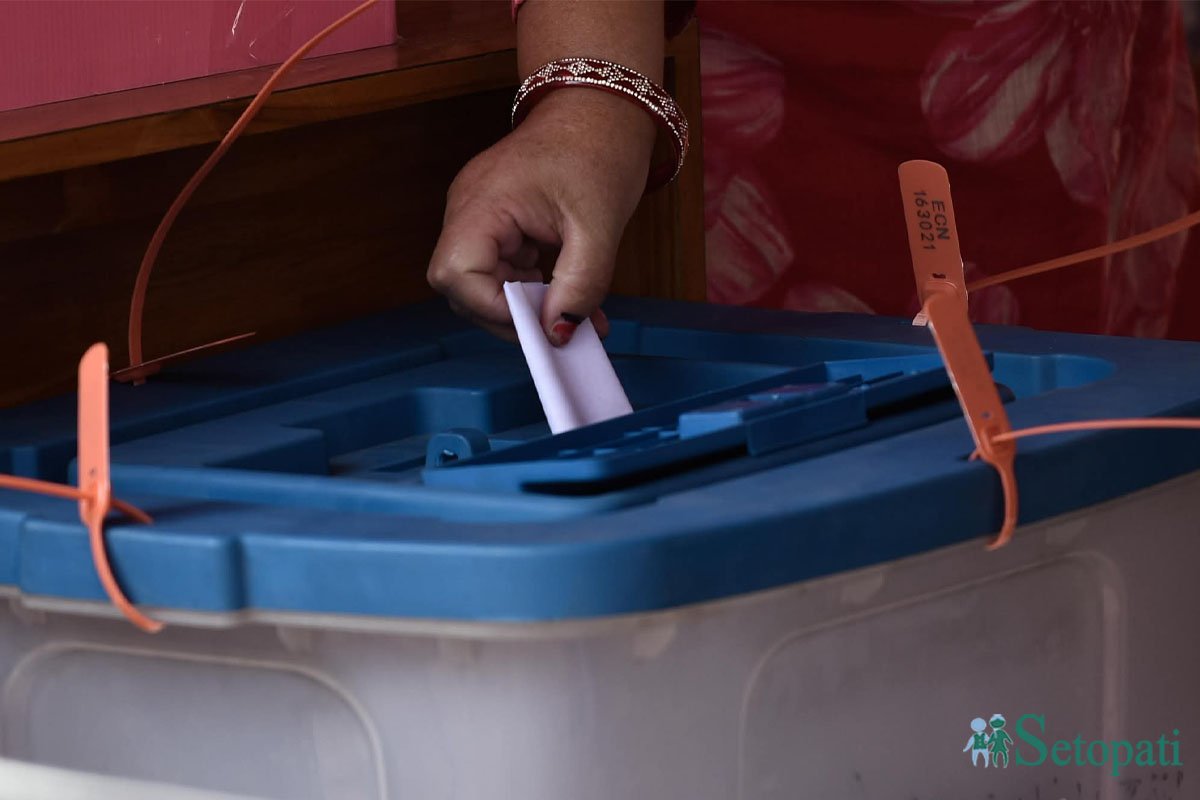
The counting of votes for the House of Representatives election held on March 5 is still ongoing. In most places, the counting has concluded and results have already been declared.
For this election, 915,000 voters were added to the rolls. Following the Gen Z movement, a majority of youth registered their names on the voter list. After registration was made possible through the national identity card, the number of voters increased significantly.
Despite this increase in the number of voters, Election Commission data shows that the turnout was the lowest recorded to date.
According to preliminary details provided by the Election Commission, only 58 percent of votes were cast this time. The total number of registered voters is 18,903,678, out of which 10,977,711 votes were cast.
The commission’s information officer, Suman Ghimire, said that this percentage could increase slightly by the time counting concludes. He also said that it wouldn't be right to label the turnout as low.
"If we look at the trend of every election, the turnout has been around 60 percent. This time too, we have estimated it at around 60. It could reach up to 59 by the end," he said. "The turnout in the previous election in 2022 was also around 61 percent. There could be various reasons why the turnout was slightly lower compared to the previous election."
According to the commission’s data, 61 percent of votes were cast in 2022. Before that, 68 percent were cast in 2017, and 78 percent were cast in the 2013 Constituent Assembly election.
Earlier records show a 61 percent turnout in the 2008 Constituent Assembly election, 65 percent in 1999, 61 percent in the 1994 mid-term election, and 65 percent in the 1991 election.
| Election Year |
Voter Turnout |
| 1991 |
65% |
| 1994 |
61% |
| 1999 |
65% |
| 2008 |
61% |
| 2013 |
78% |
| 2017 |
68% |
| 2022 |
61% |
| 2026 |
58% |
Source: Election Commission
Ghimire said that the Election Commission will review the reasons for the lower turnout in this election. He mentioned that four primary reasons have been preliminarily identified.
First, he said, it could be because voters did not return to their constituencies to vote. Many voters are registered in one constituency but live in another district for work or study.
The commission believes the turnout was low because such voters did not return home during the election. Similarly, new voters might not have returned to their constituencies, Ghimire said.
Second, a large number of voters are abroad. Ghimire said that a certain percentage of the newly added voters are those living overseas.
"The major reason is that a large number of voters are abroad. This time, while registering names through the national identity card, they also registered from abroad. Even though they registered their names on the voter list, many voters might not have been able to return," he said. "Because of this, too, the turnout might have decreased by a few percentage points."
Because voters could be in other districts or abroad, there was a debate about out-of-district and overseas voting.
Before the election, the interim government even held several rounds of discussion on this topic. However, the Election Commission and the government were unable to implement it.
The third reason, according to preliminary assessments, is that the names of deceased individuals may not have been removed from the list and some names might be duplicated.
"The voter list may include the names of those who have passed away. There might also be double entries for some. This also needs to be rectified now," he said.
The fourth reason, according to Ghimire, was the frustration within political parties.
After the Gen Z movement, party workers of the CPN-UML and Nepali Congress appeared dissatisfied with their own parties. Ghimire said that even some party workers might not have gone to vote.
"Due to a lack of internal management within political parties, it appears they did not go because of frustration. But now, research needs to be done on this," he said.