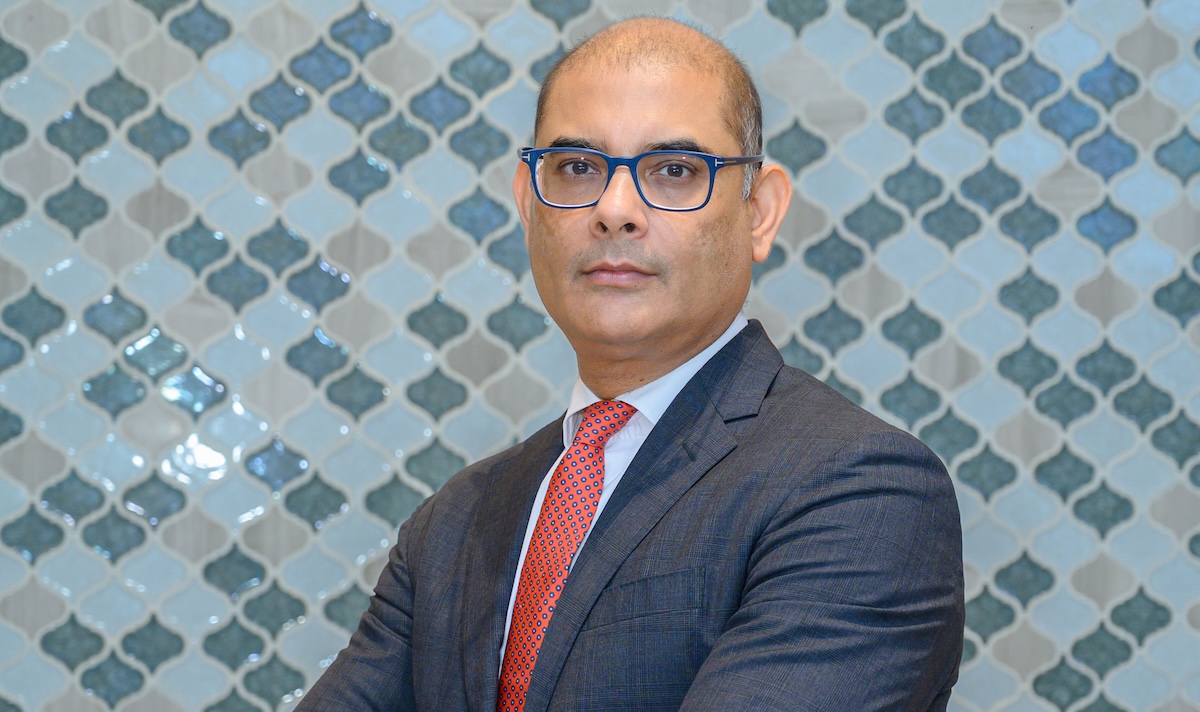
Ritesh Shukla, managing director and chief executive officer of NPCI International Payments Limited (NIPL), was in Nepal to promote UPI-based payments.
NPCI International Payments Limited (NIPL)
We interviewed him about how UPI works, its widespread adoption in India, the role of banks, fintech companies, the government and regulators, and what Nepal can learn from India’s digital payment journey. We also discussed the potential impact of seamless UPI-based cross-border payments between Nepal and India on consumers and small businesses.
We would like to start with a very simple question about UPI. What exactly is UPI, and how does it benefit people?
UPI is an account-based instant payment platform. It's an open framework that allows me, as a consumer or citizen of India, to connect my preferred funding source—it could be a savings bank account or a RuPay credit card—to any app I prefer. It could be Google Pay, PhonePe or WhatsApp.
Think of UPI as the Uber or Airbnb of payments. The savings or funding sources are connected on one side, and on the other are the channels that I, as a consumer, use to transact. Using UPI as the platform, I can create those connections.
If I like the Google Pay app, I can use UPI to connect it to my HSBC account, HDFC Bank account or RuPay credit card from SBI. Once that connection is established, I can use it for person-to-person remittances or person-to-merchant payments.
Person-to-merchant payments may include scanning the QR code at a store, on a website or on my electricity bill and paying. Today, we are also doing AutoPay and equity-market investments. There is a lot of mobilization of funds happening through the UPI platform, both for person-to-person and person-to-merchant payments.
So is this like a digital bridge or connector between my bank and the services I want to buy from merchants? How would you explain that to the general reader?
Think of it as a platform that brings consumers on one side and businesses, as well as other consumers, on the other.
For example, in Uber's case, I own a taxi fleet and connect it to the Uber platform. You are a passenger. You open the app and call for a taxi. I get a notification that a customer at a particular place is calling for a taxi. I accept, get the order and come.
UPI similarly brings the demand and supply sides together. On one side, you have consumers using whatever bank account, credit card or app they prefer. That's all in the back end.
On a macro scale, we are bringing consumers and businesses together through a platform that enables them to pay for services seamlessly, with trust, safety and security around it.
Where is India's digital payment system today in terms of reach? Has UPI become an everyday payment method and reached the mass market?
In June, I think we did about 757 million UPI transactions a day.
Those transactions are carried out at 60 million merchants by more than 550 million active users using UPI monthly. This is close to 22–23 billion transactions a month. It shows how frequently people are using it.
These transactions include merchant payments as well as P2P (person-to-person) payments. About 62–63% are merchant payments. I'm paying for groceries, parking, a Netflix subscription or an iTunes subscription. That's the universe.
If you look at the sheer scale, 85% of digital payments in India are on UPI.
People often ask whether this is affecting other digital payment platforms. The answer is no, because this is about displacing cash. Others are also growing; UPI has simply become a habit.
If I go out for dinner with friends and we have to settle among ourselves, in the old days people would have gone to an ATM, withdrawn cash and paid each other. Today, I do a UPI transaction.
In India, I can also use WhatsApp to pay someone because WhatsApp is integrated with UPI. I can use the same WhatsApp interface to transfer money. UPI is deeply entrenched in our way of life. They say it is the second most active network in the country after WhatsApp.
Why was NPCI interested in getting UPI onto WhatsApp?
I would say, why not? They have 700 million active users a month; we have 500 million. Why can't we create a network effect and work with each other?
This is where I think our clarity of thought comes in: what are we for today?
NPCI stands for four things. This is not something we have defined ourselves; it is defined by the Reserve Bank of India.
The first is access. Every citizen in the country should have access to what we create. It should not be restricted to affluent people or those living in urban areas. How do you ensure access? By going wide and working with partners that are already on everybody's phone.
The second is speed. How do you ensure that a transaction gets settled in milliseconds?
The third is transparency. Whatever charges are imposed on the consumer should be disclosed upfront.
And the fourth is affordability. There was a time before UPI when about 2% or 3% of personal consumption in India was digital; the rest was cash. Today, we are at the forefront. We are the poster child of digital payments in the world.
This is creating better economic value. It is formalizing the economy.
A formalized economy means better tax collection and better access to credit for small and medium-sized businesses. It also supports rural economies.
Today, I can confidently say that a person weaving baskets in a remote part of Nagaland in northeastern India has the option of selling them to somebody living in Delhi or Bangalore because they can receive payment instantly and start shipping.
It has supported rural economies and empowered women. A lot of women in India, for example, are running catering services from home.
How would they receive money without digital payments? Who would go and collect money from all these customers? Today, they can supply food and receive payment digitally.
This is what UPI has done. It has turbocharged the economy, given dignity to people and supported rural economies. Our model is not to blindly adopt a Western model where everybody moves to cities and nobody remains in villages.
Cities have crime and problems of urban planning. We want to give dignity to people in villages.
Sixty-five percent of India's population is in villages; only 35% live in cities. Digital payments have given us a very strong tool to drive inclusion and give people dignity.
We are a democratic country. What do you do in a democratic setup? You democratize.
You cannot have this only for a few rich, affluent and urban middle-class people. It has to be for everyone.
The UPI ecosystem now covers Indian villages, towns and cities. How important was government support in building this ecosystem, and how important is it today in sustaining it?
That's a great question and one of the most important ones.
As an organization, we never take credit for the success of UPI on our own shoulders, because for something like UPI to succeed, everybody has to play a role.
UPI found a very big sponsor in the government. The government sees value in promoting not only UPI but the whole digital stack because it empowers citizens. It helps the government deliver on its electoral promises and fulfill its goals for the country.
It is a platform closely aligned with India's national agenda. Government sponsorship has therefore been crucial.
The second factor is the progressive regulator we have in the Reserve Bank of India. The RBI has been very progressive in its thinking, approach and outlook for the future, and in how it sees the role of digital payments.
It has been very supportive and encouraging of NPCI.
Another thing that often goes understated is the contribution of the entire ecosystem—the banks and fintechs. They all came in and stepped up.
Fintechs created the best user experiences. Banks ensured that money moves with trust. Wherever money is involved, you need trust, and money is always handled by banks in the UPI ecosystem.
Fintechs are known for user experience. They interact closely with consumers and create the excitement, simplicity and wow factor.
And then there are the consumers of India, who have embraced digital payments. I think we now have about 750 million smartphone users out of 1.2 billion mobile users.
All these factors coming together have created what UPI is today. It is not the achievement of one organization or one entity.
What can Nepal learn from the Indian experience? Where do you see our digital journey?
Purely from India's perspective, it may not be fair for me to comment because every country is unique. Every market has its own dynamics.
One thing I can clearly highlight is the collaboration we have in India. I think Nepal Rastra Bank (NRB) is also looking at driving that collaboration across the ecosystem here. Our approach has been to keep the consumer at the center and create the whole picture around the consumer.
NRB and other players here, including our partners Nepal Clearing House Limited (NCHL) and Fonepay, are also on that journey. From our perspective, this is very important to our relationship.
There was some hesitation between banks and fintech companies in India in the early days, but now there is a great deal of collaboration as well as co-opetition. What helped them overcome that hesitation, and what role did the government and NPCI play?
Changing habits is very difficult. People were used to cash. And wherever money is involved, trust is very important. Trust can only be built through demonstration over a longer period of time.
As trust started building, the system and the platform began to speak for themselves. The more you demonstrate, the more adopters you create.
Having overcome the initial barriers, we are now on a rocket. There's so much happening in India on digital payments, and the whole world is excited about our experience.
We are working with many countries to create their own payment ecosystems. Namibia is using the UPI stack to create its own system. Peru is using the UPI stack. We are also working with many countries in Africa and South America.
In Nepal, there is still some hesitation between banks and fintechs over cooperation and who will eventually have the upper hand. Based on India's experience, what is your message to Nepali bank and fintech CEOs?
It would be unfair for me to preach as an outsider because every market, country and organization is different.
But from our experience, what I can highlight is that displacing cash is good for banks.
It leads to better CASA (Current Account and Savings Account) balances because people don't keep that money in their wallets; they keep it in their bank accounts.
Enabling digital payments for businesses is also good because lending can improve. You can see a business's transactions: how much business it is doing daily or monthly, its receivable position and its payable position.
You can build algorithms around that.
I know many companies in India are using AI to read bank statements and offer credit facilities. This can help banks on the asset side as well. On the liability side, you have CASA balances.
And every time a consumer transacts or a business accepts payment, you can also generate fee income.
From our experience, it's a good thing. But some of the best people in Nepal are running these big banks, and I'm sure they know what's best for their organizations and businesses.
Indian visitors can already use UPI to scan QR codes and make payments in Nepal, and hopefully Nepalis will soon be able to do the same in India. How will seamless cross-border transactions affect consumers, small businesses and the two economies?
With the first phase—Indians in Nepal—and the second phase—Nepalis in India—we are looking at empowering small businesses in an unprecedented way.
It will help them sell more, become more efficient, get better access to credit, manage more business and scale up to multiple shops or outlets. It's going to be amazing.
When that happens, businesses and consumers on both sides will find it delightful. It will genuinely be a great thing.
When can we expect to use our mobile phones to pay at shops or supermarkets in India when we next travel to Delhi or Bangalore?
It's just around the corner. Give us a few months and you should be able to do it.
Not only at shops—even at hospitals. Everything will happen. Medical tourism as well. It's just a matter of time.
What work still needs to be done?
We are onboarding partners, doing technology testing and checking the resilience of the system. Everything is underway.
We are also looking at a global setup. It is not only about catering to people from Nepal, but also about catering to people from other countries because many people visit India for business and tourism.
We are creating a standardized template that can cater to the rest of the world. It's in process. Give us a few more months, and I think we should be good to go.