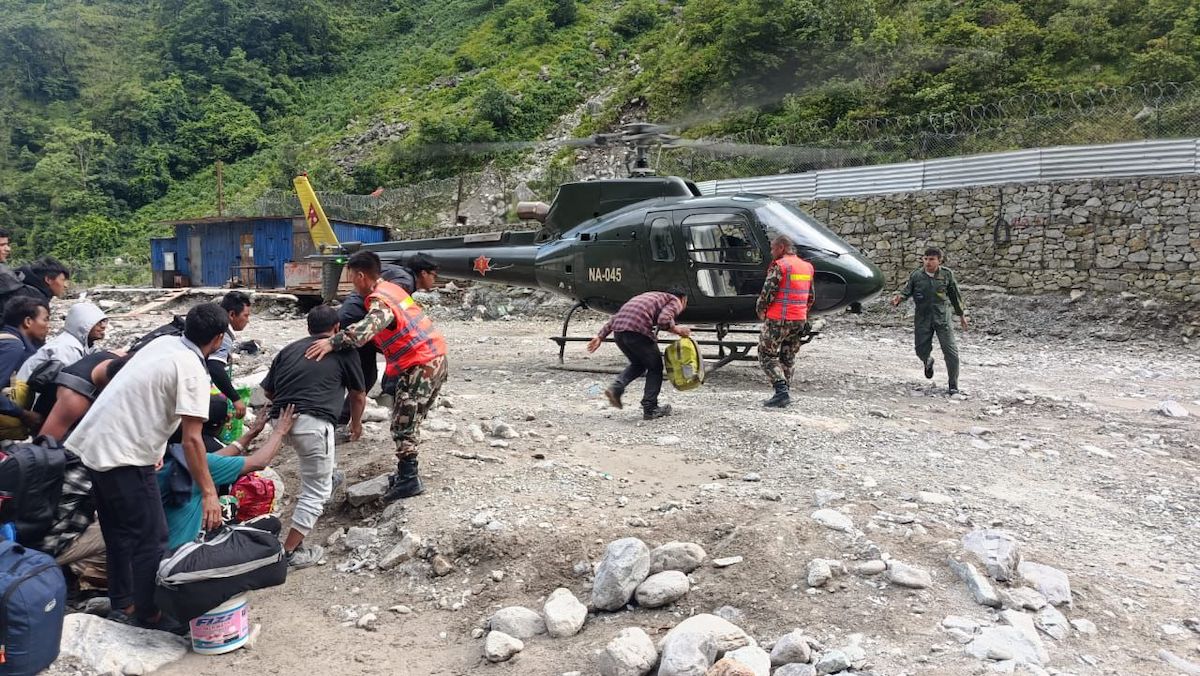
The whole nation is still in shock after the massive flash flooding caused by a high-altitude ice avalanche in Rasuwa district that created mayhem and havoc downstream, bringing destruction and sweeping away entire communities.
The incident occurred at a scale never seen before and has been called a “Himalayan tsunami.”
In the aftermath of the tragedy, which is still unfolding, the federal government has been working relentlessly in what is an extremely complex and time-sensitive phase of search and rescue.
More than 14,000 law enforcement personnel have been mobilized from the Nepal Army, Nepal Police, and the Armed Police Force.
Among them are several highly specialized units with top-notch skills and know-how – dedicated servicewomen and servicemen who know how to operate in the event of national calamities of this magnitude.
At the same time, the federal government has decided to limit the presence of international rescue teams as much as possible.
Only after several days did the authorities decide to allow specialized teams from India, China, and South Korea. These teams are now assisting with the complex task of rescuing people trapped inside a number of power-plant tunnels whose entrances have collapsed.
The decision to hold off on the admission of international search and rescue teams must, for now, be respected and accepted.
On one hand, it is understandable that the federal government wants to be fully in charge of this delicate phase.
It may be a way of showing that, over the years since the big earthquake of 2015, the technical expertise and overall capacities of the national agencies have increased significantly in the field of disaster management.
On the other hand, over the coming days and weeks, a more technical debate will emerge among experts to determine if the federal executive’s call was the best possible one, given the evolving circumstances.
Yet it is also possible to contribute to the upcoming conversation by highlighting the role that national civilians can play in these situations.
Competent, highly skilled citizens can be deployed in the aftermath of national emergencies if they operate within a clear institutional framework, which could take the form of a “National Civilian Emergency Corps.”
Their role and responsibilities should not be in competition with those entrusted to the Nepal Army and other national law enforcement agencies.
Rather, a clearly defined post-natural-disaster “governance” framework could detail the overarching modality of intervention of different specialized and technical units, including those from the defense and law enforcement establishments.
For instance, the prospective National Civilian Emergency Corps could be activated under the direct supervision of the National Disaster Risk Reduction and Management Authority (NDRRMA).
The terms of reference of the authority already include responsibilities in this area as Section 10 of the Disaster Risk Reduction and Management Act, 2074 states. Section 10(f) of the Act provides for the “formation and capacity building of search and rescue teams at federal, provincial, and local levels to provide effective search, rescue, and relief.”
Around the world, there are already plenty of experiences involving civilian corps equipped with the highest levels of know-how in dealing with natural disasters.
From Italy and France to South Korea, Japan, and the Unite States, there is a variety of approaches on how to mobilize specialized teams of civilians during such emergencies.
The European Union has even built a very clear framework on military and civilian cooperation – the Humanitarian Civil-Military Coordination (CMCoord).
Such an elaborate system, according to the EU, “is necessary to protect and promote humanitarian principles, avoid competition between civilian and military capacities, minimize inconsistency, and when appropriate, pursue common goals.”
In some cases, the work of these civilian mechanisms also has clear defense and national security objectives, while in others, the focus of these programs is entirely centered on the provision of search and rescue together with the provision of supporting the victims in the aftermath of a calamity.
The government recently came up with a new proposal to reform the National Cadet Corps (NCC) by also embedding, in what is supposed to be a leadership and skills development experience for youths, some responsibilities in the field of emergencies caused by national disasters.
While young people can certainly have a role to play during such difficult events, Nepal might consider the creation of a professional civilian corps composed exclusively of adults.
Its members could be trained to perform full-time or part-time paid duties, but there is also considerable scope for mobilizing highly prepared volunteers in such a corps.
In many countries, volunteers are trained to operate emergency ambulances and also are equipped to be highly capable of intervening in catastrophic situations like the recent flooding.
At the same time, effective and impactful volunteering is never cost-free.
Tackling nature-caused crises, including those caused by climate change, requires long-term specialized capacity building, which inevitably costs money.
The cost-effectiveness of mobilizing civilian volunteers in natural disasters should require a careful cost-benefit analysis.
Volunteering, especially of a highly technical nature, is not a cure-all but it could offer a valid and solid option that policymakers should consider among others.
The model of Female Community Health Volunteers (FCHVs) could also be considered and adapted to the context of disasters, especially in the relief phase.
The Civilian Emergency Corps could operate with a similar approach adopted by the FCHV program. FCHVs are essentially dedicated long-term volunteers, even though this label is often rejected and criticized by the volunteers themselves.
Nepal should assess the different models available, including the famous Blue Sky Rescue Team from China, which, although independent and not-for-profit, always acts in close coordination with the Chinese authorities.
The NDRRMA already has, in Section 10, clause (e), of the Disaster Risk Reduction and Management Act, 2074, the mandate of “involving non-governmental organizations, private sector, and local communities in disaster management activities, coordinating and facilitating their activities.”
This aspect opens another issue that the federal government will, sooner rather than later, confront: clarifying the role that not-for-profit organizations, including both NGOs and INGOs, should have during the relief phase of the post-disaster management framework.
It is obvious that Singha Durbar wants to avoid, at any cost, a repetition of the chaos and anarchy that followed the 2015 earthquake, when reconstruction interventions were extremely fragmented and, overall, lacked effective and strong central coordination.
Still, Nepal can boast many experts in relief and post-disaster reconstruction.
It will inevitably become necessary to consider what these individuals and their not-for-profit organizations can do to help with the reconstruction of the many settlements destroyed in Rasuwa district.
This crisis might compel the federal authorities to tackle an issue that has remained unaddressed so far: the contribution that civil society can make to support the process of national development, including in post-disaster circumstances.
It will take a very long time for the situation in the affected areas to regain even a semblance of normality.
It will take much longer for those citizens directly impacted by the floods to make sense of what happened. For those mourning the loss of their loved ones, it will be even more daunting to recover and move on with their lives.
Yet it will be unavoidable for the government of Prime Minister Balendra Shah to strategize on how to minimize the risk of such calamities occurring again.
Tragically, we all know that this is a task basically impossible and beyond our control due to the nature of climate warming.
While stronger and better warning systems will be required, humanity is, unfortunately, going to face more and more of these anthropogenic climate warming-induced cataclysms.
What is unquestionable is that civilians – both individuals trained for disaster emergencies and not-for-profit organizations with expertise in this area – can play an essential role.
It is up to Mr Shah and his administration to brainstorm and lay out ways for a strong and effective military-law enforcement-civilian framework to tackle natural disasters and their impact on the population.
Designing and delivering such a compact – a sort of “whole-of-nation approach” to what in jargon is called Disaster Risk Reduction Rehabilitation Reconstruction (NPDRR) – could make a real difference in future natural emergencies.
Getting it right could save thousands of lives.