On October 2, the world observes the International Day of Non-Violence. The United Nations General Assembly established the day through resolution A/RES/61/271, adopted on June 15, 2007, with the support of 140 countries, choosing Mahatma Gandhi’s birthday as a meaningful occasion to promote the values of non-violence. This day should be celebrated in tribute to all advocates of peace, truth, and non-violence who fought against injustice, discrimination, and oppression, and stood firmly for freedom, human dignity, and an amicable and egalitarian society. They are the ones who help create a society where tolerance, acceptance, and dignified coexistence can flourish, which are foundations of democracy, liberal values, freedom, justice, and human security.
Although humankind has been prone to violence from the Stone Age through the periods of savagery and barbarism and into the modern era of civilization, non-violence is not new to human beings either. As human beings, we have always possessed instincts for affection, empathy, justice, and peace alongside instincts for protection and survival. These instincts have enabled humankind to establish kinship, society, shared goals, and common values. It is the pursuit of power, dominance, ill will, and the desire to exploit others that have contributed to humanity's long history of exploitation, in the form of colonialism, slavery, war, racism, and claims of inherent superiority. Therefore, non-violence is not an invention but a rediscovery of human values. Mahatma Gandhi acknowledged that his path was guided by the principle of duty-driven action in the Bhagavad Gita, the Jain principle of non-harm, the moral teachings of Indian society, and the insights of scholars on peace.
Gandhi and the discipline of non-violence
For Gandhi, non-violence was not merely a political strategy; it was a way of life, a moral principle, and a means of fighting injustice, discrimination, and atrocities. His concept of Satyagraha (Satya: truth, Agraha: firmness) involved holding firmly to the truth and being prepared to endure suffering with courage and dignity. Non-violence and Satyagraha demanded the complete rejection of revenge and violence. These principles inspired and encouraged people to stand for justice, free from any concern about winning or losing. This approach gave the movement greater prominence and a stronger moral foundation.
Many of Gandhi's contemporaries dismissed this approach as submissive and cowardly, arguing that it could not effectively confront colonial violence. Yet Gandhi stood firm in his conviction that non-violence was the greatest force at humanity’s disposal, mightier than the mightiest weapon of destruction devised by human ingenuity. He was proved right by history: an empire that had ruled the world through force could not find a way to respond to a movement that refused to respond to violence and force in kind. Instead, the movement used firmness, justice, truth, and moral strength to oppose them. The success of the Champaran Satyagraha, the Salt March, the boycott of foreign goods, and the Quit India movement empirically proved the strength of non-violence.
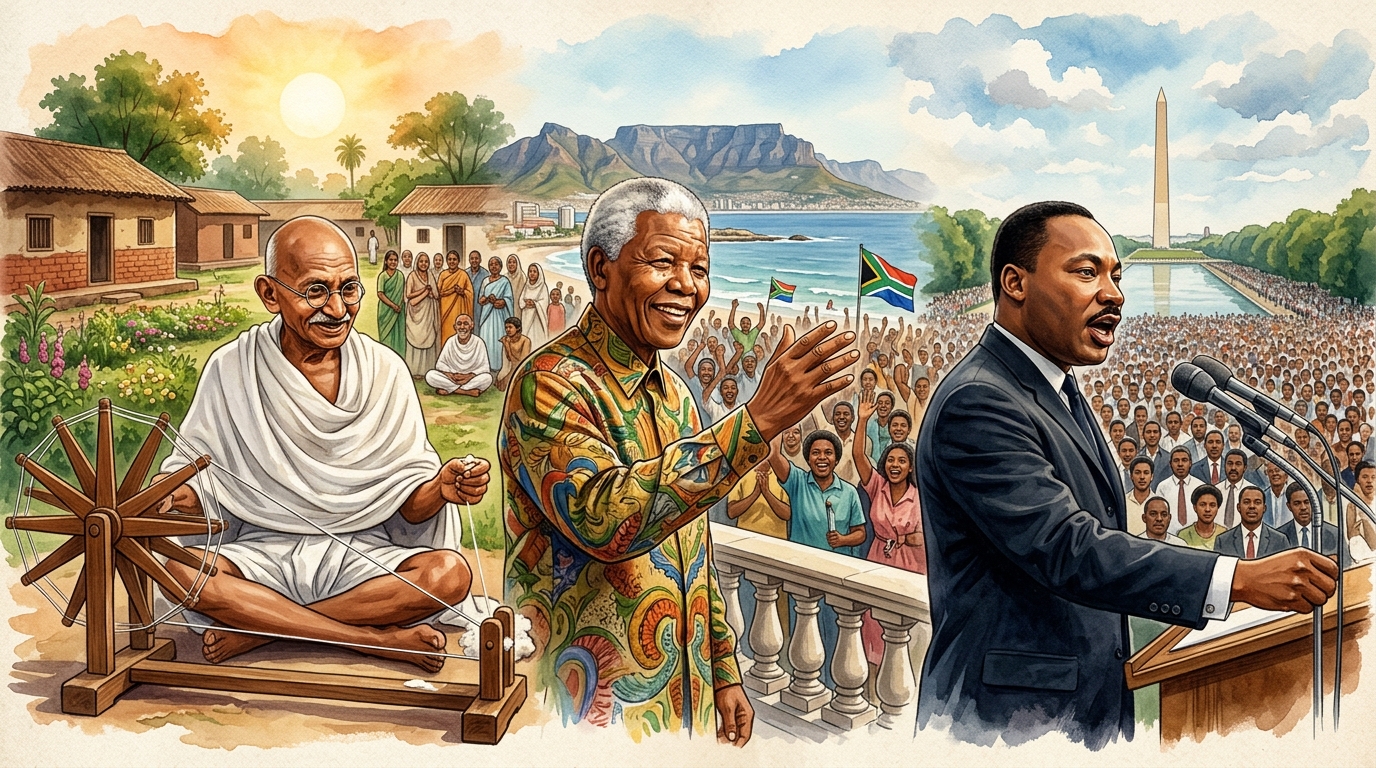
The non-violence movement, peaceful reconciliation, and Gandhi’s teachings have influenced many people and are considered necessary for the freedom, protection, dignity, and empowerment of humankind. Through this approach, victims and opponents of social and political injustice and discrimination found hope and a means of resisting oppression and injustice and building an egalitarian society. It was applied successfully at several key moments in the American civil rights movement, including sit-in protests against segregation in restaurants and food counters, the Montgomery Bus Boycott, and the 1963 March on Washington, where 250,000 people gathered. Martin Luther King Jr used non-violent means in effective and constructive ways. Similarly, Nelson Mandela drew on non-violent principles in the anti-apartheid movement in South Africa, where there was severe racial discrimination and white minority rule. South Africa also used the attribute of non-violence — fighting for a cause without hatred — in its reconciliation, and chose the path of national unity over revenge, considered one of the most successful reconciliations in the discipline of conflict management. Later, non-violence became a legitimate force behind movements for nuclear disarmament, against weapons proliferation, and on climate issues and other global concerns. It also became a means of advocating gender parity, social justice, inclusion, human rights, and labor rights.
The common thread linking Mahatma Gandhi, Martin Luther King Jr, and Nelson Mandela was the commitment to oppose injustice and oppression through non-violent means. They regarded non-violence as a guiding principle and a set of values that should not be compromised.
Why this still matters today
The world today faces multiple threats to peace, freedom, human dignity, and civilization. The proliferation of weapons, their destructive capabilities, and the threats they pose remain major global concerns. Russia's declared willingness to keep the nuclear option open and the United States’ reported deployment of space weapons mark further escalation in this area. The combined effects of internal conflicts, climate change, terrorism, poverty, disruptions to global supply chains, and rising crime rates are severe and alarming. To protect civilization, we need to raise our voices against these threats and build a society that stands firmly against every form of violence. Addressing these challenges requires dialogue, negotiation, constructive initiatives, reconciliation, tolerance, acceptance, and justice, all of which are central to non-violence and have been practiced by advocates of non-violence.
Human security and non-violence
The global acceptance of the Universal Declaration of Human Rights and its universal principles is a cornerstone of human dignity and protection. However, in spite of principles such as non-interference, sovereignty, and territorial law, humanity continues to face atrocities, brutality, and genocide. In this context, the United Nations Development Program (UNDP) introduced the concept of human security in 1994, built on two main pillars: "freedom from fear and freedom from want". The concept placed people at the heart of security, shifting the focus toward protecting and empowering individuals and communities. In 2003, the Commission on Human Security's report, "Human Security Now," described this goal in terms of ensuring people's “survival, livelihood, and dignity.”
However, the results have not been encouraging: the number of civilians suffering from war and conflict remains high. They are deliberately targeted during armed conflicts, and the reportedly willful killings of children and other civilians deepen devastation and suffering. Nuclear threats, nuclear disarmament, and the arms race remain pressing concerns for human security. Alongside challenges driven by internal conflicts, conflict-induced displacement and climate change continue to pose serious threats to human well-being. Social and cultural violence including poverty, discrimination, racism, and religious intolerance, as well as digital violence such as misinformation, disinformation, and malinformation, and hate speech have further intensified and deepened people's suffering in various ways. Taken together, these challenges have created barriers to the protection and empowerment of human beings, preventing individuals and communities from realizing their full potential.
This is because we often ignore the fundamental fact that peace is the most essential condition for achieving these objectives. Peace ensures freedom and protection, which in turn safeguard human dignity. Together, peace, freedom, protection, and dignity create the conditions necessary for human beings to realize their full potential. For lasting peace, a non-violent approach is essential. It is a precondition for lasting peace and should be reflected in the policies, plans, declarations, goals, and missions that shape our societies, states, and the world. This would help us achieve our goal of a peaceful society, freedom, protection, dignity, empowerment, and human well-being.
Non-violence and the role of the individual
The non-violence movement is the responsibility not only of the United Nations, the international community, and states, but also of every individual as a member of society, a citizen of a country, and a conscious inhabitant of the planet. Non-violent actions, or peace initiatives, have largely begun with individuals, developed into organized movements, and eventually had wider impact, whether in Gandhi's movement against colonial rule, the civil rights movement in the United States, Mandela's struggle in South Africa, or contemporary campaigns for nuclear disarmament and climate action.
Non-violence begins as a personal commitment and discipline before developing into a collective movement and a way of life. It is an ethical principle and a set of values for which one can endure suffering. Non-violence does not mean submissiveness or cowardice, not should it be associated with revenge or hatred. It is the finest discipline of tolerance, acceptance, co-existence, respect, dialogue, justice, reconciliation, and sustainable peace. These values and duties are what we, as individuals, need to practice and incorporate into our attitude, character, behavior, and personality, so that they extend from the individual to the family, the community, and eventually the wider world. In this context, one may recall a quotation widely attributed to Mother Teresa: Not all of us can do great things, but we can do small things with great love.”
Gandhi never claimed that non-violence was easy; he stated that human beings may never be strong enough to be entirely non-violent in thought, word, and deed. Nevertheless, we should continue to strive toward non-violence as a goal for the sake of humanity. If applied in our daily lives, state policy, and international diplomacy, it could offer a constructive response to the uncertainty, crises, and suffering that the world faces today. As the world marks another International Day of Non-Violence, the real question is whether we are ready to commit to promoting peace, freedom, justice, and human dignity through non-violence. The answer is that we must.