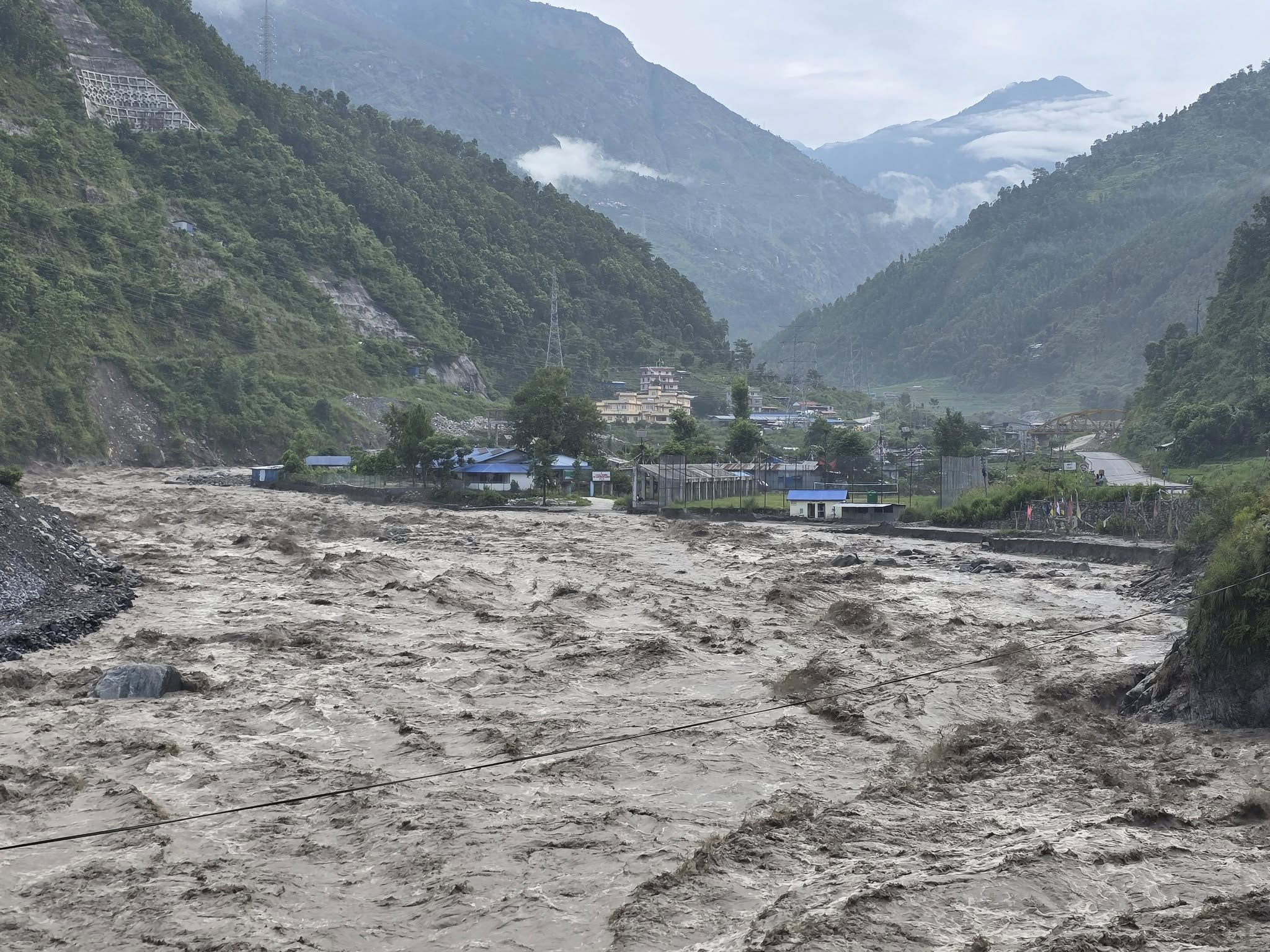
On the morning of August 26, a major ice-rock avalanche occurred in the upper Bhote Koshi watershed near the Nepal-China border, about 20 km upstream of Rasuwagadhi. Preliminary analysis by Nepal's National Disaster Risk Reduction and Management Authority (NDRRMA) indicates that the event began on a north-facing slope near the Lhende River, where a section of rock-glacier material detached and moved rapidly downslope. The water-laden debris then swept through Rasuwa, Nuwakot, Gorkha, Dhading, and Chitwan. As of September 9, at 7 p.m., the NDRRMA had recorded 1,369 people dead and 5,132 others missing. In addition, the catastrophe has badly damaged housing and shelter, roads and bridges, energy and communications infrastructure, and schools.
Ecologists, environmental scientists, and researchers in this field point to the same cause behind this suffering: global warming and climate change, driven mainly by carbon emissions, in which Nepal's role is either nil or so small that it can be ignored. According to “Our World in Data,” Nepal emitted 18.8 million tonnes of CO2 in 2024, or 0.63 tonnes per person. This represents 0.05 percent of global emissions for the year. It is grossly disproportionate to the risk this country bears and the suffering it is now going through.
This is not a country that took its share and got unlucky. It is a country that goes on suffering from the arbitrary and reckless exploitation carried out by others. According to a 2020 report by the International Centre for Integrated Mountain Development (ICIMOD), Nepal loses an average of 333 lives and property worth more than USD 17.24 million to disasters every year, and the losses have been rising in recent years. The same study identified 47 potentially dangerous glacial lakes, of which 42 are situated in the Koshi basin, three in the Gandaki, and two in the Karnali. On the Climate Risk Index, Nepal ranks among the most affected countries in the world. Between 2012 and 2024, Nepal recorded 44,000 climate-related disasters, 5,667 deaths, 922 people missing, 15,000 injuries, and damage to 42,000 structures.
What Nepal has given
Nepal has consistently promoted peace and peaceful coexistence. It has advocated against the arms race and the proliferation of weapons. Through its long participation in United Nations peacekeeping operations, it has made a significant contribution to global peace and security.
In terms of ecology, environment, and planetary well-being, the record is much the same. A total of 46.08 percent of the country's land is under forest cover, and its work to protect endangered species such as the tiger and the rhino deserves recognition. Its commitment to environmental law, the way it has written that law into its own legal framework, and the steps it has taken to protect the Himalayas, forests, and wildlife should count for something in the international arena. A country that has contributed very little to the concentration of greenhouse gases in the atmosphere, and given a great deal to the environmental security of others, is now paying the price through the suffering of its people, through deaths, through lost resources, economic hardship, and ruined infrastructure.
This is not merely an environmental problem. It is a clear case of injustice, and Nepal has every right to raise questions of justice, fairness, and accountability.
The water tower of Asia
The ice and snow of the Himalayas feed twelve major river systems. According to ICIMOD's 2023 assessment, those rivers supply freshwater and other essential services to 2 billion people across 16 countries: 240 million in the mountains themselves, and a further 1.65 billion downstream. That means a quarter of humanity depends on water from this mountain range.
So what is happening in Nepal is not a local tragedy in a small country. It is the early alarm of the water tower on which much of Asia depends. The Himalayas do not belong to Nepal alone; they never did. So, the responsibility to protect them should be a common and shared goal.
Nepal asks for cognitive empathy, not sympathy
This time Nepal is clear about what it is asking for, and it is not sympathy. Sympathy changes nothing. What Nepal asks for is recognition: that this harm has a cause, that the cause lies largely elsewhere, and that responsibility should follow from there.
Nepal seeks justice for those who lost their lives in the floods, for homes that may never be rebuilt, for children whose futures were swept away by the floodwaters, and for the Himalayas, which cannot be reborn. Compensation is needed for the dignity of survivors and for sustainable recovery. Nepal asks for assistance to build infrastructure that withstands disasters and institutions capable of responding when disasters strike. And it extends a hand of partnership for ecological sustainability, not for one’s own benefit, but for the security of the 1.65 billion people who depend on these rivers, for the generations who will inherit them, and for the forests, wildlife, and rivers that have no seat at the negotiating table.
As the victim of a catastrophe it did not cause, Nepal asks for cognitive empathy and accountability from the actors and stakeholders. It invites them to take part in making this planet better, more beautiful, and more sustainable. We may be separated by borders, but we share the same planet: Earth.
The bee and the flower
There is an old understanding in our culture about how one should take from nature. The bee draws nectar from the flower and makes honey from it, and the flower is not destroyed. It is left to bloom again. In Nepal, we have long treated our rivers, our forests, and our mountains as sacred rather than as inventory. Not because we could not use them, but because use without ruin was understood.
The atmosphere, however, was treated differently. The flower has been stripped bare, and the bill has been handed to people from a valley in Rasuwa who never sat at the table. It must not happen again, and preventing it is everyone’s responsibility. What has happened here is Nepal's problem, but it is not only Nepal's problem. It is a red flag for human security and the sustainability of the planet we all live on.
(Roshan Raj Nath is an MPhil-PhD scholar in conflict, peace, and development studies at Tribhuvan University. He has worked in disaster management for over fifteen years.)